 Back
BackElectric Potential, Conductors, and Dielectrics: Study Notes
Study Guide - Smart Notes
 Tailored notes based on your materials, expanded with key definitions, examples, and context.
Electric Potential
Definition and Concept
Electric potential is a fundamental concept in electrostatics, describing the energy per unit charge at a point in space due to electric fields. It allows us to analyze electric fields using energy rather than force.
Electric Potential (V): Defined as the electric potential energy per unit charge, measured in volts (V), where 1 V = 1 J/C.
Single Charge: A single charge does not possess electric potential energy by itself, but it creates an electric potential in the surrounding space.
Potential at a Point: The potential at a point is defined relative to infinite separation, where the potential is conventionally set to zero.
Formula: For a point charge, the electric potential at distance r is:
Electric Potential Energy: For two charges:
Example: The potential due to two particles is the sum of the potentials from each particle at a given point.
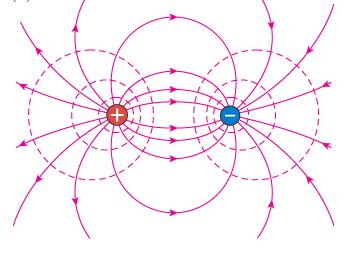
Equipotential Surfaces
Equipotential surfaces are surfaces where the electric potential is constant. For point charges, these surfaces are spherical.
Properties: No work is required to move a charge along an equipotential surface.
Relation to Field Lines: Equipotential surfaces are always perpendicular to electric field lines.
Electric Potential in Uniform Fields
Uniform Electric Field
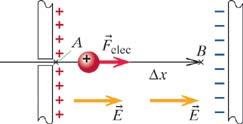
In a uniform electric field, the potential difference between two points depends only on the displacement along the field direction.
Potential Difference:
Path Independence: The change in potential between two points is independent of the path taken.
Electron-Volt (eV): An electron-volt is the energy gained by moving a charge of 1e through a potential difference of 1V.
Conductors in Electric Fields
Electrostatic Equilibrium
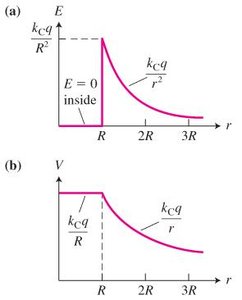
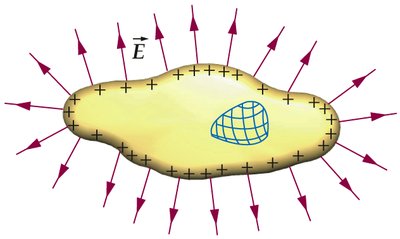
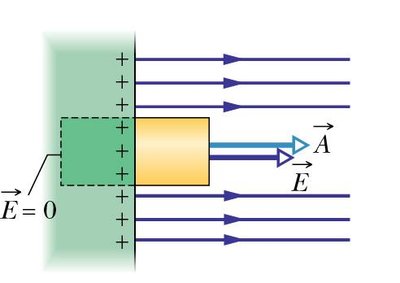
When a conductor reaches electrostatic equilibrium, free electrons redistribute so that the electric field inside the conductor is zero.
Key Properties:
The electric field inside a conductor is zero.
Excess charge resides on the surface.
The electric potential is constant throughout the conductor.
Surface Charges: The electric field just outside the surface is perpendicular to the surface.
Grounding and Shielding
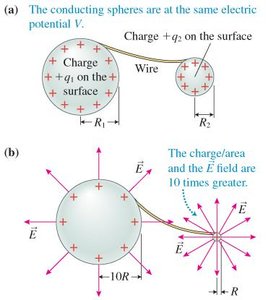
Grounding a conductor connects it to the Earth, allowing excess charge to flow and equalizing the potential. Shielding occurs when a conductor blocks external electric fields from its interior.
Grounding: Electrons move between objects until their potentials are equal.
Shielding: Free electrons redistribute to cancel the internal electric field.
Conductor with Cavities
If a conductor contains a cavity, the electric field inside the cavity is zero if no charge is present. If a charge is placed inside, surface charges redistribute to maintain zero field inside the conductor.
Charge Redistribution: Surface charges move to cancel the field from the cavity charge.
Potential: The potential remains constant throughout the conductor.
Dielectric Materials in Electric Fields
Dielectric Response
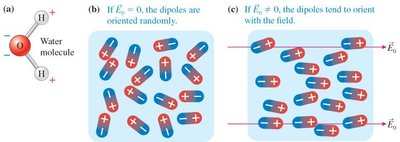
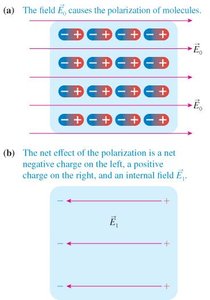
Dielectric materials respond to external electric fields by polarizing, i.e., their molecules align so that their positive and negative charges are displaced in opposite directions.
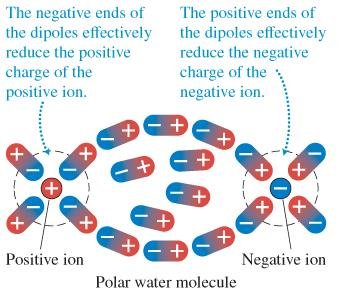
Dielectric Constant (κ): Characterizes the ability of a material to reduce the internal electric field.
Polar Molecules: Some molecules, like water, are natural electric dipoles and align with the field.
Dielectric Constants Table
The dielectric constant varies by material and affects the strength of the electric field inside the material.
Material | Dielectric Constant (κ) |
|---|---|
Vacuum | 1.0000 |
Dry air | 1.0006 |
Wax | 2.25 |
Glass | 4–7 |
Paper | 3–6 |
Axon membrane | 8 |
Body tissue | 8 |
Ethanol | 26 |
Water | 81 |
Electric Force in Dielectrics
The force between charges inside a dielectric is reduced by the dielectric constant compared to the force in a vacuum.
Coulomb's Law in Dielectric:
Summary Table: Key Equations
Quantity | Equation | Description |
|---|---|---|
Electric Potential (V) | Potential due to a point charge | |
Electric Potential Energy (U) | Potential energy between two charges | |
Potential Difference (Uniform Field) | Potential difference in a uniform field | |
Coulomb's Law (Dielectric) | Force between charges in a dielectric |
Additional info: Academic context was added to clarify the physical meaning of electric potential, equipotential surfaces, and the role of conductors and dielectrics in electric fields. Examples and formulas were expanded for completeness.
