 Back
BackElectric Potential, Electric Field, and Capacitance Ch 26
Study Guide - Smart Notes
 Tailored notes based on your materials, expanded with key definitions, examples, and context.
Electric Potential and Electric Field
Relationship Between Electric Potential and Electric Field
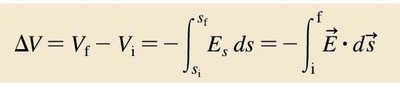
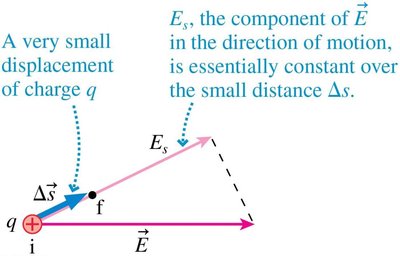
The electric potential difference (ΔV) between two points is related to the electric field (\(\vec{E}\)) by the line integral of the field along a path connecting the points. This relationship is fundamental in electrostatics and allows us to calculate one quantity if the other is known.
Electric Potential Difference: The change in electric potential (ΔV) between two points is given by the negative integral of the electric field along the path:
Graphical Interpretation: The area under the curve of \(E_x\) vs. \(x\) gives the negative of the potential difference between two points.
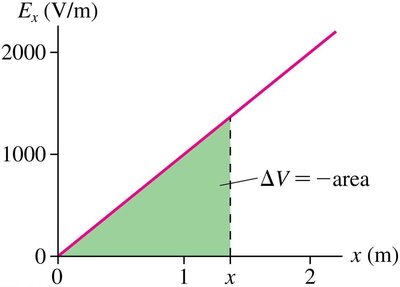
Example: If \(E_x = 1000x\) V/m, the potential difference from 0 to \(x\) is \(\Delta V = -500x^2\) V.
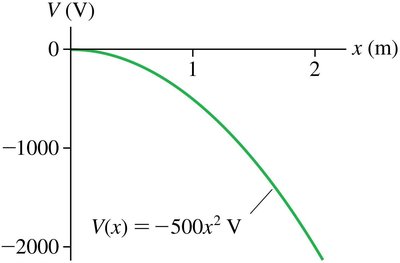
Obtaining Electric Field from Electric Potential
The electric field can be derived from the spatial rate of change of the electric potential. In one dimension, the field is the negative gradient (slope) of the potential:
Mathematical Expression:
In three dimensions, the electric field is the negative gradient of the potential:
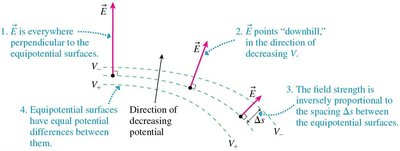
Physical Meaning: The electric field points in the direction of greatest decrease of potential, and its magnitude is proportional to how rapidly the potential changes with position.
Equipotential Surfaces and Field Lines
Equipotential surfaces are surfaces where the electric potential is constant. The electric field is always perpendicular to these surfaces and points from higher to lower potential.
Key Properties:
\(\vec{E}\) is perpendicular to equipotential surfaces.
Field strength is greater where equipotentials are closer together.
Equipotentials are spaced equally in potential difference.
Capacitance and Capacitors
Definition and Units of Capacitance
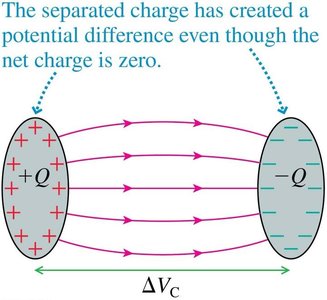
Capacitance is a measure of a device's ability to store electric charge per unit potential difference. The unit of capacitance is the farad (F), where 1 F = 1 C/V.
Capacitance Formula:
Parallel-Plate Capacitor: For an ideal parallel-plate capacitor, the capacitance is given by:
where \(A\) is the plate area, \(d\) is the separation, and \(\varepsilon_0\) is the permittivity of free space.
Charging a Capacitor
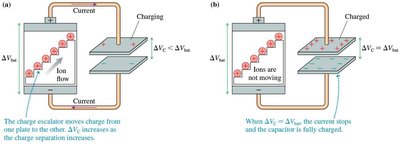
When a capacitor is connected to a battery, charge accumulates on the plates until the potential difference across the capacitor equals the battery voltage. At this point, current stops flowing.
Kirchhoff's Law: The sum of potential differences around a closed circuit is zero.
Capacitors in Series and Parallel
Capacitors can be combined in series or parallel to achieve desired equivalent capacitance values.
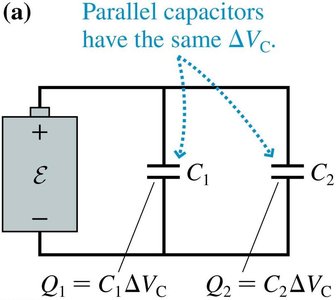
Parallel Combination: The total capacitance is the sum of individual capacitances:
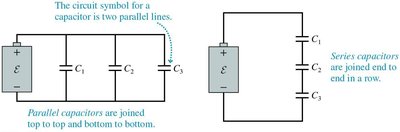
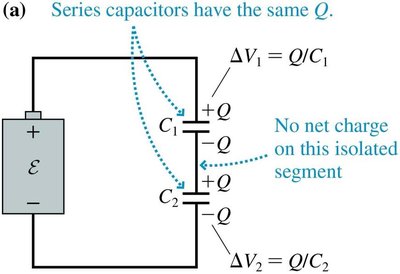
Series Combination: The reciprocal of the total capacitance is the sum of reciprocals of individual capacitances:

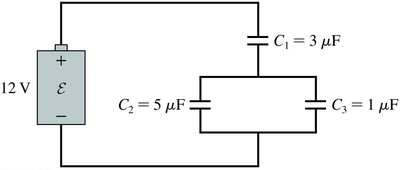
Example: For a circuit with \(C_1 = 3\,\mu\text{F}\), \(C_2 = 5\,\mu\text{F}\), and \(C_3 = 1\,\mu\text{F}\) as shown, the equivalent capacitance can be calculated by first combining the parallel capacitors and then the result in series.
Conductors in Electrostatic Equilibrium
Properties of Conductors
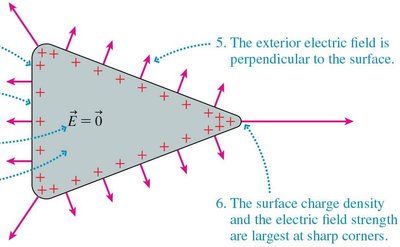
When a conductor is in electrostatic equilibrium, the electric field inside is zero, and any excess charge resides on the surface. The potential is constant throughout the conductor.
Electric field just outside the surface is perpendicular to the surface.
Field strength is greatest near sharp edges or points.
Potential and Field of Spheres Connected by Wire
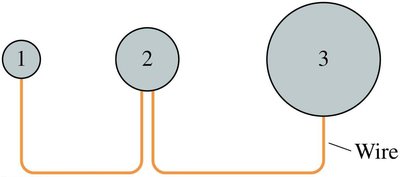
When conducting spheres of different radii are connected by a wire, they reach the same potential, but the electric field at their surfaces differs due to the difference in radius.
Potential at the surface:
Electric field at the surface:
Smaller spheres have a larger surface field for the same potential.
Summary Table: Series vs. Parallel Capacitors
Configuration | Voltage | Charge | Equivalent Capacitance |
|---|---|---|---|
Series | Sum of individual voltages | Same on all capacitors | |
Parallel | Same across all capacitors | Sum of individual charges |
Additional info: The notes above include expanded academic context and examples to ensure completeness and clarity for exam preparation.
