 Back
BackWeek 3 Lec. 1
Study Guide - Smart Notes
 Tailored notes based on your materials, expanded with key definitions, examples, and context.
Electric Potential Energy
Definition and Work-Energy Theorem
Electric potential energy is the energy stored in a system of charges due to their positions in an electric field. When a force acts on a particle as it moves from point a to b, the work done is given by a line integral. If the force is conservative, the work can be expressed in terms of a potential energy U. The work-energy theorem relates the change in kinetic and potential energy:
Work done by a conservative force:
Change in potential energy:
Work-energy theorem:
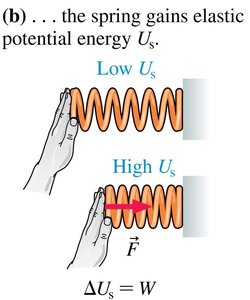
Example: Compressing a spring stores elastic potential energy, analogous to storing electric potential energy by moving charges against electric forces.
Potential Energy and Charge Motion
When a charge is moved in an electric field, work is done against the electric force, increasing the system's electric potential energy. For example, moving a positive charge closer to other positive charges requires work, increasing the potential energy of the system.
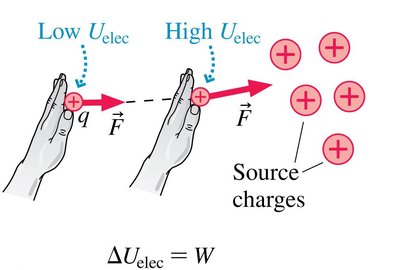
Key Point: (work done by an external agent is stored as electric potential energy)
Electric Potential Energy in a Uniform Electric Field
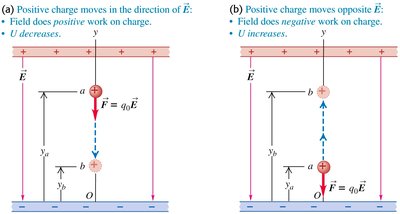
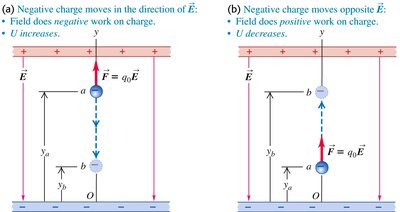
When a charge moves in a uniform electric field, the work done by the field and the change in potential energy depend on the direction of motion relative to the field:
Positive charge moving with the field: Field does positive work, decreases.
Positive charge moving against the field: Field does negative work, increases.
Negative charge moving with the field: Field does negative work, increases.
Negative charge moving against the field: Field does positive work, decreases.
Work and Path Independence
The electric force is a conservative force, meaning the work done (and thus the change in potential energy) does not depend on the path taken, only on the initial and final positions. The line integral for work is evaluated along the path of the test charge, but the result is path-independent.
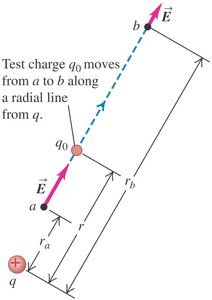
Formula for work done by the electric field:
Change in potential energy:
Potential Energy Curves and Multiple Charges
Potential Energy as a Function of Distance
The potential energy between two point charges depends on their separation and the sign of their charges. For like charges, potential energy increases (becomes more positive) as they approach each other (repulsion). For unlike charges, potential energy decreases (becomes more negative) as they approach (attraction).
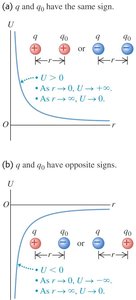
Formula for two point charges:
Potential Energy for Multiple Charges
For a system of multiple point charges, the total potential energy is the sum of the potential energies for each pair of charges:
Example: Bringing two like charges closer together increases the system's potential energy. For two charges separated by distance d, .
Electric Potential
Definition and Relationship to Potential Energy
Electric potential (V) is defined as the potential energy per unit charge at a point in an electric field. It is a scalar quantity and is independent of the test charge used to measure it.
Formula:
Unit: Volt (V), where

Key Point: Only differences in electric potential (potential difference or voltage) are physically meaningful.
Potential Difference in a Uniform Electric Field
The potential difference between two points in a uniform electric field is given by:
(for a uniform field and straight-line path)
For a positive test charge, moving with the field decreases potential energy and potential.
Energy Conservation: As a charge moves in the field, the decrease in potential energy is converted to kinetic energy.
Electric Potential for Point Charges
The electric potential due to a point charge at a distance r is:
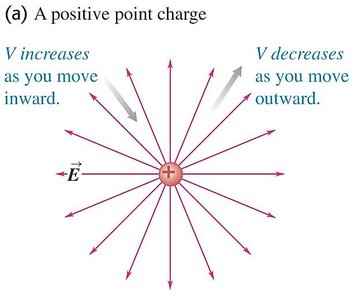
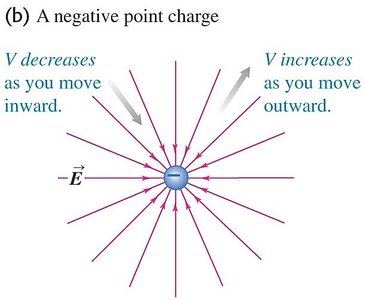
Key Point: For positive charges, potential increases as you move inward; for negative charges, potential decreases as you move inward.
Potential Due to Multiple Charges
The total electric potential at a point due to several point charges is the algebraic sum of the potentials due to each charge:
Equipotential Surfaces
Definition and Properties
Equipotential surfaces are surfaces on which the electric potential is the same at every point. No work is required to move a charge along an equipotential surface. Equipotential surfaces are always perpendicular to electric field lines.
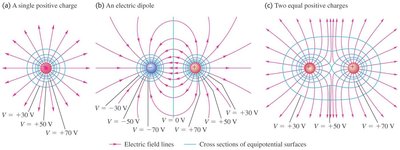
Key Point: The potential difference between any two points on the same equipotential surface is zero.
Example: Battery Potential
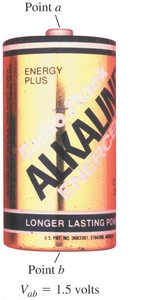
The potential difference between the terminals of a battery is a practical example of electric potential. For a typical AA battery, volts between the positive (a) and negative (b) terminals.
Summary Table: Key Relationships
Quantity | Symbol | Formula | Unit |
|---|---|---|---|
Electric Potential Energy | U | Joule (J) | |
Electric Potential | V | Volt (V) | |
Potential Difference | Volt (V) | ||
Potential Energy (Point Charges) | U | Joule (J) |
Additional info: This guide covers the core concepts of electric potential energy, electric potential, and their applications to charge systems and electric fields, as outlined in a typical college physics curriculum (Chapters 23 and 24).
