 Back
BackElectric Potential, Field, and Capacitance: Study Notes for College Physics
Study Guide - Smart Notes
 Tailored notes based on your materials, expanded with key definitions, examples, and context.
Electric Potential Energy and Electrostatics
Electrostatic Equilibrium and Conductors
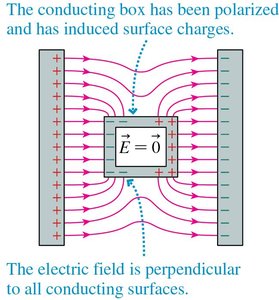
At electrostatic equilibrium, the electric field inside a conductor is zero, and any excess charge resides on the surface. This principle is crucial for understanding the behavior of conductors in electric fields and the distribution of charge.
Gauss's Law: The net electric flux through a closed surface is proportional to the net charge enclosed. For a conductor, this means the sum of the charge on the inner surface and any enclosed charge must be zero.
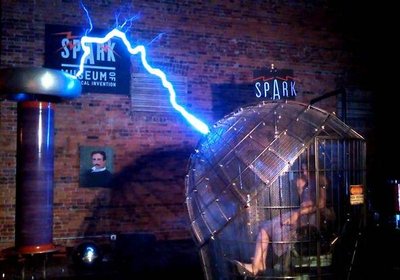
Faraday Cage: A conducting enclosure shields its interior from external electric fields by redistributing surface charges, ensuring the field inside is zero.
Example: Placing a charged ball inside a neutral metal bucket induces an equal and opposite charge on the inner surface, with the same sign charge appearing on the outer surface.
Electric Potential Energy
Potential Energy of Point Charges
Electric potential energy is the energy stored due to the positions of charged objects relative to each other. For two point charges, the potential energy is:
System of Charges: The total potential energy is the sum over all pairs of charges.
Bound States: A particle is bound if its kinetic energy is less than the magnitude of the potential energy barrier.
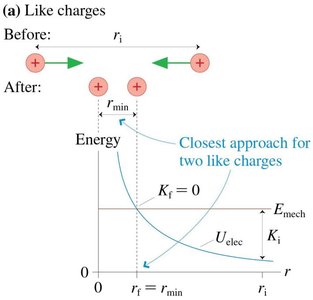
Like Charges: Repel each other, and the closest approach is determined by energy conservation.
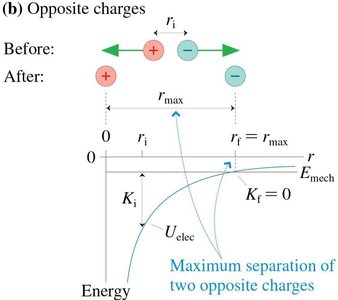
Opposite Charges: Attract each other, and the maximum separation is determined by energy conservation.
Electric Potential
Definition and Calculation
The electric potential, V, at a point is the electric potential energy per unit charge at that point. It is related to the electric field by:
Point Charge:
Uniform Sphere: For ,
Superposition: The potential due to multiple charges is the algebraic sum of the potentials from each charge.
Potential of Charge Distributions
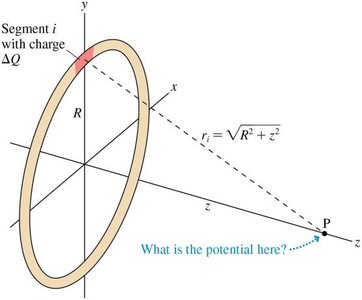
Ring of Charge: On the axis,
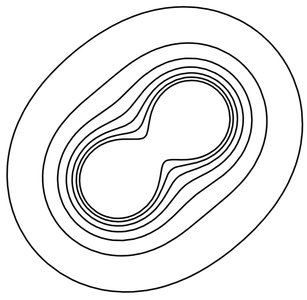
Equipotential Surfaces: Surfaces where the potential is constant; the electric field is always perpendicular to these surfaces.
Electric Field and Potential Relationship
Finding the Electric Field from Potential
The electric field is the negative gradient of the electric potential:
Direction: The electric field points in the direction of decreasing potential and is perpendicular to equipotential surfaces.
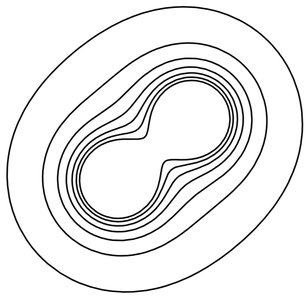
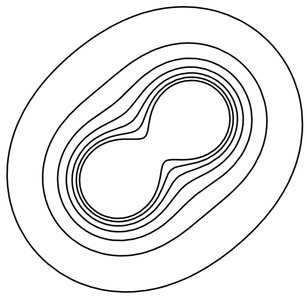
Magnitude: The field is strongest where equipotential lines are closest together.
Capacitance and Capacitors
Definition and Properties
A capacitor consists of two conductors separated by an insulator. The capacitance, C, is the ratio of the charge on one conductor to the potential difference between the conductors:
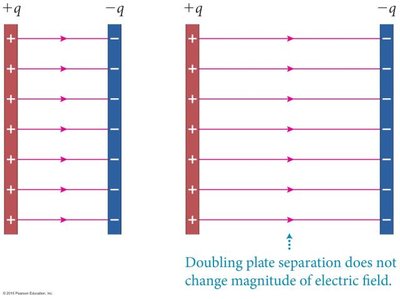
Parallel-Plate Capacitor: , where is the plate area and is the separation.
Disconnected Capacitor: If the capacitor is disconnected from the battery, the charge remains constant when the plate separation or area changes.
Potential Difference: If the plate separation increases, the potential difference increases; if the area decreases, the potential difference increases.
Energy Stored in a Capacitor
The energy stored in a capacitor is:
The energy density (energy per unit volume) in the electric field is:
Dielectrics
Effect of Dielectrics on Capacitance
Inserting a dielectric (an insulating material) between the plates of a capacitor increases its capacitance by a factor called the dielectric constant, :
Disconnected Capacitor: Inserting a dielectric decreases the potential difference.
Connected Capacitor: Inserting a dielectric increases the charge stored for the same potential difference.
Current and Resistance
Current, Current Density, and Ohm's Law
Electric current is the rate of flow of charge:
The current density is the current per unit area:
Ohm's Law relates current, voltage, and resistance:
The resistance of a wire is:
Resistivity (): A material property; lower resistivity means higher conductivity.
Increasing Current: Increase the wire's cross-sectional area, decrease its length, or use a material with lower resistivity.
Magnetic Field
Magnetic Field Due to Currents and Moving Charges
Moving charges and currents produce magnetic fields. The direction of the field can be determined by the right-hand rule.
Biot-Savart Law (point charge):
Long Straight Wire:
Coil Center:
Superposition Principle
The net magnetic field at a point is the vector sum of the fields produced by all sources.
Applications and Examples
Electrostatic Precipitators
Electrostatic precipitators use high voltage to remove particles from exhaust gases in power plants. Charged particles are attracted to collecting plates and removed from the gas stream.


Electron Guns and Cathode Ray Tubes
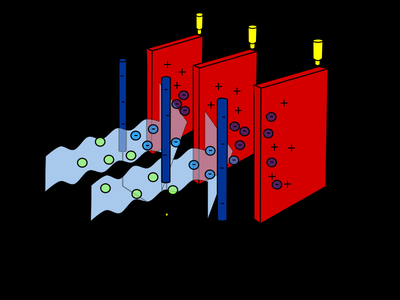
Electron guns accelerate electrons using electric fields, as in old cathode ray tube (CRT) televisions. The electrons are accelerated between plates and strike a phosphor screen to produce images.

Capacitive Keyboards and Microphones
Capacitive keyboards and microphones use changes in capacitance to detect key presses or sound waves. The movement of a plate changes the capacitance, which is detected electronically.


Additional info: Some images and examples are included to illustrate real-world applications of the concepts discussed, such as Faraday cages, electrostatic precipitators, and capacitive devices.
