 Back
Electric Potential, Potential Energy, and Capacitance: Study Notes for Physics with Calculus
Study Guide - Smart Notes
 Tailored notes based on your materials, expanded with key definitions, examples, and context.
Electric Potential and Electric Potential Energy
Introduction to Electric Potential
Electric potential is a fundamental concept in electrostatics, describing the potential for a charge to possess electric potential energy due to its position in an electric field. The voltage of a battery is a practical example of electric potential difference between two points.
Electric Potential Energy (Uelec): The energy a charge has due to its position relative to other charges.
Electric Potential (V): The potential for creating electric potential energy if a charge is placed at a given point. Measured in volts (V), where 1 V = 1 J/C.
Voltage: Commonly used term for electric potential difference.
Work and Potential Energy
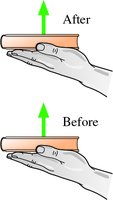
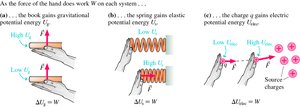
Work is required to move a charge against electric forces, resulting in a change in electric potential energy. This is analogous to lifting a book (gravitational potential energy) or compressing a spring (elastic potential energy).
Conservation of Energy: Energy is conserved in systems involving electric forces.
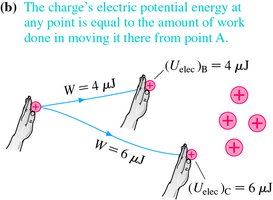
Work-Energy Principle: The work done to move a charge is equal to the change in its electric potential energy.
Electric Potential: Definitions and Properties
Electric Field and Potential
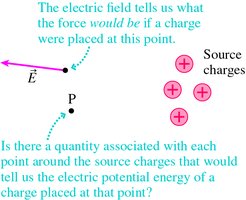
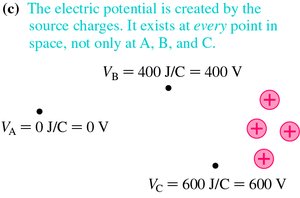
Source charges create an electric field and an electric potential in the surrounding space. The electric field exerts a force on a test charge, while the electric potential determines the potential energy a charge would have at a point.
Electric Field (E): Vector field describing the force per unit charge.
Electric Potential (V): Scalar field describing the potential energy per unit charge.
Calculating Electric Potential Energy
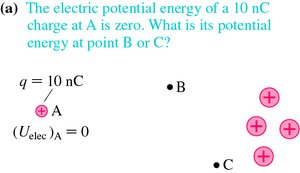
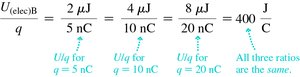
The electric potential energy of a charge at a point is determined by the work required to move it from a reference point (often where Uelec = 0) to that position.
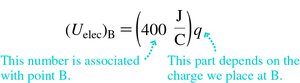
Proportionality: Electric potential energy is proportional to the charge.
Formula:
Sources of Electric Potential
Creating Potential Differences
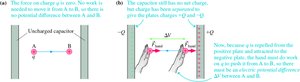
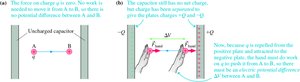
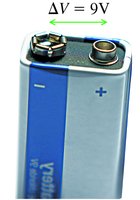
Potential differences are created by separating positive and negative charges. Examples include capacitors, batteries, and static electricity.
Capacitors: Store separated charges, creating a potential difference.
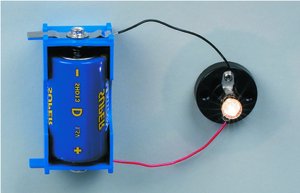
Batteries: Use chemical reactions to maintain a fixed potential difference.
Measuring Electric Potential
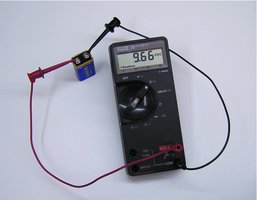
Potential difference is measured using a voltmeter, which compares the potential between two points.
Voltmeter: Instrument for measuring potential difference.
Potential Difference: The quantity measured, independent of reference point.
Electric Potential and Conservation of Energy
Energy Transformations
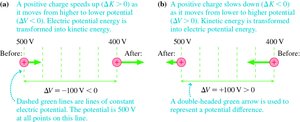
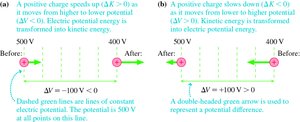
When a charge moves from high to low potential, its electric potential energy decreases and kinetic energy increases. Conservation of energy applies to electric systems.
Conservation of Energy Equation:
Potential Difference:
Electron Volt
The electron volt (eV) is a unit of energy commonly used in atomic and particle physics. It is the energy gained by an electron when accelerated through a potential difference of 1 volt.
Conversion:
Calculating Electric Potential
Parallel-Plate Capacitor
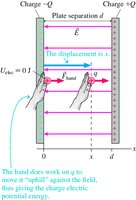
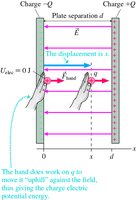
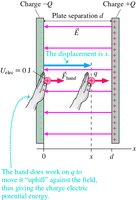
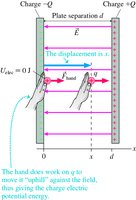
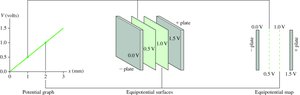
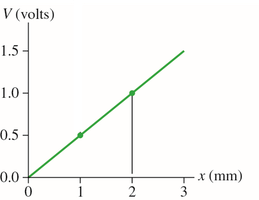
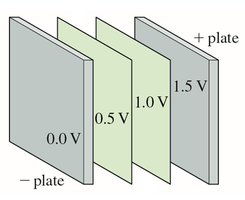
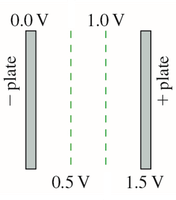
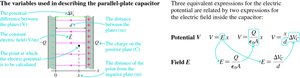
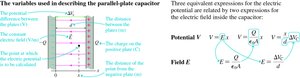
A parallel-plate capacitor creates a uniform electric field between its plates. The electric potential increases linearly from the negative plate to the positive plate.
Potential Difference:
Electric Field:
Potential at position x:
Potential of a Point Charge
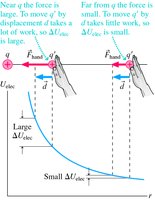
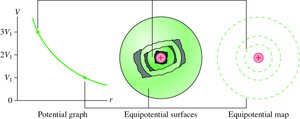
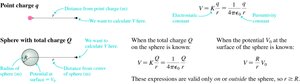
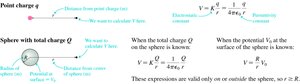
The electric potential due to a point charge decreases with distance. The potential at a distance r from a charge q is given by:
Formula:
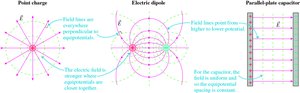
Equipotential Surfaces: Spheres centered on the charge.
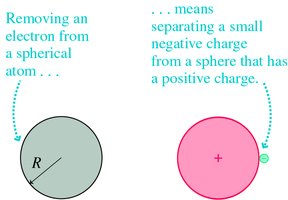
Potential of a Charged Sphere
The electric potential outside a charged sphere is identical to that of a point charge. The potential at the surface is V0, and outside the sphere:
Formula:

Potential of Many Charges
The electric potential at a point due to multiple charges is the sum of the potentials from each charge.
Formula:
Connecting Potential and Field
Relationship Between Field and Potential
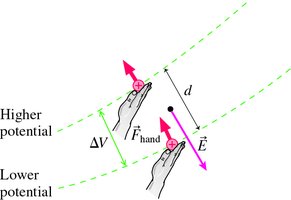
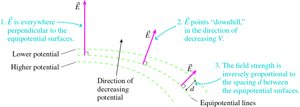
The electric field is related to the spatial rate of change of electric potential. Field lines are perpendicular to equipotential surfaces.
Formula:
Equipotential Surfaces: No work is done moving a charge along these surfaces.
Conductors in Electrostatic Equilibrium
Properties of Conductors
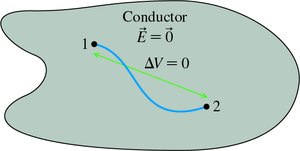
Conductors in electrostatic equilibrium have unique properties regarding charge distribution and electric potential.
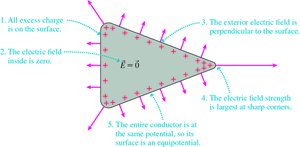
Excess charge resides on the surface.
Electric field inside is zero.
Exterior field is perpendicular to the surface.
Field strength is largest at sharp corners.
The entire conductor is at the same potential (equipotential surface).
Capacitance and Capacitors
Definition and Properties
A capacitor consists of two conductors (electrodes) with equal but opposite charge. Capacitance is the ability to store charge per unit potential difference.
Capacitance (C):
Unit: Farad (F), where 1 F = 1 C/V
Capacitance depends on shape, size, and spacing of electrodes.
Charging a Capacitor
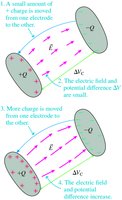
Charging a capacitor involves moving charge from one electrode to another, typically using a battery.
Charge flows until the potential difference equals the battery voltage.
The capacitor remains charged even after the battery is removed.
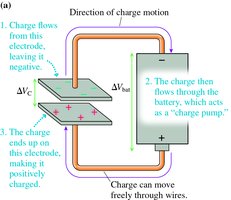
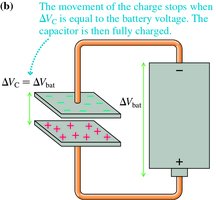
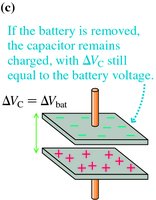
Parallel-Plate Capacitor
The parallel-plate capacitor is a common configuration, creating a uniform electric field between its plates.
Electric Field:
Capacitance:
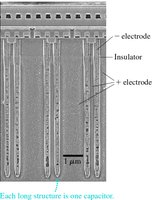
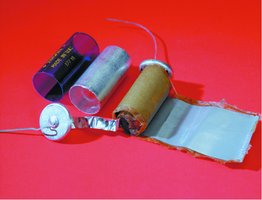
Dielectrics and Capacitors
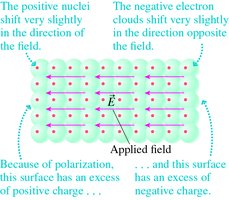
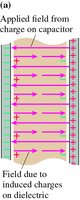
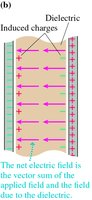
Dielectrics are insulating materials placed between capacitor plates, increasing capacitance by reducing the electric field.
Polarization: Atoms polarize in response to the electric field.
Dielectric Constant (κ): Capacitance increases by a factor κ.
Formula:
Energy Stored in Capacitors
Energy Storage
A charged capacitor stores energy as electric potential energy, which can be released rapidly for applications such as defibrillators.
Energy Stored:
Energy Density:

Summary Tables
Table: Dielectric Constants of Materials
Dielectric constants (κ) for common materials at 20°C:
Material | Dielectric Constant (κ) |
|---|---|
Vacuum | 1.00 |
Air | 1.0006 |
Water | ~80 |
Glass | ~5-10 |
Additional info: Values may vary by type and purity. |
Table: Distinguishing Electric Potential and Potential Energy
Quantity | Definition | Units |
|---|---|---|
Electric Potential (V) | Created by source charges, exists at every point | J/C (Volt) |
Electric Potential Energy (Uelec) | Interaction energy of a charged particle with source charges | Joule (J) |
Key Equations
Summary of Concepts
Electric potential is a scalar field created by charges, existing at every point in space.
Potential differences are created by separation of charge (batteries, capacitors).
Capacitors store charge and energy, with capacitance determined by geometry and dielectric properties.
Energy stored in capacitors can be released rapidly for practical applications.
Conductors in equilibrium are equipotential surfaces.
