 Back
BackElectricity: Concepts, Charge, and Circuits
Study Guide - Smart Notes
 Tailored notes based on your materials, expanded with key definitions, examples, and context.
Electricity: Fundamental Concepts
Introduction to Electricity
Electricity is a fundamental aspect of physics, describing the behavior and interaction of electric charges. It encompasses phenomena such as static electricity, electric current, and the forces between charged particles. The study of electricity is essential for understanding both natural events (like lightning) and technological applications (such as circuits and electronic devices).
Electric Charge
Nature of Electric Charge
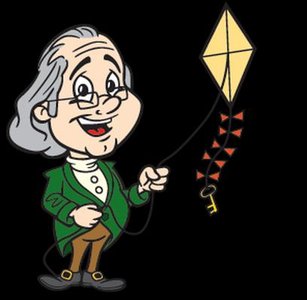
Electric charge is a basic property of matter, existing in two types: positive and negative. These terms were coined by Benjamin Franklin to describe the observed attraction and repulsion between materials.
Positive charge: Associated with protons.
Negative charge: Associated with electrons.
Like charges repel; unlike charges attract.
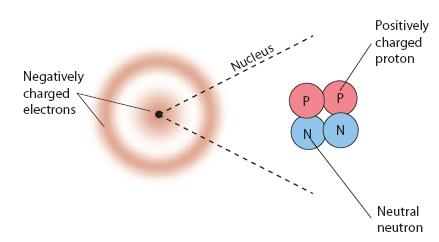
Example: Rubbing a balloon on your hair transfers electrons, causing static electricity.
Discovery of Charges
Historically, the existence of electric charges was inferred from observations of attraction and repulsion. The electron (negative charge) was identified by J.J. Thomson in 1897, and the proton (positive charge) by Ernest Rutherford in 1920.
Conductors, Insulators, and Semiconductors
Electrical Conductors
Conductors are materials in which electrons are free to move, allowing electric charge to flow easily. Examples include metals and graphite.
Added charge dissipates quickly.
Electrical Insulators
Insulators restrict the motion of electrons, so added charge tends to remain localized. Examples include glass, wood, and diamond.
Added charge remains on the object.
Semiconductors
Semiconductors can behave as conductors or insulators depending on conditions. They are crucial in modern electronics, such as computer chips and solar cells.
Static Electricity and Charging Mechanisms
Electrostatic Charge
Electrostatics deals with charges at rest or moving very slowly. Static electricity arises when charges are transferred and then remain stationary.
Charging by Friction (Rubbing)
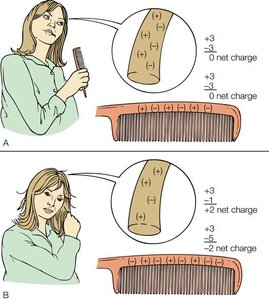
When two different materials are rubbed together, electrons may be transferred from one to the other, resulting in one object becoming negatively charged and the other positively charged.
Charging by Conduction
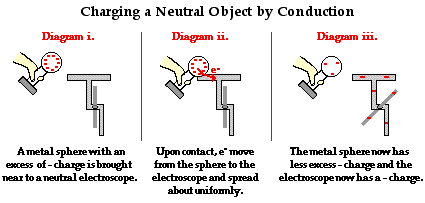
Conduction involves direct contact between a charged object and a neutral object, allowing electrons to move and share charge.
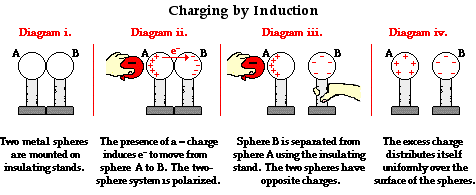
Charging by Induction
Induction is the process of charging an object without direct contact. A charged object brought near a conductor causes redistribution of charges, and grounding can separate the charges permanently.
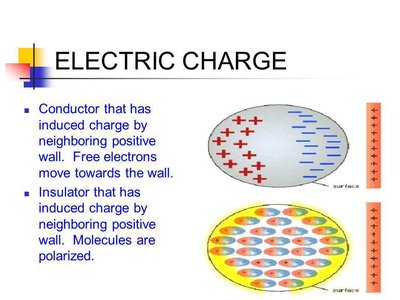
Polarization
Polarization occurs when the charges within an insulator rearrange slightly in response to a nearby charged object, creating regions of slight positive and negative charge without overall charge transfer.
Quantifying Electric Charge
Units and Fundamental Charge
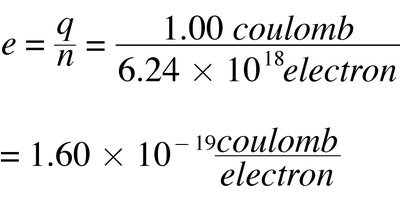
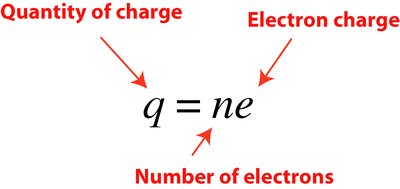
The SI unit of electric charge is the coulomb (C). One coulomb is equivalent to the charge of approximately electrons. The charge of a single electron is the smallest observed in nature.
Electron charge: coulombs
Net Charge and Ions
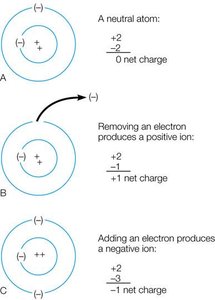
The net charge of an atom or object depends on the balance between protons and electrons. Removing or adding electrons creates ions:
Positive ion: Fewer electrons than protons
Negative ion: More electrons than protons
Electrostatic Forces
Coulomb's Law
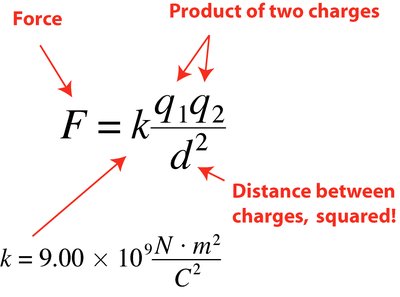
The force between two point charges is described by Coulomb's Law:
= electrostatic force (Newtons)
, = charges (Coulombs)
= distance between charges (meters)
Electric Current
Definition and Properties
Electric current is the flow of electric charge, typically carried by electrons in a conductor. The symbol for current is I, and the unit is the ampere (A).
Current () is the amount of charge passing a point per unit time.
Materials with many free electrons are good conductors.
Example: Copper wires in household circuits carry electric current efficiently.
Resistance
Definition and Factors
Resistance is a measure of how much a material opposes the flow of electric current. The symbol is R, and the unit is the ohm (\Omega).
Depends on material, length (), and cross-sectional area ().
Formula: , where is resistivity.
Resistance causes energy dissipation, often as heat.
Voltage (Potential Difference)
Definition
Voltage, or electric potential difference, is the "push" that drives electric charges through a circuit. The symbol is V, and the unit is the volt (V).
Batteries are common sources of voltage.
Simple Circuits
Requirements for Current Flow
For electric current to flow, there must be a complete, unbroken path (a closed circuit) for the charges to move through. If the path is broken (open circuit), current cannot flow.







Closed and Open Circuits
Closed circuit: Unbroken path; current flows.
Open circuit: Path is broken; no current flows.
Ohm's Law
Relationship Between Voltage, Current, and Resistance
Ohm's Law describes the relationship between voltage (V), current (I), and resistance (R):
If resistance increases, current decreases for a given voltage.
If voltage increases, current increases for a given resistance.

Electric Power
Definition and Formula
Electric power is the rate at which electrical energy is converted to another form (heat, light, mechanical, etc.). The unit is the watt (W).
Power can also be expressed as (energy per unit time).
Series and Parallel Circuits
Series Circuits
In a series circuit, there is only one path for current to follow. All components share the same current.
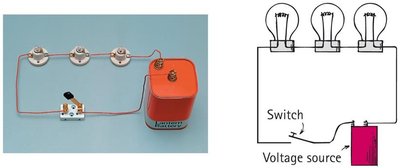
Resistances add:
Batteries in series add voltages.
Parallel Circuits
In a parallel circuit, there are multiple paths for current. Each component has the same voltage across it.
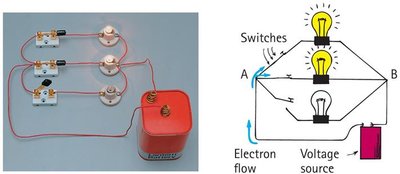
Inverse of resistances add:
Batteries in parallel do not add voltages but provide backup.
Comparison Table: Series vs. Parallel Circuits
Property | Series Circuit | Parallel Circuit |
|---|---|---|
Current | Same through all components | Divided among branches |
Voltage | Divided among components | Same across all branches |
Resistance | Adds directly | Adds as reciprocals |
Batteries | Voltages add | Voltages do not add |
Applications: Light-Emitting Diodes (LEDs) and Incandescent Bulbs
Energy Efficiency
Incandescent bulbs convert most energy to heat, while LEDs are more efficient, converting a greater fraction to light. LEDs are becoming the standard for lighting due to their efficiency and longevity.
Incandescent: ~95% heat, 5% light
LED: ~65% heat, 35% light
Summary
This guide covers the essential concepts of electricity, including charge, current, resistance, voltage, and circuit types. Understanding these principles is foundational for further study in physics and engineering.
