 Back
BackElectromagnetic Fields and Waves: Maxwell’s Equations, Wave Properties, and Energy Transport
Study Guide - Smart Notes
 Tailored notes based on your materials, expanded with key definitions, examples, and context.
Electromagnetic Fields and Waves
Maxwell’s Equations
Maxwell’s equations are the foundation of classical electromagnetism, unifying electricity, magnetism, and optics. They describe how electric and magnetic fields are generated and altered by each other and by charges and currents.
Gauss’s Law for Electricity: The electric flux through a closed surface is proportional to the enclosed electric charge.
Gauss’s Law for Magnetism: The net magnetic flux through a closed surface is zero (no magnetic monopoles).
Faraday’s Law of Induction: A changing magnetic flux induces an electric field.
Ampère-Maxwell Law: Magnetic fields are generated by electric currents and changing electric fields.
In differential form, these equations are:
These equations predict that oscillating electric and magnetic fields can sustain each other and propagate as electromagnetic waves.
Electromagnetic Waves
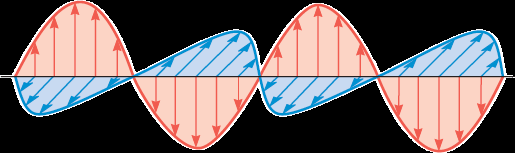
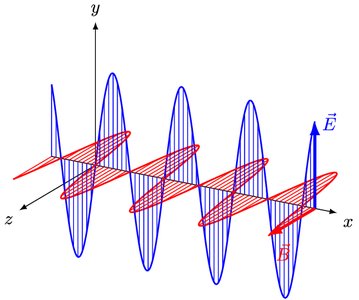
Electromagnetic waves are solutions to Maxwell’s equations in free space. They consist of oscillating electric (E) and magnetic (B) fields that are perpendicular to each other and to the direction of propagation.
Directionality: The E field, B field, and propagation direction form a right-handed set of vectors.
Example: For a wave traveling in the x-direction, E oscillates in the y-direction, and B oscillates in the z-direction.
Wave Equation and Properties
By combining Faraday’s and Ampère’s laws, we derive the wave equations for the electric and magnetic fields:
The general solutions are sinusoidal:
Where:
Wave number:
Angular frequency:
Wave speed:
Relationship:
Electromagnetic Spectrum
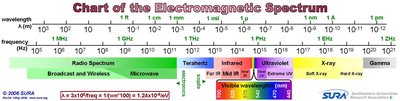
Electromagnetic waves span a vast range of wavelengths and frequencies, collectively known as the electromagnetic spectrum. This includes radio waves, microwaves, infrared, visible light, ultraviolet, X-rays, and gamma rays.
Applications of Electromagnetic Waves
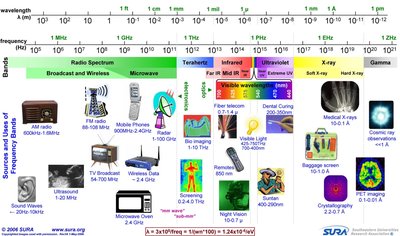
Electromagnetic waves have numerous applications across different frequency ranges, including communication, medical imaging, and everyday technology.
Energy and Momentum in Electromagnetic Waves
Poynting Vector and Energy Transport
The Poynting vector () represents the energy current density (power per unit area) carried by an electromagnetic wave. Its direction is the same as the direction of wave propagation.
For a sinusoidal wave, the average value over a cycle is the intensity ():
Energy Density
The energy stored in the electric and magnetic fields per unit volume is called the energy density:
Electric field:
Magnetic field:
Total:
For sinusoidal waves, the average over a cycle is:
Example Calculation: Satellite Detection of Radio Waves
A radio station radiates 50 kW of power. At a distance of 100 km, the intensity and field amplitudes can be calculated:
Intensity:
Electric field amplitude:
Magnetic field amplitude:
Average energy densities at the satellite location can be found using the formulas above.
Momentum and Radiation Pressure of Electromagnetic Waves
Momentum Transport
Electromagnetic waves carry linear momentum as well as energy. The momentum density (momentum per unit volume) is:
Momentum current density:
When EM waves strike a surface, they exert radiation pressure:
For total absorption:
For total reflection:
Example: Solar Panels in Space
Solar panels with area 4.0 m2 absorb sunlight with intensity 1.4 kW/m2:
Power absorbed: kW
Radiation pressure: Pa
Force: N
Light Mill (Crookes Radiometer)
The Crookes radiometer is a device with vanes that spin when exposed to light. However, the rotation is not due to radiation pressure but rather to thermal effects and gas molecule interactions.
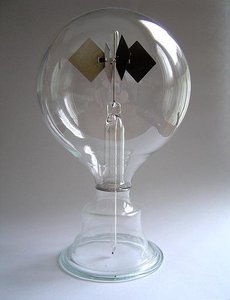
Additional info: The detailed mechanism involves thermal transpiration and is still a subject of research.
Key Equations Summary
Quantity | Equation |
|---|---|
Poynting vector | |
Energy density | |
Intensity (average S) | |
Field ratio | |
Wave number | |
Angular frequency | |
Wave speed | |
Radiation pressure (absorption) | |
Radiation pressure (reflection) |
