 Back
BackElectromagnetic Induction and Electromagnetic Waves: Study Notes
Study Guide - Smart Notes
 Tailored notes based on your materials, expanded with key definitions, examples, and context.
Electromagnetic Induction and Electromagnetic Waves
Introduction to Electromagnetic Induction
Electromagnetic induction is a fundamental phenomenon in physics where a changing magnetic flux induces an electric field, which can drive a current in a conductor. This process is central to the operation of generators, transformers, and the propagation of electromagnetic waves.
Key Concept: A changing magnetic field through a loop of wire induces a current in that wire.
Discovery: Michael Faraday discovered electromagnetic induction in the 1830s.
Applications: Electromagnetic waves (light, radio waves, x-rays, etc.) are produced by this phenomenon.
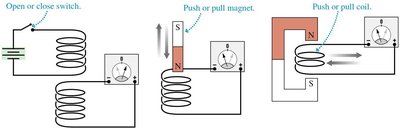
25.1: Induced Currents
Motional EMF
Motional emf is the potential difference generated when a conductor moves through a magnetic field. Unlike a battery, where emf is produced by chemical reactions, motional emf arises from the physical movement of charge carriers in a magnetic field.
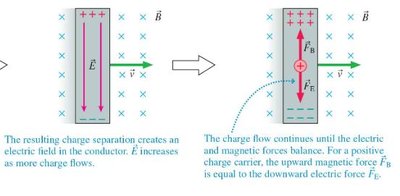
Force on Charge Carriers: Each charge carrier experiences a force given by .
Charge Separation: Positive charges are pushed toward one end of the conductor, negative charges toward the other, creating an electric field.
Equilibrium: The electric force balances the magnetic force: .
Electric Field Strength: At equilibrium, .
Formula for Motional EMF
The potential difference (emf) induced in a conductor of length moving at velocity perpendicular to a magnetic field is:
Variables: = speed (m/s), = length (m), = magnetic field strength (T)

Induced Current in a Circuit
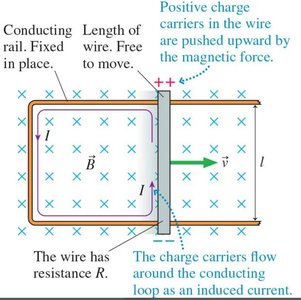
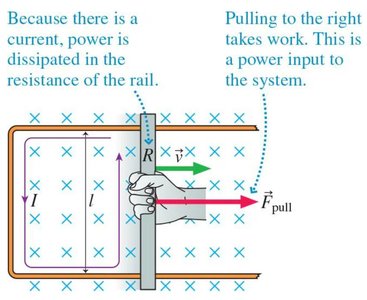
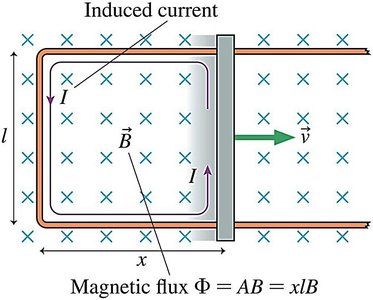
When a wire with resistance slides along a conducting rail in a magnetic field,The induced emf acts like a battery, driving a current through the circuit.
Induced Current:
Direction: Determined by the right-hand rule (RHR) for forces.
Magnetic Drag and Force
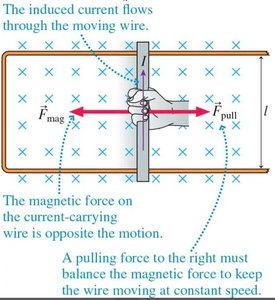
The wire with current moving in a magnetic field experiences a magnetic force opposite to its motion, known as magnetic drag. To keep the wire moving at constant speed, an equal and opposite pulling force must be applied.
Pulling Force:
Energy Considerations
Energy is transferred to the circuit by the pulling force, and dissipated as heat in the resistor.
Power Input:
Power Dissipated:
Conservation of Energy:
25.2: Generators
AC Generators
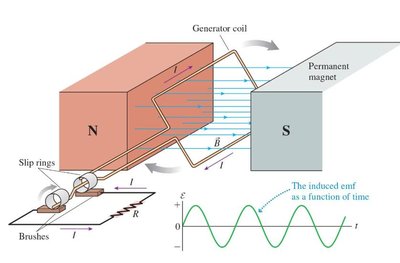
A generator converts mechanical energy to electrical energy by moving coils through a magnetic field, inducing an alternating current (AC).
Alternating Voltage: The induced emf alternates in sign, producing AC.
Components: Generator coil, permanent magnet, slip rings, brushes.
25.3: Magnetic Flux and Lenz's Law
Magnetic Flux
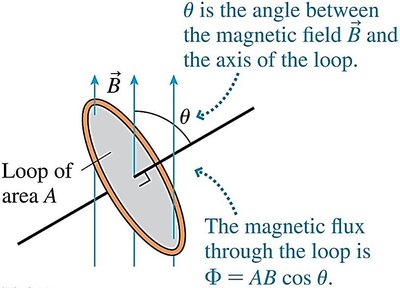
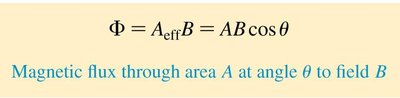
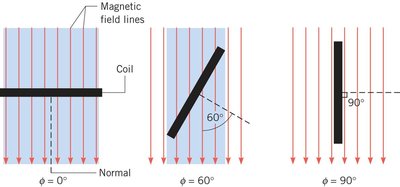
Magnetic flux () quantifies the amount of magnetic field passing through a loop. It depends on the field strength, area, and orientation of the loop.
Formula:
Units: Weber (Wb), where
Effective Area:
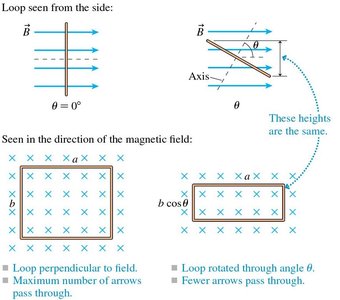
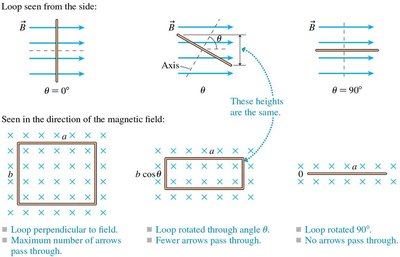
Calculating Magnetic Flux: Example
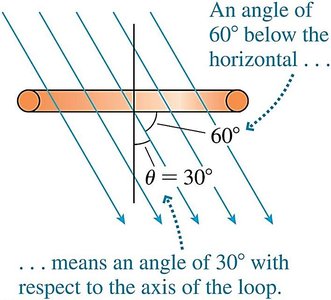
For a loop of radius 5.0 cm in a 50 μT field at 30° to the axis:

Lenz's Law
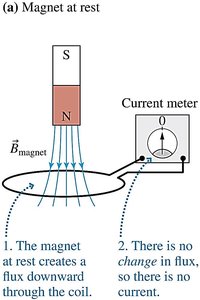
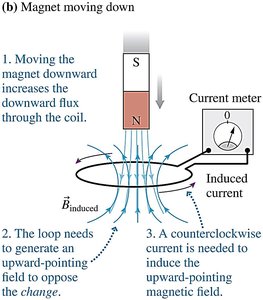
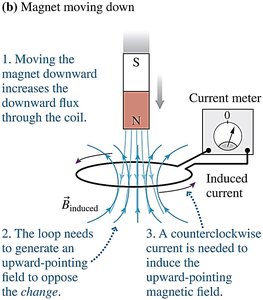
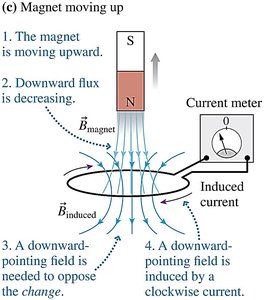
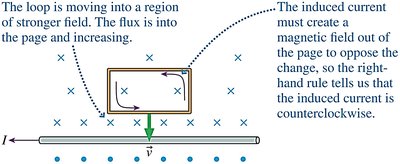
Lenz's law states that the direction of the induced current in a loop is such that the magnetic field it creates opposes the change in magnetic flux that caused it.
Induced Current: Only occurs if magnetic flux is changing.
Opposition: Induced magnetic field opposes the change in flux.

Applying Lenz's Law
To determine the direction of induced current:
Is the magnetic flux increasing or decreasing?
What is the direction of the original magnetic field?
The induced field opposes the change in flux.
Use the right-hand rule to find current direction.
25.4: Faraday's Law
Faraday's Law of Induction
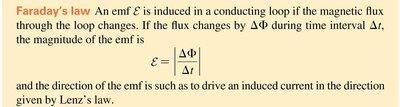
Faraday's law quantifies the induced emf in a loop due to a changing magnetic flux:
Induced Current:
Coil with N Turns:
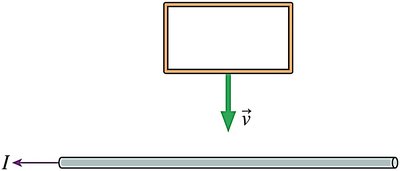
Example: Expanding Loop
For a sliding wire in a magnetic field, the area changes, so the flux changes:
Area:
Flux:
Induced emf:
Induced current:
Eddy Currents
Formation and Effects
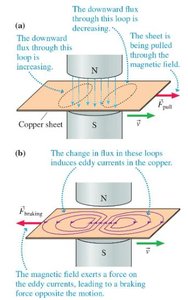
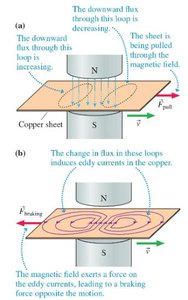
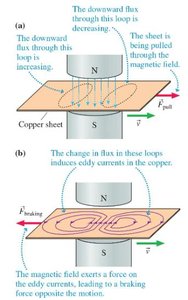
Eddy currents are circulating currents induced in solid conductors when the magnetic flux changes. These currents create their own magnetic fields, which oppose the motion causing the flux change, resulting in a braking force.
Direction: Determined by Lenz's law.
Effect: Magnetic field exerts a force opposite to the motion.
25.5: Electromagnetic Waves
Self-Sustaining Fields
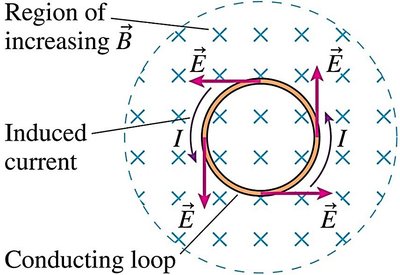
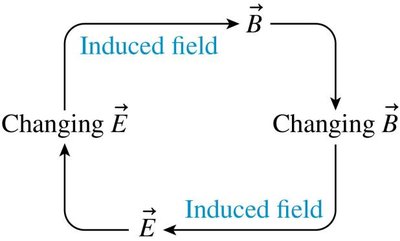
A changing magnetic field induces an electric field, and a changing electric field induces a magnetic field. This mutual induction allows electromagnetic waves to propagate through space, even in a vacuum.
EM Waves: Consist of oscillating electric and magnetic fields perpendicular to each other and to the direction of propagation.
Speed:
Relationship:
Properties of Electromagnetic Waves
Transverse Wave: and are perpendicular to each other and to the direction of travel.
Wave Equations: ,
Speed of Light:
Intensity of Electromagnetic Waves
Intensity is the power per unit area carried by a wave:
Point Source:
Polarization
Polarization refers to the orientation of the electric field vector in an electromagnetic wave. Polarizing filters allow only one direction of polarization to pass through.
Unpolarized Light: Random polarization directions; intensity after filter is
Malus' Law: for polarized light passing through a filter at angle
25.6: Photon Model of EM Waves
Quantum Nature of Light
Electromagnetic waves also exhibit particle-like behavior, consisting of photons.
Photon Energy:
Planck's Constant:
Wave-Particle Duality: Large numbers of photons behave as continuous waves.
25.7: Electromagnetic Spectrum
Range and Sources
The electromagnetic spectrum covers a wide range of frequencies and wavelengths, from radio waves to gamma rays. Visible light is only a small portion of this spectrum.
Radio Waves: Produced by oscillating charges in antennas.
Infrared, Visible, Ultraviolet: Generated by atomic vibrations and thermal radiation.
Thermal Radiation: Described by Stefan's law:
Wien's Law: Peak wavelength
Color Vision and Ionizing Radiation
Color Vision: Human eyes detect three primary colors; other animals may see different wavelengths.
X-rays and Gamma Rays: High-energy photons capable of ionizing atoms.
Type of EM Wave | Source | Typical Application |
|---|---|---|
Radio Waves | Oscillating charges in antennas | Communication |
Infrared | Thermal vibrations | Remote controls, heat sensing |
Visible Light | Atomic transitions | Vision, illumination |
Ultraviolet | Atomic transitions | Sterilization, fluorescence |
X-rays | Electron deceleration | Medical imaging |
Gamma Rays | Nuclear reactions | Cancer treatment |
Additional info: Some explanations and examples were expanded for clarity and completeness, including the table summarizing EM wave types and their sources/applications.
