 Back
BackElectromagnetic Induction and Faraday’s Law
Study Guide - Smart Notes
 Tailored notes based on your materials, expanded with key definitions, examples, and context.
Electromagnetic Induction
Discovery and Historical Context
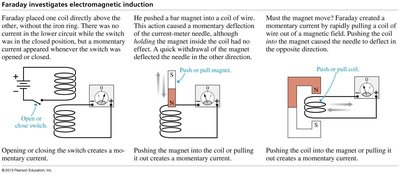
Electromagnetic induction is the process by which a changing magnetic field induces an electric current in a conductor. This phenomenon was first observed by Michael Faraday in 1831, marking a pivotal moment in the development of electromagnetism. Faraday’s experiments demonstrated that a current could be produced in a coil of wire not by a static magnetic field, but only when the magnetic field through the coil was changing.
Key Concept: A changing magnetic field is necessary to induce a current; a static field does not suffice.
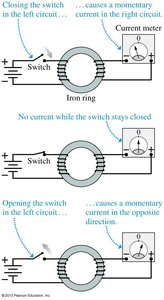
Historical Experiment: Faraday used two coils wrapped around an iron ring. Closing or opening a switch in one coil caused a momentary current in the other, but no current flowed when the switch remained closed.
Motional emf
Induced emf in a Moving Conductor
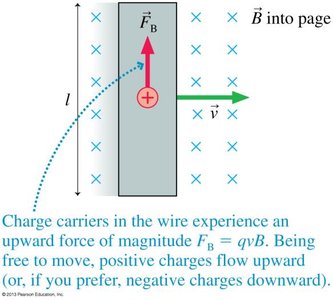
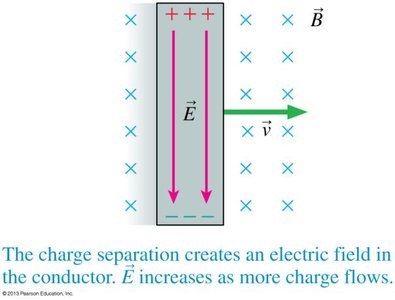
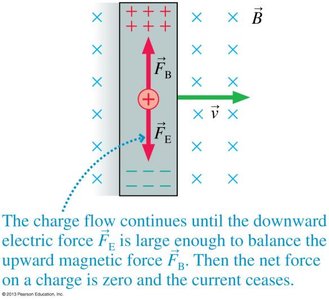
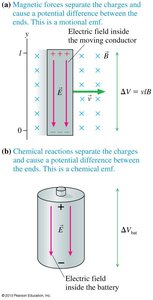
When a conductor moves through a magnetic field, the charge carriers inside experience a magnetic force. This force separates charges, creating an electric field and a potential difference across the conductor, known as motional emf.
Magnetic Force: The force on a charge q moving with velocity v in a magnetic field B is given by .
Charge Separation: Positive charges move in one direction, negative in the opposite, creating an internal electric field .
Equilibrium: The electric force balances the magnetic force when .
Motional emf Formula
The potential difference (emf) generated across a conductor of length l moving at velocity v perpendicular to a magnetic field B is:
Motional emf:
Induced Current in a Circuit
Sliding Wire in a Magnetic Field
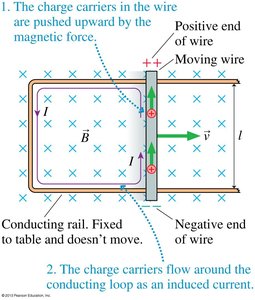
When a conducting wire slides along a U-shaped rail in a perpendicular magnetic field, a current is induced in the circuit. The direction of the induced current is determined by the right-hand rule and the orientation of the magnetic field and velocity.
Induced Current: , where R is the total resistance of the circuit.
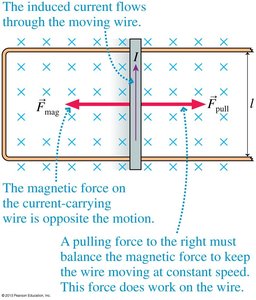
Force on the Wire: The current-carrying wire experiences a magnetic force opposite to its motion, requiring an external force to maintain constant velocity.
Energy Considerations: The mechanical work done to move the wire is dissipated as heat in the resistor.
Applications: Generators and Eddy Currents
Electric Generators
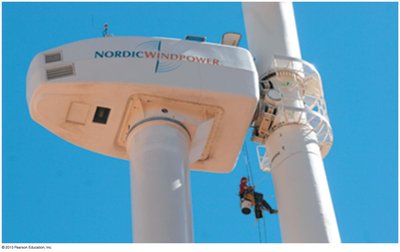
Generators convert mechanical energy into electrical energy by rotating coils in a magnetic field, inducing an emf according to Faraday’s law. Wind turbines are practical examples of generators in use today.
Eddy Currents
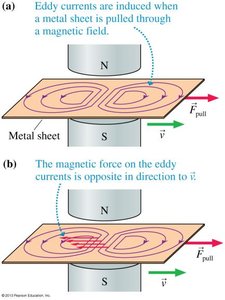
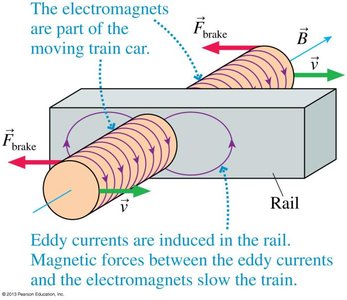
Eddy currents are loops of induced current that form in conductors exposed to changing magnetic fields. These currents can cause energy dissipation (heating) and are used in applications such as magnetic braking systems in trains.
Magnetic Braking: Eddy currents induced in the rails oppose the motion of the train, providing a non-contact braking force.
Magnetic Flux
Definition and Calculation
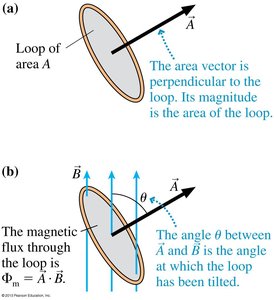
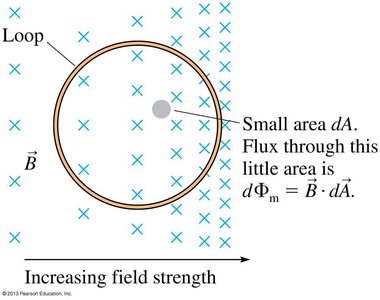
Magnetic flux quantifies the amount of magnetic field passing through a given area. For a uniform field and flat loop, it is defined as:
Magnetic Flux:
SI Unit: Weber (Wb), where
Faraday’s Law and Lenz’s Law
Faraday’s Law of Induction
Faraday’s law states that an emf is induced in a closed loop when the magnetic flux through the loop changes. The magnitude of the induced emf is proportional to the rate of change of magnetic flux:
Faraday’s Law:
N-Turn Coil:
Lenz’s Law
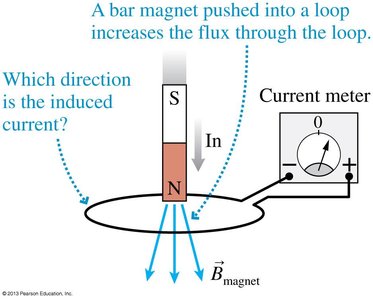
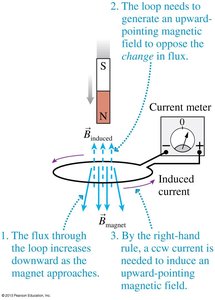
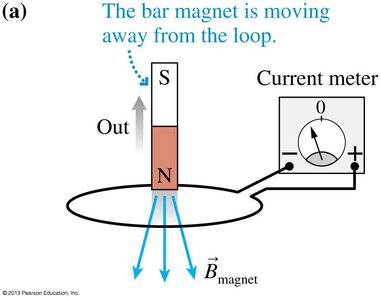
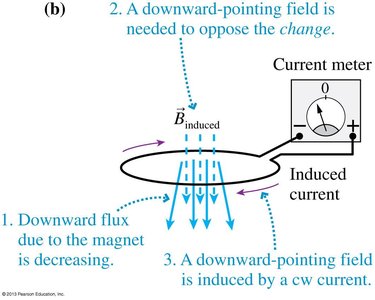
Lenz’s law determines the direction of the induced current: it always opposes the change in magnetic flux that produced it. This is a consequence of the conservation of energy.
Direction: The induced current creates a magnetic field that opposes the change in the original magnetic flux.
Induced Electric Fields
Non-Coulomb Electric Fields
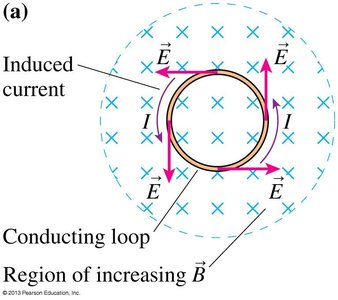
Changing magnetic fields induce electric fields that form closed loops, unlike the electric fields produced by static charges (Coulomb fields). These induced electric fields are responsible for driving currents in stationary conductors when the magnetic flux changes.
Faraday’s Law (Integral Form):
Applications of Induced Currents
Electric Motors and Generators
Electric motors and generators are practical devices based on electromagnetic induction. Motors convert electrical energy into mechanical energy, while generators do the reverse.
Motors: External magnetic fields exert forces on current-carrying coils, causing rotation.
Generators: Rotating coils in a magnetic field induce an emf, generating current.
Transformers
Transformers use electromagnetic induction to change the voltage of alternating current (AC). They consist of two coils wound around an iron core. The voltage ratio is determined by the number of turns in each coil:
Transformer Equation:
Metal Detectors
Metal detectors operate by inducing eddy currents in metallic objects, which alter the magnetic field detected by a receiver coil, triggering an alarm.
Maxwell’s Equations and Electromagnetic Waves
Maxwell’s Equations
Maxwell’s equations summarize the fundamental laws of electromagnetism, including Gauss’s law, the absence of magnetic monopoles, Faraday’s law, and the Ampere-Maxwell law. They predict that changing electric fields create magnetic fields and vice versa.
Key Result: Electromagnetic waves are self-sustaining oscillations of electric and magnetic fields that propagate through space at the speed of light.
Speed of Light:
Properties of Electromagnetic Waves
Electric and magnetic fields are perpendicular to each other and to the direction of wave propagation.
The direction of propagation is given by .
All electromagnetic waves travel at the same speed in vacuum, which is the speed of light.
