 Back
BackElectromagnetic Induction and Faraday’s Law – Study Notes
Study Guide - Smart Notes
 Tailored notes based on your materials, expanded with key definitions, examples, and context.
Electromagnetic Induction and Faraday’s Law
Introduction to Electromagnetic Induction
Electromagnetic induction is the process by which a changing magnetic field produces an electromotive force (emf) in a conductor. This phenomenon is fundamental to the operation of many electrical devices, including generators, transformers, and inductors.
Induced emf: The voltage generated by changing magnetic conditions in a circuit.
Applications: Electric generators, transformers, wireless charging, and more.
Magnetic Flux (Φ)
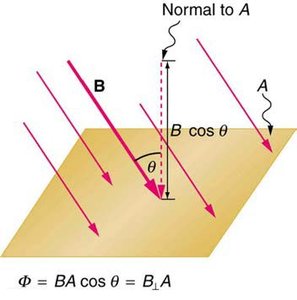
Magnetic flux quantifies the amount of magnetic field passing through a given area. It is a key concept in understanding electromagnetic induction.
Definition: Magnetic flux through an area A in a uniform magnetic field B is given by:
θ: The angle between the magnetic field and the normal (perpendicular) to the surface.
Units: Weber (Wb), where 1 Wb = 1 T·m².
Maximum flux: When θ = 0°, , so .
Zero flux: When θ = 90°, , so .
Faraday’s Law of Induction
Faraday’s Law states that a change in magnetic flux through a circuit induces an emf in the circuit. The induced emf is proportional to the rate of change of the magnetic flux.
Mathematical Formulation:
N: Number of turns in the coil.
The negative sign indicates the direction of the induced emf opposes the change in flux (Lenz’s Law).
Lenz’s Law
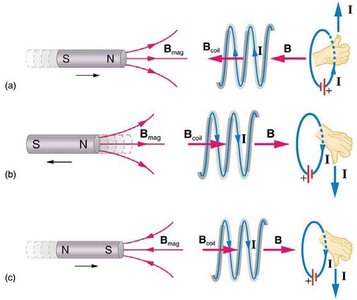
Lenz’s Law determines the direction of the induced current. It states that the induced current will flow in such a direction that its magnetic field opposes the change in the original magnetic flux.
Physical Meaning: The system resists changes in magnetic flux, conserving energy.
Example: If a magnet is moved toward a coil, the induced current creates a magnetic field opposing the magnet’s motion.
Induced emf in a Moving Conductor
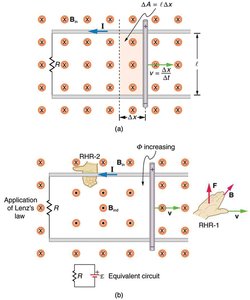
An emf can also be induced when a conductor moves through a magnetic field, or when the area of a loop in a magnetic field changes.
Formula for a straight conductor of length l moving at velocity v perpendicular to B:
General case for changing area:
Electric Generators
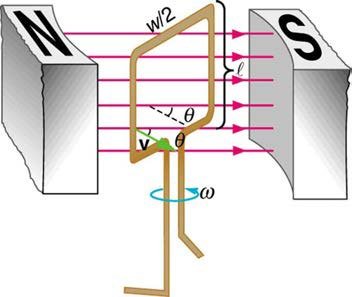
Electric generators convert mechanical energy into electrical energy using electromagnetic induction. A coil is rotated in a magnetic field, causing the magnetic flux through the coil to change and inducing an emf.
Emf induced in a rotating coil:
ω: Angular velocity of the coil (in radians per second).
Peak emf:
Transformers
Transformers use electromagnetic induction to change the voltage of alternating current (AC). They consist of two coils (primary and secondary) wound around a common magnetic core.
Voltage relationship:
Current relationship (assuming ideal transformer):
Applications: Power transmission, adapters, and chargers.
Mutual and Self-Inductance
Inductance is the property of a circuit or coil that opposes changes in current. Mutual inductance occurs between two coils, while self-inductance occurs within a single coil.
Mutual Inductance (M):
Self-Inductance (L):
Unit: Henry (H), where 1 H = 1 Ω·s.
Energy Stored in a Magnetic Field
Inductors store energy in their magnetic field when current flows through them.
Energy stored in an inductor:
LR Circuits
An LR circuit consists of an inductor (L) and a resistor (R) in series. When the circuit is switched on or off, the current changes exponentially with time due to the inductor’s opposition to changes in current.
Time constant:
Current growth (switch on):
Current decay (switch off):
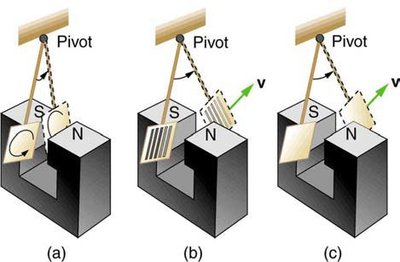
Eddy Currents and Magnetic Damping
Eddy currents are loops of induced current in conductors exposed to changing magnetic fields. These currents can cause energy loss and produce magnetic damping forces that oppose motion.
Applications: Magnetic braking in roller coasters, sorting metals, and sensitive balances.
Summary Table: Key Equations and Concepts
Concept | Equation | Description |
|---|---|---|
Magnetic Flux | Amount of magnetic field through area A | |
Faraday’s Law | Induced emf from changing flux | |
Lenz’s Law | Direction opposes change | Induced current opposes flux change |
Moving Conductor | Emf from motion in B field | |
Transformer | Voltage ratio equals turns ratio | |
Mutual Inductance | Emf in one coil due to another | |
Self-Inductance | Emf in a coil due to its own current change | |
Energy in Inductor | Energy stored in magnetic field | |
LR Circuit Time Constant | Time for current to change significantly |
Additional info: These notes cover the core concepts of Chapter 21: Electromagnetic Induction and Faraday’s Law, including applications, mathematical formulations, and practical examples relevant to college-level Physics with Calculus.
