 Back
BackElectromagnetic Induction and Faraday’s Law: Study Notes
Study Guide - Smart Notes
 Tailored notes based on your materials, expanded with key definitions, examples, and context.
Electromagnetic Induction and Faraday’s Law
Induced EMF and Faraday’s Experiments
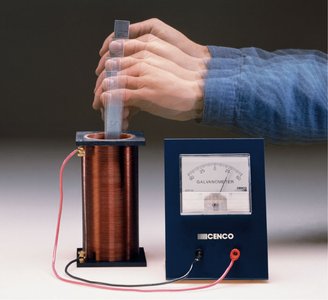
Electromagnetic induction is the process by which a changing magnetic field induces an electromotive force (emf) in a conductor. This phenomenon was first observed by Joseph Henry and Michael Faraday in the early 19th century. Faraday’s experiments demonstrated that a current is induced in a coil of wire when the magnetic flux through the coil changes, either by moving a magnet relative to the coil or by changing the current in a nearby coil.
Key Point 1: A constant magnetic field does not induce a current; only a changing magnetic field does.
Key Point 2: The induced current is called an induced current, and the emf responsible is the induced emf.
Example: Moving a bar magnet into or out of a coil causes the galvanometer to register a current spike, indicating an induced emf.
Faraday’s Law of Induction and Lenz’s Law
Faraday’s law quantifies the induced emf in a circuit as proportional to the rate of change of magnetic flux through the circuit. Lenz’s law states that the direction of the induced emf is such that it opposes the change in magnetic flux that caused it.
Key Point 1: Magnetic flux () is defined as .
Key Point 2: Faraday’s Law: , where is the number of loops.
Key Point 3: Lenz’s Law: The induced current creates a magnetic field that opposes the original change in flux.
Example: If a magnet is moved toward a coil, the induced current opposes the increase in flux; if moved away, it opposes the decrease.
Applications of Electromagnetic Induction
Electromagnetic induction is the basis for many practical devices and technologies.
Key Point 1: Electric generators convert mechanical energy to electrical energy using rotating coils in a magnetic field.
Key Point 2: Transformers use induction to step up or step down AC voltages for power transmission.
Key Point 3: Induction stoves heat metal pans by inducing currents in the pan, which convert electrical energy to heat.
Example: An induction stove heats a metal pan but not a glass container, as only conductors allow induced currents.

Motional EMF and Moving Conductors
An emf can also be induced in a conductor moving through a magnetic field. This is called motional emf and is given by , where is the magnetic field, is the length of the conductor, and is its velocity perpendicular to $B$.
Key Point 1: Motional emf is used in devices such as generators and blood flow meters.
Example: An airplane moving through Earth’s magnetic field develops a potential difference between its wingtips.

Transformers and Power Transmission
Transformers are essential for efficient transmission of electrical power over long distances. They operate on the principle of electromagnetic induction, allowing voltages to be increased (step-up) or decreased (step-down) as needed.
Key Point 1: Transformer Equation: , where and are the secondary and primary voltages, and and are the number of turns in each coil.
Key Point 2: Power transmission at high voltage reduces current and minimizes energy loss due to resistance.
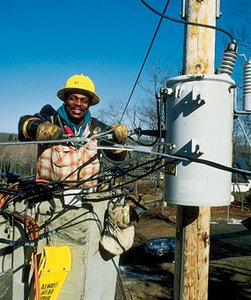
Example: Utility pole transformers step down high transmission voltages to safe levels for home use.
Eddy Currents and Magnetic Damping
Eddy currents are induced currents that flow in conductors exposed to changing magnetic fields. They can cause energy loss as heat but are also used for braking and damping in various applications.
Key Point 1: Eddy currents can be minimized by laminating the core of devices like transformers and motors.
Key Point 2: Magnetic damping is used in devices such as seismographs and metal detectors.
Example: Walk-through metal detectors use electromagnetic induction to detect metal objects via eddy currents.

Information Storage: Magnetic and Semiconductor Devices
Electromagnetic induction is fundamental to the operation of magnetic storage devices such as hard drives and tape recorders. Changing magnetic fields induce signals that can be read and written as data.
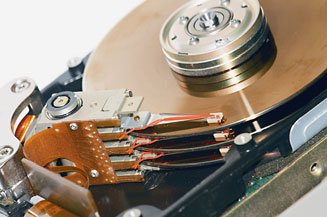
Key Point 1: Hard drives use read/write heads to magnetize and detect changes in the ferromagnetic surface of disks.
Key Point 2: Semiconductor memory (RAM, flash) stores information as electric charge or voltage, often using MOSFET transistors.
Example: The read/write head of a hard drive induces an emf in the coil as the disk rotates, allowing data to be stored and retrieved.
Ground Fault Circuit Interrupters (GFCI)
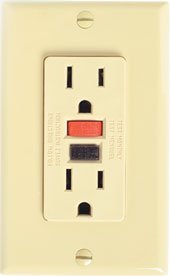
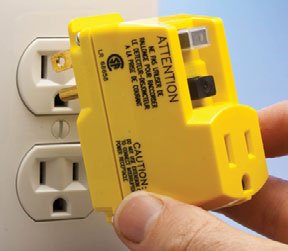
GFCIs are safety devices that use electromagnetic induction to detect differences in current between the hot and neutral wires, indicating a ground fault. When a fault is detected, the GFCI quickly interrupts the circuit to prevent electric shock.
Key Point 1: GFCIs can sense current differences as low as 5 mA and react in 1 ms.
Key Point 2: GFCIs are installed in wall outlets or as plug-in units for appliances.
Example: GFCI wall outlets and plug-in units protect users in kitchens, bathrooms, and outdoor locations.
Additional info: These notes cover the main concepts, applications, and equations related to electromagnetic induction, Faraday’s law, and their practical uses in modern technology and safety devices.
