 Back
BackElectromagnetic Induction and Magnetic Flux: Step-by-Step Physics Guidance
Study Guide - Smart Notes
 Tailored notes based on your materials, expanded with key definitions, examples, and context.
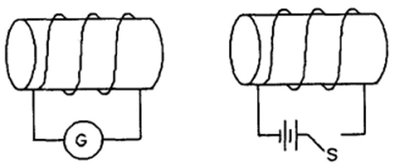
Q3. When the switch is suddenly closed in the right solenoid, which way will the induced current flow through the galvanometer in the left-hand solenoid?
Background
Topic: Electromagnetic Induction (Mutual Induction)
This question tests your understanding of how a changing current in one solenoid induces an emf (and current) in a nearby solenoid, according to Faraday's Law of Induction and Lenz's Law.
Key Terms and Formulas:
Faraday's Law of Induction:
Lenz's Law: The direction of the induced current opposes the change in magnetic flux that caused it.
Magnetic Flux ():
Step-by-Step Guidance
When the switch is closed, current begins to flow in the right solenoid, creating a magnetic field inside it.
This changing magnetic field passes through the left solenoid, increasing the magnetic flux through it.
According to Faraday's Law, an emf is induced in the left solenoid due to the changing flux.
Apply Lenz's Law: The induced current in the left solenoid will flow in a direction that opposes the increase in magnetic flux (i.e., it will try to create a magnetic field opposing the one produced by the right solenoid).
Try solving on your own before revealing the answer!
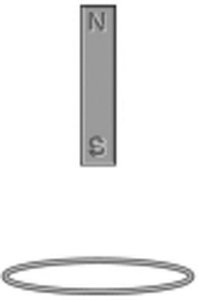
Q5. As a bar magnet (south pole downward) falls toward a horizontal coil, what is the direction of the induced current in the coil as viewed from above?
Background
Topic: Electromagnetic Induction (Lenz's Law)
This question tests your understanding of how a changing magnetic field (due to a moving magnet) induces a current in a coil, and how to determine the direction of that current using Lenz's Law.
Key Terms and Formulas:
Lenz's Law: The induced current will flow in a direction that opposes the change in magnetic flux.
Right-Hand Rule: Used to determine the direction of the induced current based on the direction of the changing magnetic field.
Step-by-Step Guidance
As the south pole of the magnet approaches the coil, the magnetic flux through the coil increases (pointing downward).
The coil will induce a current that creates a magnetic field opposing this increase (i.e., upward through the coil).
Use the right-hand rule: Point your thumb upward (opposing the approaching south pole's field), and your fingers curl in the direction of the induced current as seen from above.
Try solving on your own before revealing the answer!
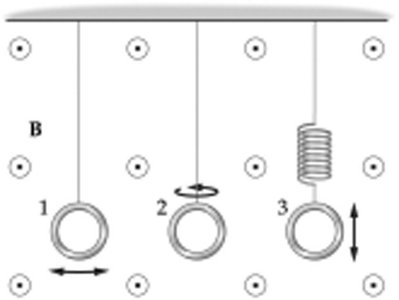
Q7. Which loops will have an emf induced in them as they move in a uniform, time-invariant magnetic field?
Background
Topic: Electromagnetic Induction (Faraday's Law)
This question tests your understanding of when a changing magnetic flux induces an emf in a loop, and how different types of motion affect the flux through the loop.
Key Terms and Formulas:
Faraday's Law:
Magnetic Flux (): Depends on the area, the magnetic field, and the orientation of the loop.
Step-by-Step Guidance
Loop 1 swings back and forth, changing its position but not its orientation relative to the field.
Loop 2 rotates about a vertical axis, changing the angle between the field and the loop's plane (thus changing flux).
Loop 3 oscillates up and down, changing its position in the field but not the orientation or area exposed to the field.
Recall: Only a change in magnetic flux through the loop (by changing area, field strength, or orientation) induces an emf.
Try solving on your own before revealing the answer!
