 Back
BackElectromagnetic Induction and Maxwell's Equations
Study Guide - Smart Notes
 Tailored notes based on your materials, expanded with key definitions, examples, and context.
Chapter 29: Electromagnetic Induction
Introduction to Electromagnetic Induction
Electromagnetic induction is the process by which a changing magnetic field induces an electromotive force (emf) in a conductor. This phenomenon is fundamental to the operation of many electrical devices, including generators, transformers, and card readers. Faraday's law and Lenz's law describe the quantitative and qualitative aspects of induced emf and current.
Faraday's Law: Relates the induced emf to the rate of change of magnetic flux through a loop.
Lenz's Law: Determines the direction of the induced emf, always opposing the change in flux.
Maxwell's Equations: Provide a unified description of electric and magnetic fields.
Experimental Basis of Induction
Early experiments demonstrated that a current is induced in a coil when the magnetic environment changes. The induced current only appears when there is motion or a change in current, not when the system is static.
Moving Magnet: A current is induced in a coil when a magnet is moved toward or away from it.
Relative Motion of Coils: Induced current occurs when two coils move relative to each other, or when the current in one coil changes.
Magnetic Flux
Magnetic flux quantifies the amount of magnetic field passing through a given area. It is a key concept in understanding electromagnetic induction.
Definition: The magnetic flux through an area A is given by .
Units: Weber (Wb).
Orientation: Flux is maximum when the field is perpendicular to the surface and zero when parallel.
Formulas:
For a uniform field and flat surface:
Faraday's Law of Induction
Faraday's law states that the induced emf in a closed loop equals the negative rate of change of magnetic flux through the loop.
Mathematical Form:
Physical Meaning: A changing magnetic flux induces an emf, which can drive a current if the circuit is closed.
For N turns:
Determining the Direction of Induced Emf (Lenz's Law)
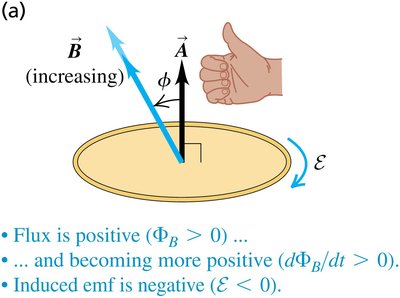
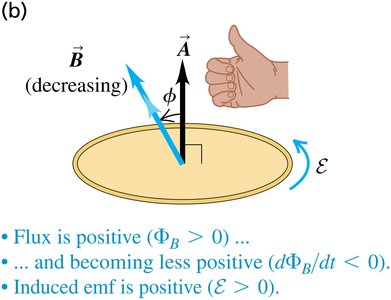
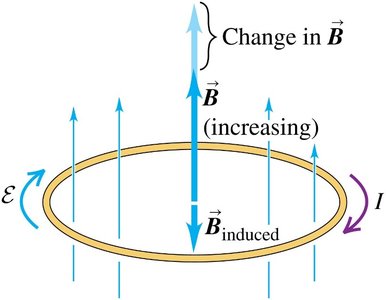
Lenz's law provides a rule for finding the direction of the induced emf: the induced current always opposes the change in magnetic flux that produced it.
Right-Hand Rule: Point your thumb in the direction of the area vector (normal to the loop); the curl of your fingers shows the direction of positive current.
Opposition: If the magnetic flux increases, the induced current creates a field opposing the increase; if it decreases, the induced current supports the original field.
Motional Electromotive Force (emf)
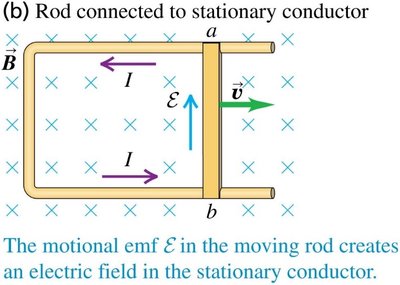
When a conductor moves through a magnetic field, an emf is induced due to the motion. This is called motional emf.
Formula:
Where: v = speed of conductor, B = magnetic field strength, L = length of conductor perpendicular to motion.

Induced Electric Fields
A changing magnetic field induces a circulating electric field, even in the absence of a conductor. This is a key aspect of Faraday's law in its general form.
Faraday's Law (Integral Form):
Physical Meaning: The induced electric field forms closed loops around the changing magnetic flux.


Eddy Currents
Eddy currents are loops of electric current induced within conductors by a changing magnetic field. These currents can cause energy loss but are also used in applications such as metal detectors.
Applications: Metal detectors sense eddy currents in metallic objects.

Displacement Current and Maxwell's Correction
Ampere's law, as originally formulated, is incomplete for situations involving changing electric fields, such as charging a capacitor. Maxwell introduced the concept of displacement current to resolve this issue.
Displacement Current:
Physical Meaning: The changing electric field between capacitor plates acts like a current, producing a magnetic field.


Maxwell's Equations
Maxwell's equations summarize the fundamental laws of electricity and magnetism. They describe how electric and magnetic fields are generated and altered by each other and by charges and currents.
Gauss's Law for Electricity:
Gauss's Law for Magnetism:
Faraday's Law:
Ampere-Maxwell Law:


Superconductivity and the Meissner Effect
Superconductors are materials that exhibit zero electrical resistance below a critical temperature (Tc). When placed in a magnetic field and cooled below Tc, they expel all magnetic flux—a phenomenon known as the Meissner effect.
Critical Temperature: The temperature below which a material becomes superconducting.
Meissner Effect: The expulsion of magnetic flux from a superconductor, making it a perfect diamagnet.
Applications: Magnetic levitation due to the repulsion between a superconductor and a magnet.
Example: High-temperature superconductors can levitate magnets due to the Meissner effect.
Additional info: This guide covers the core concepts of electromagnetic induction, including Faraday's and Lenz's laws, motional emf, induced electric fields, Maxwell's equations, and superconductivity. These topics are essential for understanding the interplay between electricity and magnetism in modern physics and engineering.
