 Back
BackElectromagnetic Induction and Motional EMF: Step-by-Step Study Guidance
Study Guide - Smart Notes
 Tailored notes based on your materials, expanded with key definitions, examples, and context.
Q1. A 10-cm-long wire is pulled along a U-shaped conducting rail in a perpendicular magnetic field. The total resistance of the wire and rail is 0.20 Ω. Pulling the wire with a force of 1.0 N causes 4.0 W of power to be dissipated in the circuit. (a) What is the speed of the wire when pulled with a force of 1.0 N? (b) What is the strength of the magnetic field?
Background
Topic: Motional EMF and Energy Conservation in Magnetic Fields
This question tests your understanding of how a moving conductor in a magnetic field generates an emf (motional emf), and how mechanical work is converted into electrical energy (power dissipated in the resistor). It also involves using the relationships between force, velocity, power, and the properties of the magnetic field.
Key Terms and Formulas
Motional emf:
Ohm's Law:
Power dissipated:
Force on the wire:
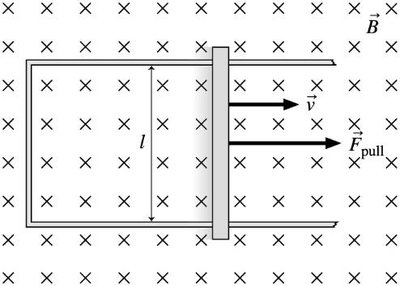
Step-by-Step Guidance
Start by recognizing that the mechanical power supplied by the pulling force is equal to the electrical power dissipated in the resistor: .
Rearrange this equation to solve for the speed of the wire: .
Next, recall that the motional emf generated is , where is the length of the wire in the field.
Use Ohm's law to relate the emf to the current: .
Recall that the force required to pull the wire at constant speed is . Substitute the expression for from the previous step into this equation.
Combine the equations to solve for the magnetic field in terms of the known quantities (, , , ).
Try solving on your own before revealing the answer!
Final Answers:
(a)
(b)
We used the relationships between power, force, and velocity for part (a), and combined the motional emf and force equations for part (b).
