 Back
BackElectromagnetic Induction and Related Phenomena: Study Notes
Study Guide - Smart Notes
 Tailored notes based on your materials, expanded with key definitions, examples, and context.
Electromagnetic Induction
Introduction to Electromagnetic Induction
Electromagnetic induction is the process by which a changing magnetic field induces an electromotive force (emf) in a conductor. This phenomenon is fundamental to the operation of many electrical devices, including generators, transformers, and card readers. Faraday's law and Lenz's law provide the theoretical framework for understanding induced currents and emf.
Key Concept: A changing magnetic flux through a loop induces an emf in the loop.
Application: Devices such as card readers at gas stations rely on the rapid movement of a magnetic strip to induce a readable signal.

Induction Experiments
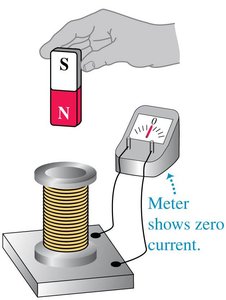
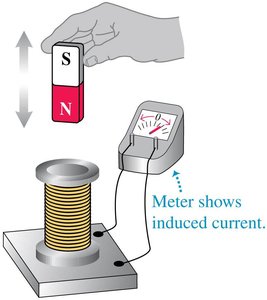
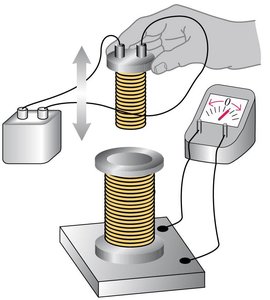
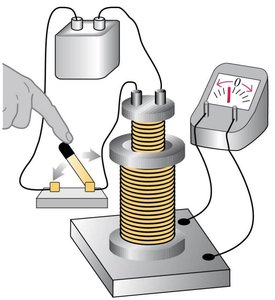
Early experiments demonstrated that a current is induced in a coil only when there is a change in the magnetic environment of the coil. This can be achieved by moving a magnet relative to the coil or by changing the current in a nearby coil.
Stationary Magnet: No current is induced when the magnet is stationary relative to the coil.
Moving Magnet: Current is induced only while the magnet is moving.
Changing Current in Nearby Coil: Induced current appears only when the current in the second coil is changing.
Magnetic Flux
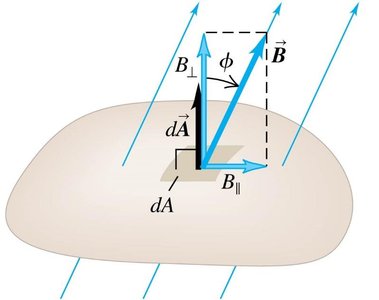
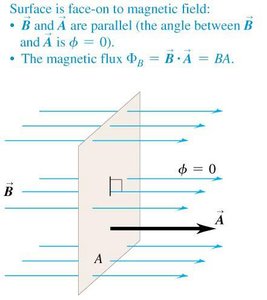
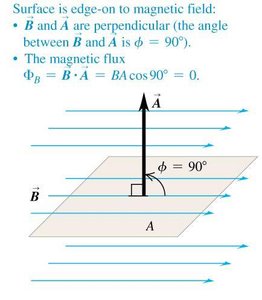
Magnetic flux quantifies the amount of magnetic field passing through a given area. It is a scalar quantity defined as the surface integral of the magnetic field over the area.
Definition:
Units: Weber (Wb), where
Orientation: The flux is maximum when the surface is perpendicular to the field and zero when parallel.
Faraday's Law of Induction
Faraday's law states that the induced emf in a closed loop equals the negative rate of change of magnetic flux through the loop. This law is the foundation of electromagnetic induction.
Mathematical Form:
Physical Meaning: The induced emf opposes the change in magnetic flux.

Determining the Direction of Induced Emf (Lenz's Law)
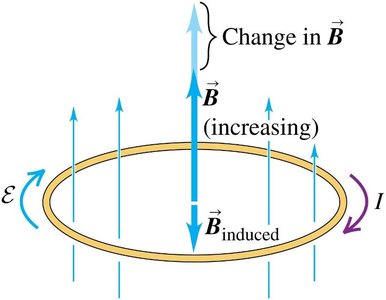
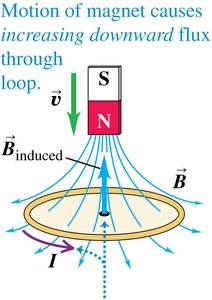
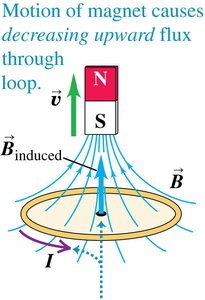
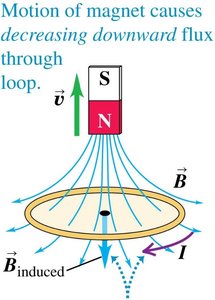
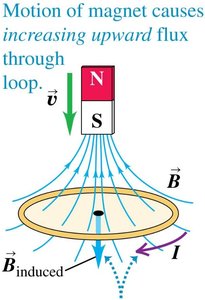
Lenz's law provides a rule for determining the direction of the induced emf and current: the induced current always flows in a direction that opposes the change in magnetic flux that produced it.
Opposition Principle: The induced magnetic field opposes the change in the original magnetic field.
Right-Hand Rule: Used to determine the direction of induced current based on the change in flux.
Faraday's Law for a Coil
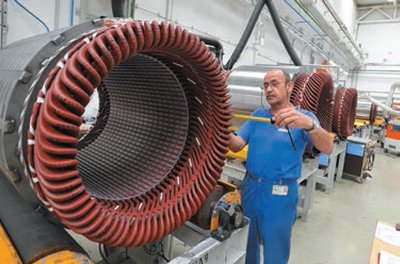
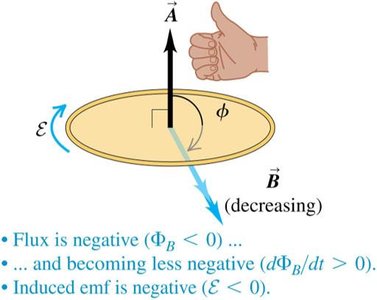
For a coil with identical turns, the total induced emf is $N$ times the emf induced in a single loop, provided the flux changes at the same rate through each turn.
Equation:
Application: Used in alternators and generators to produce large emf values.
Motional Electromotive Force (emf)
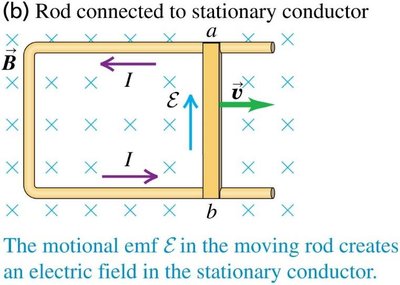
When a conductor moves through a magnetic field, an emf is induced due to the motion. This is called motional emf and is given by the product of the magnetic field, the length of the conductor, and its velocity perpendicular to the field.
Equation:
Direction: Determined by the right-hand rule.

Induced Electric Fields
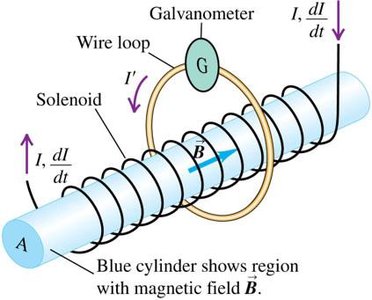
A changing magnetic flux induces a circulating electric field, even in the absence of a conductor. This is a key distinction from electrostatic fields, which are conservative.
Faraday's Law (Integral Form):
Application: Explains the operation of transformers and inductors.

Eddy Currents
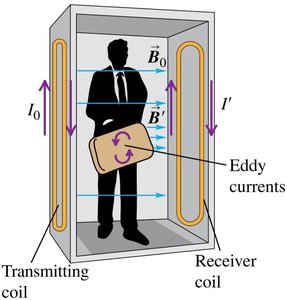
Eddy currents are loops of electric current induced within conductors by a changing magnetic field. These currents can cause energy loss due to resistive heating but are also used in applications such as metal detectors.
Key Point: Eddy currents oppose the change in magnetic flux, consistent with Lenz's law.
Application: Used in electromagnetic braking and induction heating.
Displacement Current and Maxwell's Equations
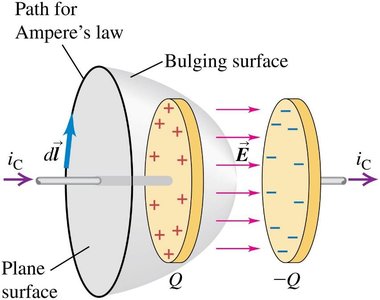
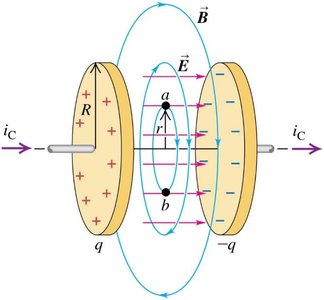
Maxwell introduced the concept of displacement current to resolve inconsistencies in Ampère's law, particularly in situations involving changing electric fields, such as charging a capacitor. This addition led to the unification of electricity and magnetism in Maxwell's equations.
Displacement Current:
Maxwell's Equations: Four fundamental equations describing all classical electromagnetic phenomena.


Superconductivity and the Meissner Effect
Superconductors are materials that exhibit zero electrical resistance below a critical temperature. When placed in a magnetic field and cooled below this temperature, they expel all magnetic flux—a phenomenon known as the Meissner effect. This makes superconductors perfect diamagnets and enables phenomena such as magnetic levitation.
Critical Temperature (): The temperature below which a material becomes superconducting.
Meissner Effect: Complete expulsion of magnetic flux from the interior of a superconductor.
Application: Magnetic levitation and lossless power transmission.
Sample Problems and Applications
Problem 1: Rotating Coil in Earth's Magnetic Field
Given: Coil with 210 turns, area , rotated in , Earth's field .
Find: Initial and final magnetic flux, average induced emf.
Solution:
Initial flux:
Final flux: (plane parallel to field)
Average emf:
Problem 2: Induced Current in a Loop
Given: Circular loop, radius , resistance , magnetic field decreases at .
Find: Direction of induced current (counterclockwise), rate of energy dissipation ().
Problem 3: Force on a Moving Loop
Given: Rectangular loop, dimensions , resistance , speed , .
Find: Magnitude of force (), direction (left).
Problem 4: Induced Electric Field in a Ring
Given: Metal ring, diameter , field decreases at .
Find: Induced electric field (), current direction (counterclockwise).
Problem 5: Displacement Current in a Capacitor
Given: Parallel-plate capacitor, plate radius , conduction current .
Find: Displacement current density (), rate of change of electric field (), induced magnetic field at () and ().
Additional info: These notes cover the core concepts of electromagnetic induction, including Faraday's law, Lenz's law, motional emf, induced electric fields, eddy currents, displacement current, Maxwell's equations, and superconductivity. The included problems illustrate practical applications and reinforce theoretical understanding.
