 Back
BackElectromagnetic Induction: Faraday’s Law, Lenz’s Law, and Applications
Study Guide - Smart Notes
 Tailored notes based on your materials, expanded with key definitions, examples, and context.
Electromagnetic Induction
Introduction to Electromagnetism
Electromagnetism describes the relationship between electric charges and magnetic fields. Electric charges create electric fields, and moving electric charges (currents) generate magnetic fields. The interplay between these fields is foundational to understanding electromagnetic induction, a phenomenon first systematically studied by Michael Faraday in the 1830s.
Electric charge creates electric fields (as described by Gauss’s Law).
Moving electric charge (current) creates magnetic fields (as described by Ampère’s Law).
Magnetic charge does not exist (Gauss’s Law for Magnetism).
Faraday discovered that a changing magnetic field can induce an electric field, leading to the phenomenon of induced emf and induced current.
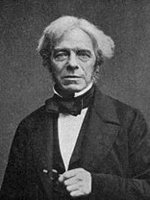
Faraday’s Experiments and the Discovery of Induced EMF
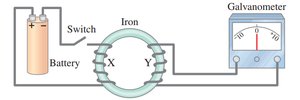
Faraday’s experiments demonstrated that a steady magnetic field does not induce a current in a nearby circuit. However, when the magnetic field changes (such as when a switch is turned on or off), a current is observed. This effect is called electromagnetic induction.
Induced emf is the voltage generated by a changing magnetic field.
Induced current is the current resulting from the induced emf.
A steady magnetic field produces no current; only a changing field does.
Faraday’s Law of Induction
Magnetic Flux
Faraday found that the magnitude of the induced emf is proportional to the rate of change of magnetic flux through a circuit. Magnetic flux quantifies the amount of magnetic field passing through a given area.
Magnetic flux (\( \Phi_B \)) through an area \( A \) is defined as:
Where \( \vec{B} \) is the magnetic field and \( d\vec{A} \) is an infinitesimal area vector perpendicular to the surface.
Faraday’s Law
Faraday’s Law states that the induced emf in a closed loop equals the negative rate of change of magnetic flux through the loop:
The negative sign indicates the direction of the induced emf opposes the change in flux (Lenz’s Law).
Lenz’s Law
Lenz’s Law provides the direction of the induced current: the induced current flows in such a way that its magnetic field opposes the change in the original magnetic flux.
"A current produced by an induced emf moves in a direction so that the magnetic field created by that current opposes the original change in flux."
Visualizing Faraday’s Law
If the magnetic field through a loop increases, the induced current creates a magnetic field that opposes this increase. If the field decreases, the induced current acts to maintain the original flux.
Use the right-hand rule to determine the direction of the induced current.
Examples: Determining Induced Current Direction
If a loop leaves a magnetic field (flux decreases), the induced current flows to increase the field (counter-clockwise if the field is into the page).
If a loop shrinks in a magnetic field (area decreases, flux decreases), the induced current flows to increase the field (clockwise if the field is into the page).
Applications and Examples of Faraday’s Law
Motional EMF
When a conductor moves through a magnetic field, an emf is induced across its ends. This is called motional emf. The emf generated is given by:
Where \( B \) is the magnetic field strength, \( \ell \) is the length of the conductor, and \( v \) is its velocity perpendicular to the field.

Electric Generators: AC and DC
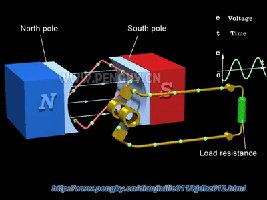
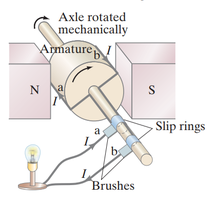
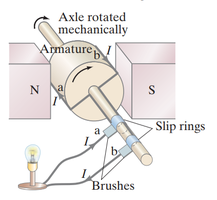
Electric generators convert mechanical energy into electrical energy using electromagnetic induction. There are two main types:
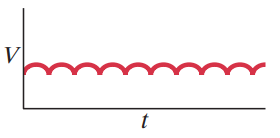
AC Generators (Alternators): Use slip rings to produce alternating current as the coil rotates in a magnetic field.
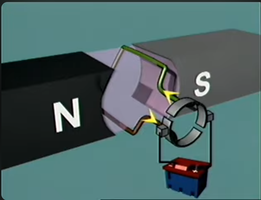
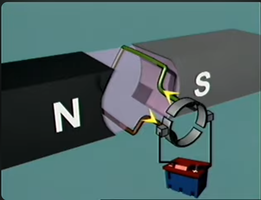
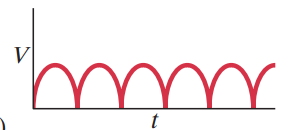
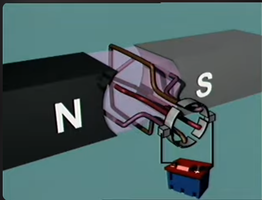
DC Generators: Use a split-ring commutator to produce direct current, ensuring current flows in one direction.
Back EMF
When a device like a motor operates, the changing magnetic field it produces can induce an emf that opposes the applied voltage. This is called back emf and is important in the operation and efficiency of electric motors.
Eddy Currents and Magnetic Damping
When a bulk conductor moves through a changing magnetic field, circulating currents called eddy currents are induced. These currents create magnetic fields that oppose the motion, leading to magnetic damping.
Eddy currents are responsible for energy loss in transformers and electric motors, but are also used in applications like electromagnetic braking.

Transformers
Transformers use electromagnetic induction to increase or decrease AC voltages. They consist of primary and secondary coils wound around a common core. The voltage ratio is proportional to the ratio of turns in the coils:
Where \( V_s \) and \( V_p \) are the secondary and primary voltages, and \( N_s \) and \( N_p \) are the number of turns in the secondary and primary coils, respectively.
Faraday’s Law: Relation to Electric Field
Faraday’s Law can be expressed in terms of the electric field generated by a changing magnetic field. The induced emf around a closed loop equals the line integral of the electric field:
This shows that a changing magnetic field produces a non-conservative electric field, which drives the induced current.
Summary Table: Key Laws and Equations
Law/Concept | Equation | Description |
|---|---|---|
Magnetic Flux | Amount of magnetic field through an area | |
Faraday’s Law | Induced emf equals negative rate of change of flux | |
Motional emf | Emf induced in a moving conductor | |
Transformer Equation | Voltage ratio equals turns ratio |
Conclusion
Electromagnetic induction is a cornerstone of modern physics and technology, underlying the operation of generators, transformers, and many electrical devices. Faraday’s and Lenz’s Laws provide the quantitative and qualitative framework for understanding how changing magnetic fields produce electric currents and voltages.
