Back
BackElectromagnetic Induction: Magnetic Flux, Faraday’s Law, and Lenz’s Law
Study Guide - Smart Notes
 Tailored notes based on your materials, expanded with key definitions, examples, and context.
Magnetic Flux
Definition and Calculation
Magnetic flux (Φ) quantifies the amount of magnetic field (\(\vec{B}\)) passing through a given surface area (A). It is a fundamental concept in electromagnetism, especially in the study of electromagnetic induction.
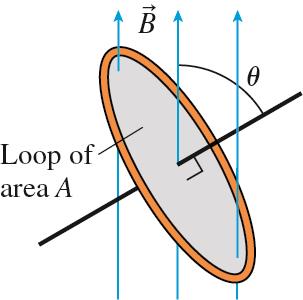
Formula: The magnetic flux through a surface is given by: where:
B = magnitude of the magnetic field (in teslas, T)
A = area of the surface (in m2)
\(\theta\) = angle between the magnetic field and the normal (perpendicular) to the surface
Units: The SI unit of magnetic flux is the weber (Wb).
Interpretation: Maximum flux occurs when the field is perpendicular to the surface (\(\theta = 0\)), and zero flux when the field is parallel (\(\theta = 90^\circ\)).
Example: Magnetic Flux through a Horizontal Loop
A 10-cm-diameter circular loop lies flat on a table. If the Earth's magnetic field is tipped at 60° below horizontal, the flux through the loop can be calculated using the formula above.
Comparing Magnetic Flux in Different Loops
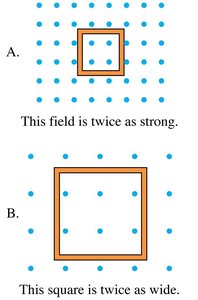
Magnetic flux depends on both the strength of the magnetic field and the area of the loop.
For two loops, one with twice the area and one in a field twice as strong, the flux can be compared by calculating \(\Phi\) for each.
Electromagnetic Induction
Faraday’s Experiments
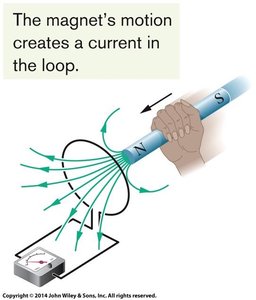
Michael Faraday discovered that a changing magnetic flux through a conducting loop induces an electromotive force (emf) and, consequently, a current in the loop. This phenomenon is known as electromagnetic induction.
Experiment 1: Moving Magnet and Loop
A current is induced in a loop only when there is relative motion between the loop and a magnet.
The direction of the induced current depends on the direction of motion and the pole of the magnet.
Faster motion produces a greater current.
Experiment 2: Changing Current in a Nearby Loop
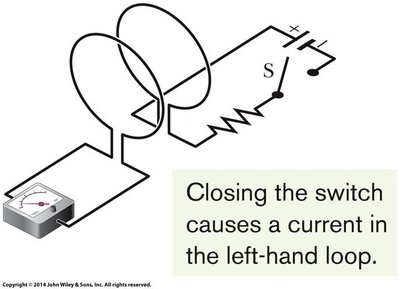
When two loops are placed close together, changing the current in one loop (by opening or closing a switch) induces a current in the other loop.
No current is induced if the current in the first loop is steady.
Faraday’s Law of Induction
Faraday’s law quantifies the induced emf (\(\varepsilon\)) in a loop due to a changing magnetic flux:
Faraday’s Law:
The negative sign indicates the direction of the induced emf opposes the change in flux (Lenz’s law).
For a coil with N turns:
Induced Current: The induced current is given by Ohm’s law: where R is the resistance of the loop.
Example: Induced Current in an MRI Bracelet
A copper bracelet (diameter 6.0 cm, resistance 0.010 Ω) is exposed to a magnetic field that decreases from 1.00 T to 0.40 T in 1.2 s. The induced emf and current can be found using Faraday’s law and Ohm’s law.
Lenz’s Law
Determining the Direction of Induced Current
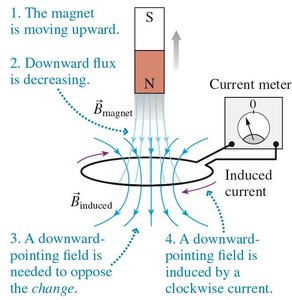
Lenz’s law states that the direction of the induced current in a closed loop is always such that the induced magnetic field opposes the change in magnetic flux that produced it.
Summary: The induced current creates a magnetic field that opposes the change in the original magnetic flux.
Application: If the magnetic flux through a loop increases, the induced current produces a field opposing the increase. If the flux decreases, the induced current produces a field that tries to maintain the original flux.
QuickCheck: Direction of Induced Current
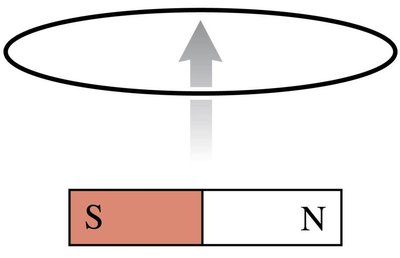
When a bar magnet is pushed toward the center of a wire loop, the direction of the induced current can be determined using Lenz’s law.