Back
BackElectromagnetic Induction: Magnetic Flux, Faraday’s Law, and Lenz’s Law
Study Guide - Smart Notes
 Tailored notes based on your materials, expanded with key definitions, examples, and context.
Magnetic Flux
Definition and Calculation
Magnetic flux (Φ) quantifies the total magnetic field (B) passing through a given surface area (A). It is a fundamental concept in electromagnetism, especially in the study of electromagnetic induction.
Magnetic Flux (Φ): The product of the magnetic field, the area it penetrates, and the cosine of the angle (θ) between the field and the normal to the surface.
Formula:
$ \Phi = B A \cos \theta $
Units: Weber (Wb) in SI units.
Angle θ: The angle between the magnetic field direction and the normal (perpendicular) to the surface.
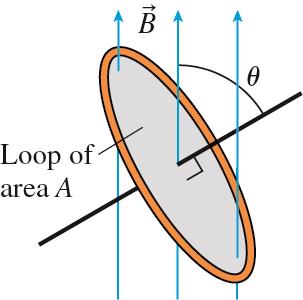
Example: For a circular loop of diameter 10 cm lying flat on a table, with Earth's magnetic field tipped at 60° below horizontal, the flux is calculated using the above formula.
Comparing Magnetic Flux in Different Loops
The magnetic flux through a loop depends on both the strength of the magnetic field and the area of the loop. If either the field or the area increases, the flux increases proportionally.
Key Point: Doubling the area or doubling the field strength will double the flux, all else being equal.
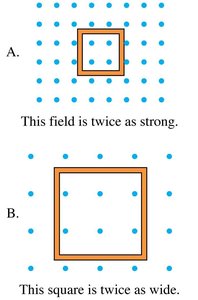
Example: If one loop is twice as wide (so its area is four times larger) but the other loop is in a field twice as strong, the actual flux must be calculated for each to determine which is larger.
Electromagnetic Induction: Faraday’s Experiments
Faraday’s First Experiment: Moving Magnet and Loop
Michael Faraday discovered that a current is induced in a closed conducting loop when there is relative motion between the loop and a magnet. This phenomenon is called electromagnetic induction.
Key Observations:
A current appears only when the magnet and loop move relative to each other.
Faster motion produces a greater current.
The direction of the induced current depends on the direction of motion and the pole of the magnet.
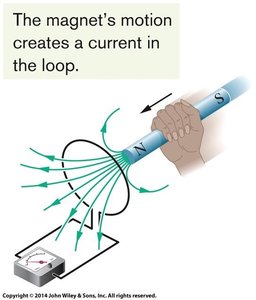
Example: Moving the north pole of a magnet toward a loop induces a current in one direction; moving it away reverses the current.
Faraday’s Second Experiment: Changing Current in Nearby Loop
Faraday also found that a changing current in one loop can induce a current in a nearby loop, even if they are not physically connected. This is due to the changing magnetic field produced by the first loop.
Key Observations:
An induced current appears in the second loop only when the current in the first loop is changing (turning on or off).
No induced current is observed when the current in the first loop is steady.
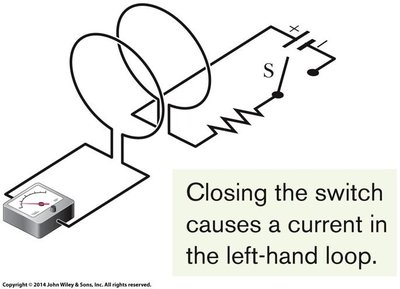
Example: Closing a switch to start current in one loop induces a brief current in a nearby loop; opening the switch induces a current in the opposite direction.
Faraday’s Law of Electromagnetic Induction
Statement and Formula
Faraday’s law quantifies the induced electromotive force (emf) in a loop due to a changing magnetic flux.
Faraday’s Law: The magnitude of the induced emf (ε) is equal to the rate of change of magnetic flux through the loop.
$ \epsilon = - \frac{\Delta \Phi}{\Delta t} $
For a coil with N turns:
$ \epsilon_{\text{coil}} = -N \frac{\Delta \Phi}{\Delta t} $
Direction: The negative sign indicates the direction of the induced emf opposes the change in flux (Lenz’s law).
Units: Volts (V).
Example: Induced Current in an MRI Bracelet
Given: A copper bracelet (diameter 6.0 cm, resistance 0.010 Ω) in a solenoid where the magnetic field decreases from 1.00 T to 0.40 T in 1.2 s.
Find: The magnitude and direction of the induced current.
Solution Steps:
Calculate the change in magnetic flux: $ \Delta \Phi = \Delta B \cdot A $
Find the induced emf: $ \epsilon = - \frac{\Delta \Phi}{\Delta t} $
Calculate the induced current: $ I = \frac{\epsilon}{R} $
Additional info: The direction of the current is determined by Lenz’s law, which states it will oppose the decrease in magnetic field.
Lenz’s Law
Determining the Direction of Induced Current
Lenz’s law provides the rule for the direction of the induced current in a closed loop. It states that the induced current will always flow in such a way as to oppose the change in magnetic flux that produced it.
Lenz’s Law: The direction of the induced current is such that the magnetic field it creates opposes the change in the original magnetic flux.
Physical Meaning: This is a consequence of the conservation of energy and ensures that induced currents always resist the change in magnetic environment.
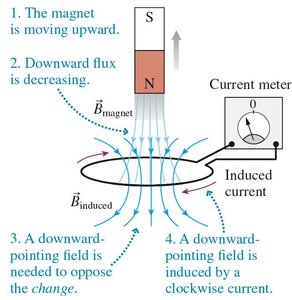
Example: If a bar magnet is pushed toward the center of a wire loop, the induced current will create a magnetic field opposing the approach of the magnet.
Application: QuickCheck Example
Scenario: A bar magnet is pushed toward a wire loop.
Question: What is the direction of the induced current?
Answer: The induced current will be in the direction that creates a magnetic field opposing the motion of the magnet (clockwise or counterclockwise, depending on the orientation).