 Back
BackElectromagnetic Induction: Principles, Laws, and Applications
Study Guide - Smart Notes
 Tailored notes based on your materials, expanded with key definitions, examples, and context.
Chapter 21: Electromagnetic Induction
Introduction to Electromagnetic Induction
Electromagnetic induction is a fundamental phenomenon in physics where a changing magnetic field induces an electromotive force (emf) in a conductor. This principle underlies many technologies in daily life and medicine, such as credit card readers, transformers, and medical imaging devices.
Daily Life Examples: Credit card readers, power transformers, and parking lot exit gates utilize electromagnetic induction to function.
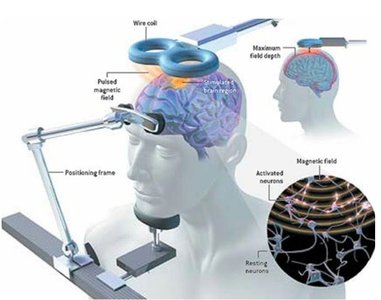
Medical Applications: Magnetic Resonance Imaging (MRI), Transcranial Magnetic Stimulation (TMS), and electromagnetic flow meters rely on induced currents and magnetic fields.
Induction Experiments
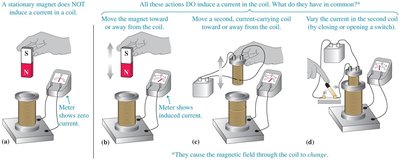
Experiments demonstrate that a current is induced in a coil when there is relative motion between a magnet and the coil, or when the magnetic field through the coil changes. This induced current is called an induced emf.
Moving a magnet toward or away from a coil induces a current.
Moving the coil relative to a stationary magnet also induces a current.
Replacing the magnet with a second coil (connected to a battery) and moving it induces current only during motion.
Induced emf arises from changes in magnetic flux through the coil.
Magnetic Flux
Definition and Calculation
Magnetic flux quantifies the number of magnetic field lines passing through a given surface. It is analogous to electric flux and is closely related to the orientation of the surface with respect to the magnetic field.
Formula:
Units: Weber (Wb), where
is the angle between the normal to the surface and the magnetic field direction.
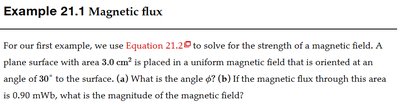
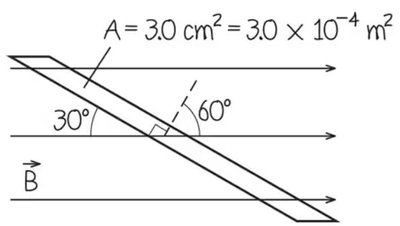
Example: For a surface of area in a uniform magnetic field at to the surface, the flux is calculated using the above formula.
Effect of Coil Shape on Flux
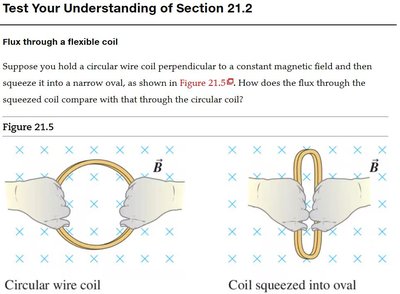
Changing the shape of a wire coil (e.g., squeezing a circular coil into an oval) alters the area and thus the magnetic flux through the coil, assuming the magnetic field remains constant.
Faraday’s Law of Induction
Statement and Mathematical Formulation
Faraday’s Law states that the magnitude of the induced emf in a circuit is equal to the absolute value of the time rate of change of magnetic flux through the circuit.
Formula:
For a coil with turns:
The emf exists only while the flux is changing (due to changes in magnetic field, orientation, or area).
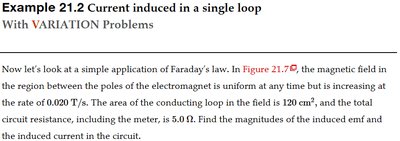
Example 21.2: Calculating induced emf and current in a single loop with changing magnetic field.
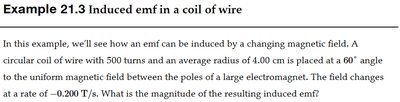
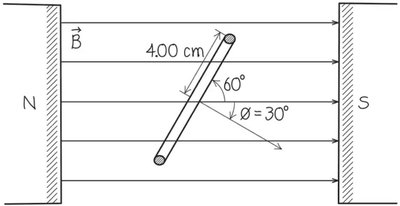
Example 21.3: Induced emf in a coil of wire with multiple turns and a changing magnetic field.
Lenz’s Law
Direction of Induced emf and Current
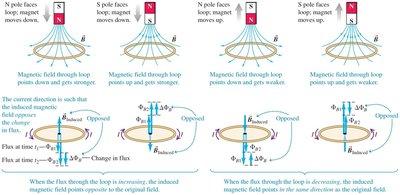
Lenz’s Law provides the direction of the induced emf and current: the induced current opposes the change in magnetic flux that produced it. This is a consequence of the conservation of energy.
If the magnetic flux through a loop increases, the induced current creates a magnetic field opposing the increase.
If the flux decreases, the induced current creates a field that tries to maintain the original flux.
Motional Electromotive Force (emf)
Concept and Calculation
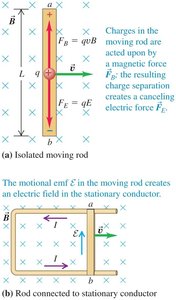
A motional emf is generated when a conductor moves through a magnetic field, causing charge separation and a potential difference across the conductor.
Magnetic force on charge:
Potential difference across the rod:
When the rod forms part of a closed circuit, a current is established due to the motional emf:
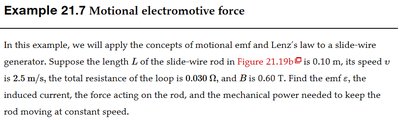
Example 21.7: Application of motional emf and Lenz’s law in a slide-wire generator, including calculation of emf, current, force, and mechanical power.
Magnetic Field Energy
Energy Storage in Inductors
Inductors store energy in their magnetic fields when current flows through them, analogous to capacitors storing energy in electric fields.
Energy stored in a capacitor:
Energy density in an electric field:
Energy stored in an inductor:
Energy density in a magnetic field:
Unit of inductance: Henry (H)

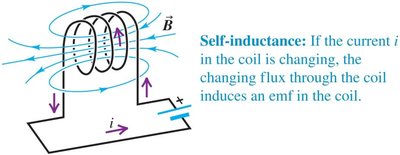
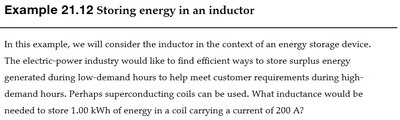
Example 21.12: Calculating the inductance required to store a specified amount of energy in a coil carrying a given current.
Additional info: The notes above include expanded academic context, definitions, and examples to ensure completeness and clarity for college-level physics students. All images included are directly relevant to the adjacent explanations and reinforce the concepts discussed.
