 Back
BackElectromagnetic Induction, Wave Optics, and Interference Patterns
Study Guide - Smart Notes
 Tailored notes based on your materials, expanded with key definitions, examples, and context.
Electromagnetic Induction
Faraday's Law and Motional EMF
Electromagnetic induction describes how a changing magnetic field can induce an electromotive force (EMF) and, consequently, a current in a conductor. This phenomenon is governed by Faraday's Law of Induction and is foundational for understanding electric generators and transformers.
Faraday's Law: The induced EMF in a closed loop equals the negative rate of change of magnetic flux through the loop.
Magnetic Flux (\(\Phi_B\)): Measures the amount of magnetic field passing through a given area. \(\Phi_B = \vec{B} \cdot \vec{A} = BA \cos \theta\)
Motional EMF: When a conductor of length \(L\) moves with velocity \(v\) perpendicular to a magnetic field \(B\), the induced EMF is \(\varepsilon = vBL\).
Lenz's Law: The direction of the induced current opposes the change in magnetic flux that produced it.
Key Equations:
(for a straight conductor moving in a uniform field)
Example: A metal rod of length \(L\) moves at velocity \(v\) through a magnetic field \(B\), generating a potential difference \(V = vBL\) across its ends.
Energy Conservation in Induction
When a current is induced in a conductor, energy is conserved. The mechanical work done to move the conductor is converted into electrical energy, which may be dissipated as heat in the circuit's resistance.
Power Input:
Power Dissipated:
For steady motion,
Applications: Generators
Electric generators convert mechanical energy into electrical energy by rotating wire loops in magnetic fields, producing alternating current (AC).
Wave Optics and Interference
Nature of Light
Light exhibits both particle and wave properties. As a wave, it is described by oscillating electric and magnetic fields, and as a particle, it consists of photons with energy .
Wavelength (\(\lambda\)): Distance between successive wave crests.
Frequency (\(f\)): Number of cycles per second.
Speed of Light: m/s, with
Reflection and Refraction
When light encounters an interface between two media, it can reflect or refract (bend). The laws governing these phenomena are:
Law of Reflection: Angle of incidence equals angle of reflection ().
Snell's Law (Refraction):
Mirrors and Lenses
Mirrors form images by reflection, while lenses form images by refraction. The mirror and lens equations relate object distance, image distance, and focal length:
Mirror/Lens Equation:
Magnification:
Wave Interference and Diffraction
Principle of Superposition
When two or more waves overlap, their amplitudes add. This can result in constructive interference (amplitudes reinforce) or destructive interference (amplitudes cancel).
Double-Slit Interference
When light passes through two slits, it creates an interference pattern of bright and dark fringes due to path length differences.
Constructive Interference (Bright Fringes):
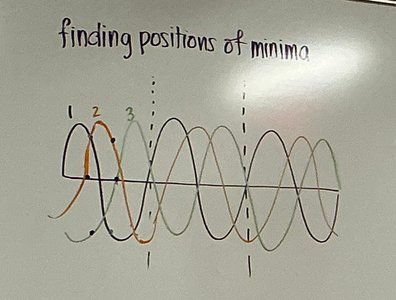
Destructive Interference (Dark Fringes):
Where is slit separation, is the angle from the central maximum, is an integer (order of the fringe).
Example: The position of the -th bright fringe on a screen a distance away is .
Diffraction Gratings
Multiple slits produce sharper and more widely separated interference maxima. The condition for maxima is similar to the double-slit case but with more slits, resulting in higher resolving power.
Resolving Power: (where is the number of slits, is the order)
Diffraction and the Rayleigh Criterion
Diffraction is the bending of light around obstacles or through narrow openings. The Rayleigh criterion sets the limit for resolving two point sources:
First Minimum (Single Slit): (where is slit width, )
Rayleigh Criterion: (for a circular aperture of diameter )
Interference Patterns and Color Separation
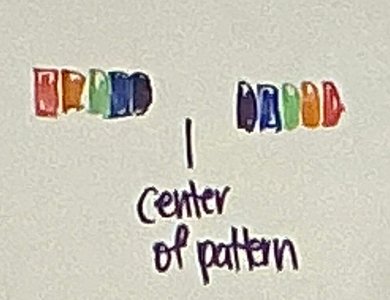
Interference patterns can separate light into its constituent colors, with violet light closer to the center and red light further away in the pattern.
Thin Film Interference
When light reflects off thin films, such as soap bubbles, constructive and destructive interference can enhance or diminish certain colors. The condition for constructive interference is:
(where is the refractive index, is film thickness, is an integer)
Summary Table: Key Equations in Wave Optics and Induction
Phenomenon | Key Equation | Variables |
|---|---|---|
Faraday's Law | = magnetic flux | |
Motional EMF | = velocity, = field, = length | |
Double-Slit Interference | = slit separation, = order | |
Single-Slit Diffraction | = slit width | |
Rayleigh Criterion | = aperture diameter | |
Thin Film Interference | = refractive index, = thickness |
