 Back
BackElectromagnetic Waves and Geometric Optics: College Physics Study Notes
Study Guide - Smart Notes
 Tailored notes based on your materials, expanded with key definitions, examples, and context.
Electromagnetic Waves
Production and Nature of Electromagnetic Waves
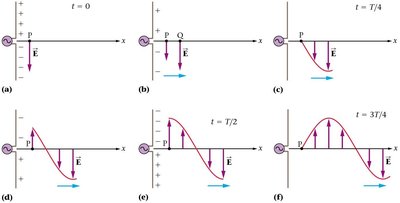
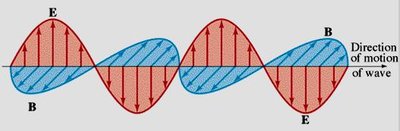
Electromagnetic (EM) waves are produced by accelerating electric charges. These waves consist of oscillating electric and magnetic fields that propagate through space, even in a vacuum. The electric field (E) and magnetic field (B) are always perpendicular to each other and to the direction of wave propagation.
Stationary charge creates an electric field.
Moving charge creates a magnetic field.
Accelerating charge creates electromagnetic waves.
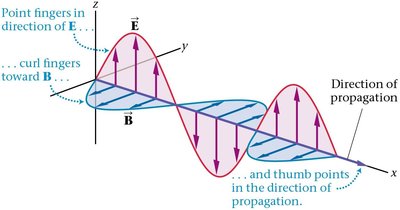
Right-Hand Rule: Point your fingers in the direction of E, curl them toward B, and your thumb points in the direction of propagation.
Historical Development
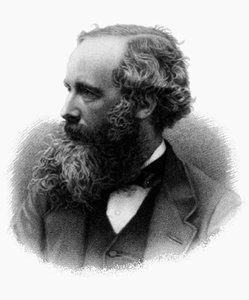
James Clerk Maxwell unified electricity and magnetism, predicting that light is an electromagnetic wave. Heinrich Hertz experimentally confirmed the existence of EM waves.
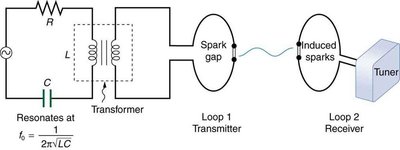
Properties of Electromagnetic Waves
Transverse nature: E and B fields oscillate perpendicular to each other and to the direction of propagation.
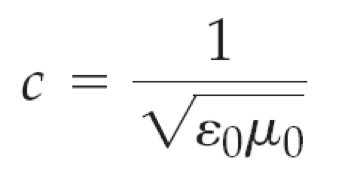
Speed in vacuum:
Relationship:
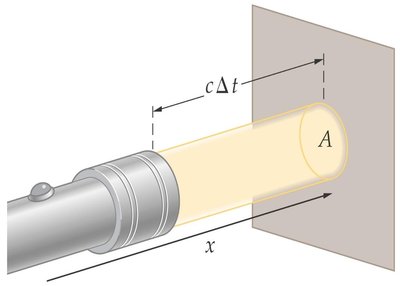
Energy transport: EM waves carry energy and momentum, exerting pressure on surfaces.
Intensity: , where is intensity, is power, is area.

Relationship between E and B:
Intensity in terms of E:
The Electromagnetic Spectrum
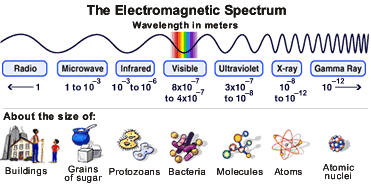
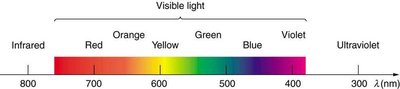
The electromagnetic spectrum encompasses all EM waves, classified by wavelength and frequency. All EM waves travel at the same speed in vacuum, so .
Radio waves: to Hz
Microwaves: to Hz
Infrared: to Hz
Visible light: to Hz
Ultraviolet: to Hz
X-rays: to Hz
Gamma rays: Hz
Applications and Examples
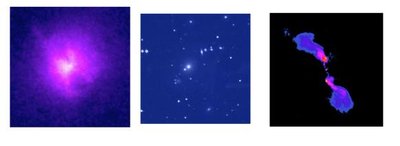
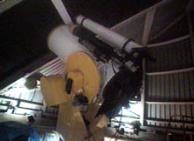
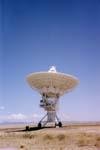
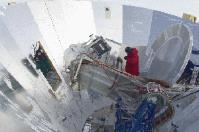
Astronomy: Different telescopes are used to observe different wavelengths, revealing various physical processes in celestial objects.
Doppler Effect for Light
The Doppler effect describes the change in observed frequency and wavelength due to the relative motion of the source and observer.
Moving toward observer: Observed frequency increases (blueshift), wavelength decreases.
Moving away: Observed frequency decreases (redshift), wavelength increases.
Redshift formula:

Geometric Optics
The Nature of Light: Historical Models
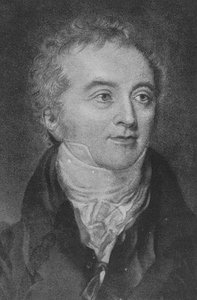
Light was historically modeled as both a particle (Newton) and a wave (Huygens, Young). The wave model explains interference and diffraction, while the particle model explains phenomena like the photoelectric effect.

Wavefronts and Rays
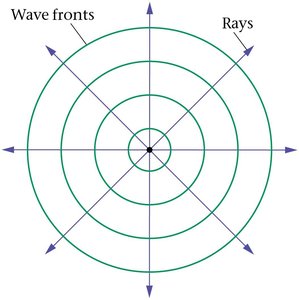
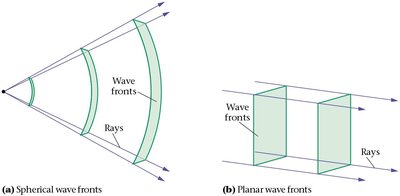
A ray is an imaginary line showing the direction of light propagation. A wavefront is a surface of constant phase (e.g., all crests). Rays are always perpendicular to wavefronts.
Reflection of Light
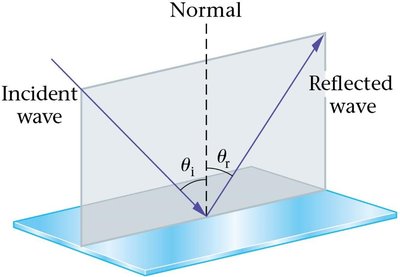
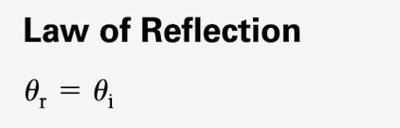
Reflection occurs when light bounces off a surface. The law of reflection states that the angle of incidence equals the angle of reflection: .
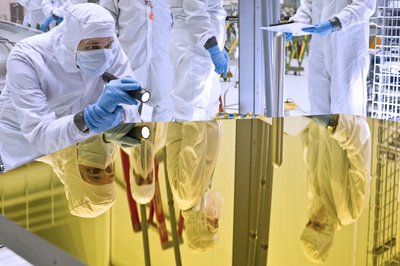
Specular reflection: From smooth surfaces (mirrors), produces clear images.
Diffuse reflection: From rough surfaces, scatters light in many directions.
Images Formed by Flat Mirrors
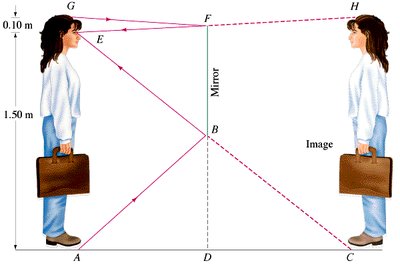
Flat mirrors produce virtual, upright images that are the same size as the object and appear as far behind the mirror as the object is in front.
Ray tracing: At least two rays are needed to locate the image.
Magnification: for flat mirrors.

Refraction of Light
Refraction is the bending of light as it passes from one medium to another due to a change in speed. The index of refraction is defined as , where is the speed of light in vacuum and is the speed in the medium.
Snell's Law:
Dispersion: The index of refraction depends on wavelength, causing different colors to bend differently (e.g., prisms, rainbows).
Total Internal Reflection and Applications
Total internal reflection occurs when light attempts to move from a denser to a less dense medium at an angle greater than the critical angle, causing all light to reflect back into the denser medium. This principle is used in optical fibers.
Summary Table: Electromagnetic Spectrum
Type | Frequency (Hz) | Wavelength (m) | Applications |
|---|---|---|---|
Radio | 106–109 | 102–100 | Broadcast, communication |
Microwave | 109–1012 | 10-2–10-4 | Cooking, radar |
Infrared | 1012–4.3×10¹⁴ | 10-4–10-6 | Remote controls, heat |
Visible | 4.3×10¹⁴–7.5×10¹⁴ | 7×10⁻⁷–4×10⁻⁷ | Vision |
Ultraviolet | 7.5×10¹⁴–1017 | 4×10⁻⁷–10-9 | Sterilization, tanning |
X-ray | 1017–1020 | 10-9–10-12 | Medical imaging |
Gamma ray | >1020 | <10-12 | Cancer treatment, nuclear |
Key Equations
Speed of light:
Relationship:
Snell's Law:
Index of refraction:
Intensity:
Energy density:
Example: If a microwave oven operates at Hz, its wavelength is m (3 cm).
Additional info: These notes provide a comprehensive overview of electromagnetic waves and geometric optics, suitable for college-level physics students preparing for exams.
