 Back
BackElectromagnetic Waves and Geometric Optics: Study Notes
Study Guide - Smart Notes
 Tailored notes based on your materials, expanded with key definitions, examples, and context.
Electromagnetic Waves
Nature and Properties of Electromagnetic Waves
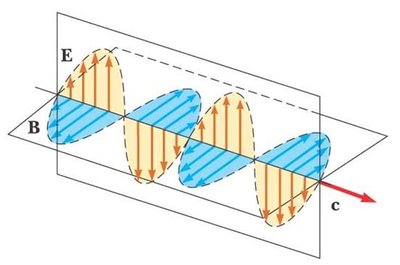
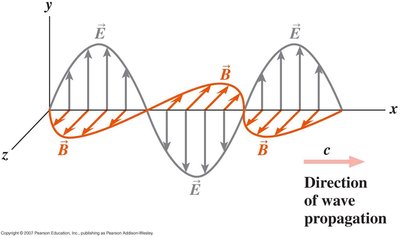
Electromagnetic (EM) waves are produced by accelerating or vibrating electric charges. These waves consist of oscillating electric (E) and magnetic (B) fields that are perpendicular to each other and to the direction of wave propagation. EM waves are transverse waves, meaning the oscillations of the fields are perpendicular to the direction of energy transfer.
Electric and Magnetic Fields: The electric and magnetic fields in an EM wave are always in phase and perpendicular to each other.
Wave Equation: The general form for the electric and magnetic fields in an EM wave traveling in the x-direction is:
Relationship between E and B:
Speed of Light: In a vacuum, the speed of light is m/s.
Universal Wave Equation:
Electromagnetic Spectrum
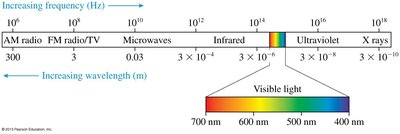
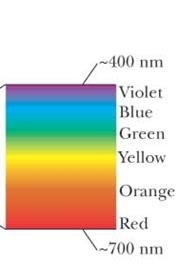
The electromagnetic spectrum encompasses all types of EM radiation, ranging from long-wavelength radio waves to short-wavelength gamma rays. The visible spectrum, which can be detected by the human eye, ranges from approximately 400 nm (violet) to 700 nm (red).
Order of Spectrum (increasing frequency): Radio waves, Microwaves, Infrared, Visible, Ultraviolet, X-rays, Gamma rays
Visible Light: The eye is most sensitive to light at around 550 nm (green-yellow).
Geometric Optics
Ray Model of Light
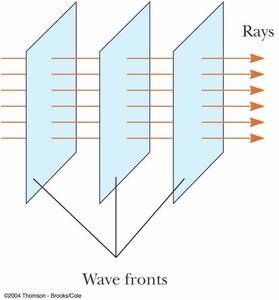
Geometric optics, or the ray model of light, treats light as traveling in straight lines called rays. This model is valid when the wavelength of light is much smaller than the objects it interacts with, allowing us to neglect wave effects like diffraction.
Light Rays: Represent the direction of light propagation; drawn as arrows.
Wavefronts: Surfaces of constant phase perpendicular to rays.
Ray Properties:
Travel in straight lines in a uniform medium
Can cross without affecting each other
Change direction at interfaces (reflection/refraction)
Reflection of Light
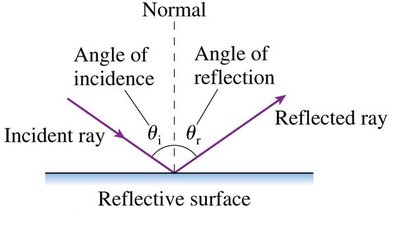
Reflection occurs when light bounces off a surface. The law of reflection states that the angle of incidence equals the angle of reflection, both measured from the normal to the surface.
Law of Reflection:
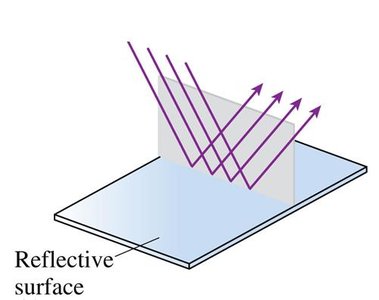
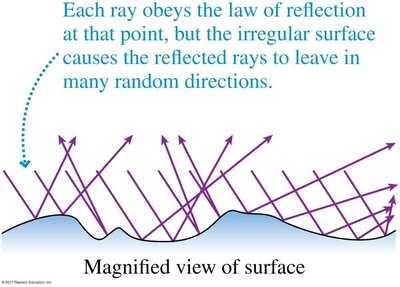
Specular Reflection: Occurs on smooth surfaces; reflected rays remain parallel, forming clear images.
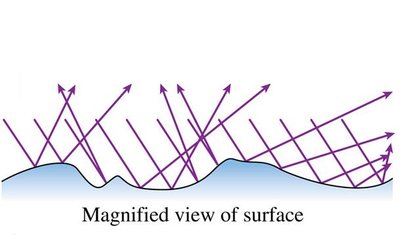
Diffuse Reflection: Occurs on rough surfaces; reflected rays scatter in many directions, preventing image formation.
Refraction and Index of Refraction
Index of Refraction
The index of refraction (n) of a medium is the ratio of the speed of light in vacuum to the speed of light in that medium. It quantifies how much light slows down in a material.
Formula:
Typical values: Air ≈ 1.00, Water ≈ 1.33, Glass ≈ 1.5–1.7
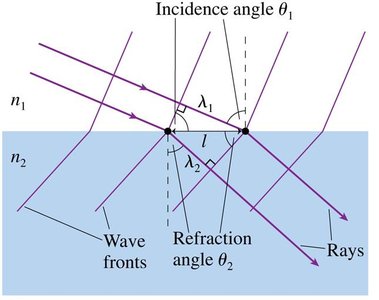
Wavelength Change: As light enters a new medium, its frequency remains constant, but its wavelength changes:
Refraction and Snell's Law
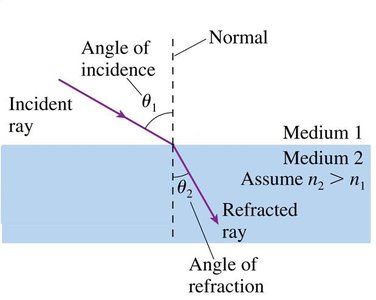
Refraction is the bending of light as it passes from one medium to another with a different index of refraction. Snell's Law relates the angles and indices of refraction for the two media.
Snell's Law:
Normal Incidence: If light enters perpendicular to the interface, it does not change direction.
Oblique Incidence: Light bends toward the normal if entering a higher-index medium, and away if entering a lower-index medium.
Total Internal Reflection
Critical Angle and Total Internal Reflection
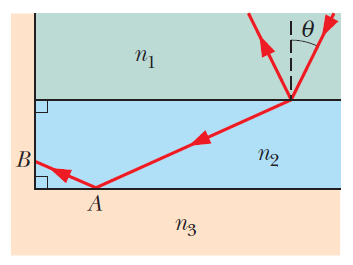
Total internal reflection occurs when light attempts to move from a medium with higher index of refraction to one with lower index at an angle greater than the critical angle. Beyond this angle, all light is reflected back into the original medium.
Critical Angle: , where
Applications: Optical fibers, prisms, and some natural phenomena (e.g., mirages)
Optical Fibers
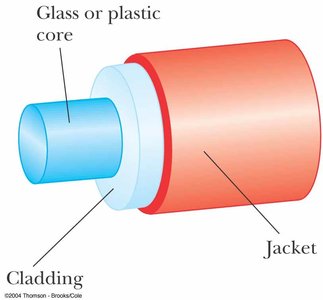
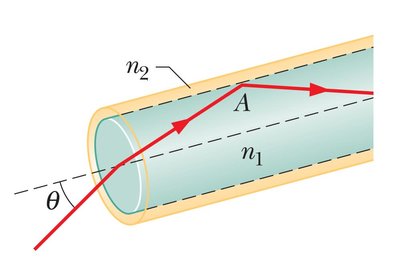
Optical fibers use total internal reflection to transmit light over long distances with minimal loss. They consist of a core with a higher refractive index surrounded by cladding with a lower refractive index.
Core and Cladding: Light is confined to the core by total internal reflection at the core-cladding boundary.
Critical Angle in Fibers: The maximum angle for total internal reflection depends on the indices of the core and cladding.
Dispersion and Prisms
Dispersion
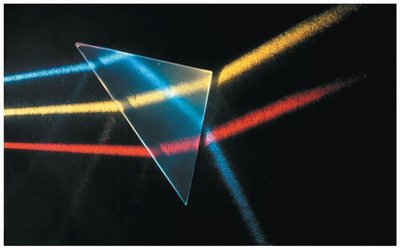
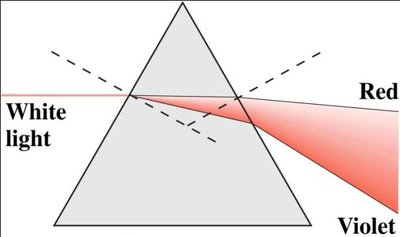
Dispersion occurs because the index of refraction of a material depends on the wavelength of light. As a result, different colors (wavelengths) of light are refracted by different amounts, causing them to spread out.
Effect: White light passing through a prism separates into its constituent colors.
Applications: Rainbows, spectrometers, and color separation in optics.
Rainbows
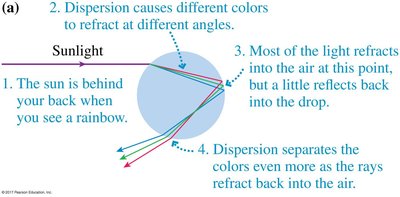
Rainbows are formed by a combination of refraction, reflection, and dispersion of sunlight in water droplets. Each color emerges at a slightly different angle, creating the spectrum seen in a rainbow.
Prisms and Angular Spread
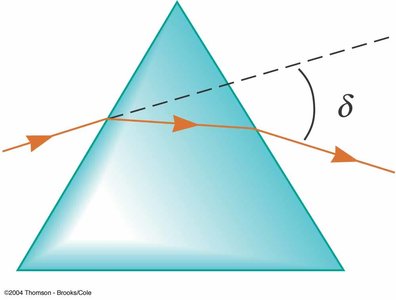
When light passes through a prism, it is deviated from its original path by an angle called the angle of deviation. The angular spread quantifies the separation between different colors due to dispersion.
Angle of Deviation:
Angular Spread: The difference in deviation angles for different wavelengths.
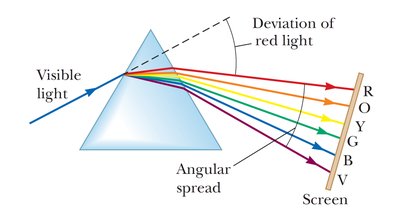
Example: If the index of refraction for violet, yellow, and red light in a prism are 1.66, 1.64, and 1.62 respectively, and the apex angle is 60°, the angular spread can be calculated using the deviation formula for each wavelength and finding the difference.
