 Back
BackElectromagnetic Waves and Polarization: Maxwell’s Equations and Applications
Study Guide - Smart Notes
 Tailored notes based on your materials, expanded with key definitions, examples, and context.
Ch. 22 Electromagnetic Waves
Introduction to Electromagnetic Waves
Electromagnetic waves are oscillations of electric and magnetic fields that propagate through space. The unification of electricity and magnetism into a single theory was one of the greatest achievements of 19th-century physics, culminating in Maxwell’s equations.
Electromagnetic waves can travel through a vacuum, unlike mechanical waves which require a medium.
James Clerk Maxwell unified electric and magnetic phenomena using the concept of fields, building on Faraday’s work.
All classical electromagnetic phenomena are described by four fundamental equations known as Maxwell’s equations.

Maxwell’s Equations: The Foundation of Electromagnetism
Maxwell’s equations describe how electric and magnetic fields are generated and altered by each other and by charges and currents.
Gauss’ Law for Electric Charge: The electric flux through a closed surface is proportional to the enclosed electric charge.
Gauss’ Law for Magnetism: There are no magnetic monopoles; the net magnetic flux through a closed surface is zero.
Faraday’s Law of Induction: A changing magnetic field produces an electric field.
Ampère’s Law (with Maxwell’s correction): A magnetic field is produced by an electric current and by a changing electric field.

Changing Fields and Displacement Current
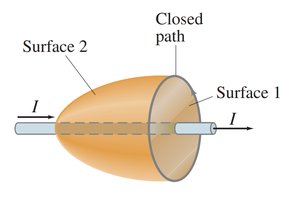
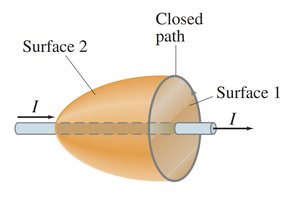
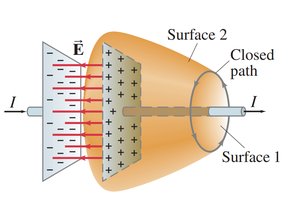
Maxwell’s insight was that a changing electric field can produce a magnetic field, just as a changing magnetic field produces an electric field. This led to the concept of the displacement current.
Ampère’s Law originally related magnetic fields to electric currents, but Maxwell added the displacement current term to account for changing electric fields.
The displacement current is not a real current of moving charges, but a mathematical term representing a changing electric field.
Production of Electromagnetic Waves
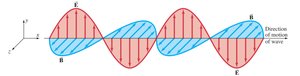
Accelerating charges produce electromagnetic waves. These waves consist of oscillating electric and magnetic fields that propagate perpendicular to each other and to the direction of wave travel.
If a charge is stationary, it produces a static electric field.
If a charge moves at constant velocity, it produces a magnetic field.
If a charge accelerates, it produces electromagnetic radiation (waves).
Speed of Electromagnetic Waves
Maxwell derived that the speed of electromagnetic waves in a vacuum is determined by the electric constant (permittivity) and the magnetic constant (permeability) of free space:
The speed of light in vacuum:
This discovery showed that light itself is an electromagnetic wave.
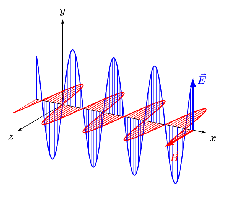
Light as an Electromagnetic Wave
Visible light is just a small part of the electromagnetic spectrum, which includes radio waves, microwaves, infrared, ultraviolet, X-rays, and gamma rays. The wave velocity equation relates wavelength and frequency:
Wave velocity:
For light in vacuum:
Production of Waves: Antenna
Electromagnetic waves can be generated by antennas, which use alternating currents to produce oscillating electric and magnetic fields that radiate outward.
An antenna consists of two sides (positive and negative), connected to an alternating power source.
As the polarity flips, loops of electromagnetic waves are emitted and can be detected by another antenna.

Energy and Intensity of Electromagnetic Waves
Electromagnetic waves carry energy, which can be described by energy density and intensity.
Energy density (): The energy per unit volume carried by the wave.
Intensity (): The power per unit area, or the rate at which energy passes through a surface perpendicular to the wave’s direction.
Intensity decreases with distance from the source.
Momentum and Radiation Pressure
Electromagnetic waves also carry momentum and can exert pressure (radiation pressure) on objects.
When EM waves are absorbed or reflected, they transfer momentum to the surface.
Radiation pressure (): The force per unit area exerted by the wave, related to intensity and the speed of light.
Reflective surfaces experience greater radiation pressure than absorbing surfaces.
Ch. 24 Polarization
Polarization of Light
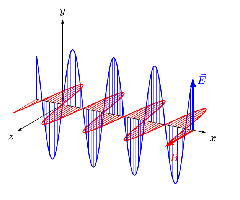
Polarization describes the orientation of the oscillations of the electric field in an electromagnetic wave. Light can be polarized in various ways, with linear polarization being the most common.
Linear polarization: The electric field oscillates in a single plane.
Unpolarized light consists of waves with electric fields in random directions perpendicular to the direction of propagation.
Polarizers and Malus’ Law
Polarizers are materials that allow only light with a specific polarization direction to pass through. When unpolarized light passes through a polarizer, its intensity is reduced by half. If two polarizers are used, the intensity of transmitted light depends on the angle between their axes, described by Malus’ Law:
Malus’ Law:
is the initial intensity, is the angle between the light’s polarization direction and the axis of the polarizer.
Two perpendicular polarizers block all light.



Summary Table: Maxwell’s Equations
Equation | Physical Law | Mathematical Form | Physical Meaning |
|---|---|---|---|
Gauss’ Law (Electric) | Electric charges produce electric fields | Electric flux through a closed surface equals enclosed charge over permittivity | |
Gauss’ Law (Magnetic) | No magnetic monopoles | Net magnetic flux through a closed surface is zero | |
Faraday’s Law | Changing magnetic field produces electric field | Induced emf equals negative rate of change of magnetic flux | |
Ampère-Maxwell Law | Currents and changing electric fields produce magnetic fields | Magnetic field around a loop is due to current and changing electric field |
