 Back
BackElectromagnetic Waves: Maxwell’s Theory, Properties, and Applications
Study Guide - Smart Notes
 Tailored notes based on your materials, expanded with key definitions, examples, and context.
Electromagnetic Waves
Introduction to Electromagnetic Waves
Electromagnetic (EM) waves are oscillations of electric and magnetic fields that propagate through space, carrying energy and momentum. The unification of electricity and magnetism by James Clerk Maxwell led to the prediction and understanding of these waves, which include visible light, radio waves, microwaves, and more.
Electric and magnetic fields are perpendicular to each other and to the direction of wave propagation.
EM waves are transverse waves, meaning the oscillations are perpendicular to the direction of travel.
All EM waves travel at the speed of light in a vacuum, denoted by c.
Maxwell’s Theory and Equations
Maxwell’s Unification of Electricity and Magnetism
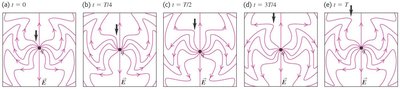
Maxwell’s equations mathematically describe the relationships between electric and magnetic fields and their sources (charges and currents). They predict that oscillating electric and magnetic fields can propagate as waves through empty space.
Gauss’s Law for Electricity: Describes the relationship between electric charge and electric field.
Gauss’s Law for Magnetism: States that magnetic field lines form closed loops (no magnetic monopoles).
Faraday’s Law: A changing magnetic field induces an electric field.
Ampère-Maxwell Law: A changing electric field or current produces a magnetic field.
Maxwell’s equations predict that:
A changing electric field produces a magnetic field.
Accelerating charges radiate electromagnetic waves.
EM waves travel at the speed of light, c.
Mathematical Formulation
The speed of light in vacuum is given by: where is the permeability of free space and is the permittivity of free space.
Relationship between electric and magnetic field amplitudes:
Properties of Electromagnetic Waves
Key Characteristics
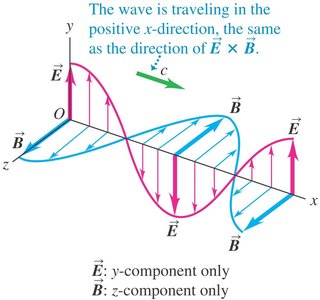
EM waves are transverse: both E and B fields are perpendicular to the direction of propagation and to each other.
The fields are in phase: maxima and minima occur simultaneously.
All EM waves travel at the same speed in vacuum: m/s.
EM waves can be polarized, meaning the direction of the electric field can be fixed.
The Electromagnetic Spectrum
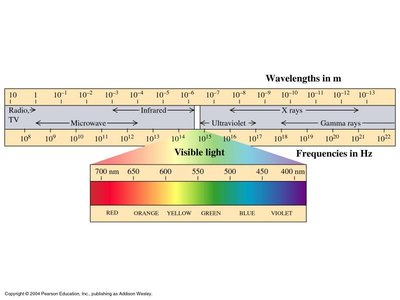
The electromagnetic spectrum encompasses all types of EM waves, classified by wavelength and frequency. Visible light is only a small portion of the spectrum.
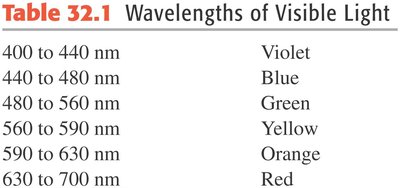
Wavelength (nm) | Color |
|---|---|
400 to 440 | Violet |
440 to 480 | Blue |
480 to 560 | Green |
560 to 590 | Yellow |
590 to 630 | Orange |
630 to 700 | Red |
Wavefronts and Rays
Wavefronts and Rays in EM Wave Propagation
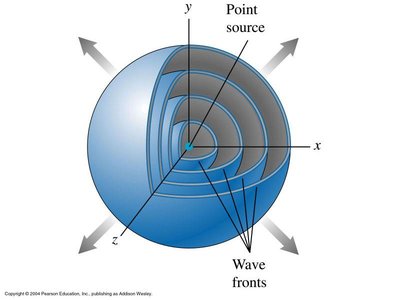
Wavefronts are surfaces connecting points of equal phase in a wave, while rays are vectors perpendicular to wavefronts indicating the direction of propagation.
Spherical wavefronts spread out from a point source.
Plane wavefronts occur far from the source, where rays are parallel.
Plane Electromagnetic Waves
Structure of Plane Waves
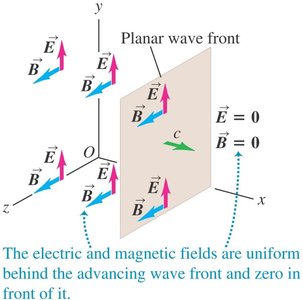
In free space, EM waves can be modeled as plane waves, where the electric and magnetic fields are uniform in a plane perpendicular to the direction of propagation.
The fields are zero in front of the advancing wavefront and uniform behind it.
Both E and B fields oscillate sinusoidally.
Maxwell’s Equations and Plane Waves
Maxwell’s equations require that the electric and magnetic fields in a plane wave are perpendicular to each other and to the direction of propagation. The ratio of their magnitudes is the speed of light.
(where is frequency and is wavelength)
Sinusoidal Electromagnetic Waves
Mathematical Representation
Sinusoidal EM waves can be described by the following equations:
where is the wave number and is the angular frequency.
Energy and Momentum in Electromagnetic Waves
Poynting Vector and Intensity
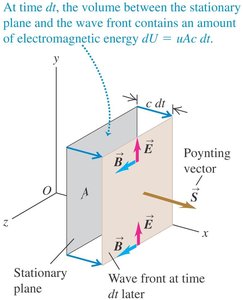
The Poynting vector () represents the power per unit area carried by an EM wave and points in the direction of propagation:
The intensity is the time-averaged value of the Poynting vector.
Energy Density
The energy density in an EM wave is the sum of the energy densities of the electric and magnetic fields:
In a vacuum, (since )
Electromagnetic Momentum and Radiation Pressure
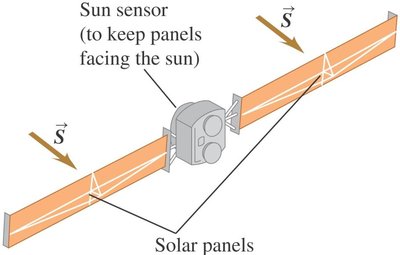
EM waves carry momentum and can exert pressure (radiation pressure) on surfaces:
Radiation pressure for a perfectly absorbing surface.
For a perfectly reflecting surface, .
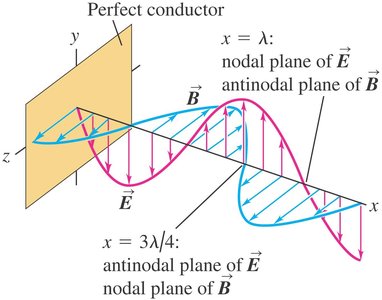
Standing Electromagnetic Waves
Formation of Standing Waves
When EM waves reflect from a conductor or dielectric, standing waves can form. These have nodes and antinodes for both electric and magnetic fields, depending on the boundary conditions.
Nodes: Points where the field is always zero.
Antinodes: Points where the field reaches maximum amplitude.
Summary Table: Maxwell’s Equations and EM Waves
Equation | Description |
|---|---|
Gauss’s Law for Electricity | |
Gauss’s Law for Magnetism | |
Faraday’s Law | |
Ampère-Maxwell Law |
Key Equations
Speed of light:
Relationship between fields:
Wave equation:
Poynting vector:
Energy density:
Radiation pressure: (absorbing), (reflecting)
Additional info:
These notes provide a comprehensive overview of electromagnetic waves, their theoretical foundation, properties, and practical implications, suitable for college-level physics students preparing for exams.
