 Back
BackElectromagnetic Waves: Properties, Behavior, and Applications
Study Guide - Smart Notes
 Tailored notes based on your materials, expanded with key definitions, examples, and context.
Electromagnetic Waves
Introduction to Waves
Waves are disturbances that transfer energy through a medium or vacuum. They are fundamental to many physical phenomena, including sound, light, and even the behavior of subatomic particles. Waves can be observed in daily life, such as in ocean surf, sound, and light.
Mechanical Waves: Require a medium to propagate. Examples include water waves and sound waves.
Transverse Waves: The displacement of the medium is perpendicular to the direction of wave propagation (e.g., water waves, waves on a string).
Longitudinal Waves: The displacement of the medium is parallel to the direction of wave propagation (e.g., sound waves).
Electromagnetic Waves: Do not require a medium and are always transverse. Examples include radio waves and light waves.


Properties of Waves
Waves are characterized by several key properties that describe their behavior and energy transfer:
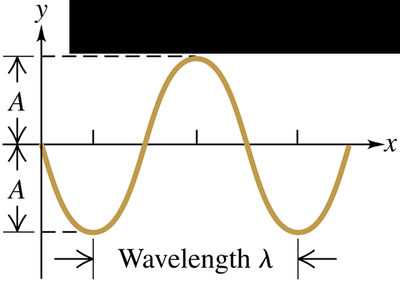
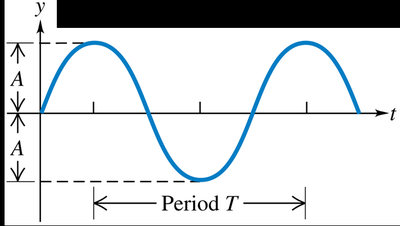
Sinusoidal Waves: Waves in which particles undergo periodic motion during propagation.
Wave Speed (v): The speed at which the disturbance propagates through the medium.
Wavelength (\(\lambda\)): The distance between two consecutive, identical points on a wave (e.g., crest to crest).
Period (T): The time taken for one complete cycle of the wave to pass a given point.
Frequency (f): The number of cycles passing a point per second, measured in hertz (Hz). \(f = \frac{1}{T}\)
Amplitude (A): The maximum displacement from the equilibrium position.
Wave Equation: The general form for a wave traveling in the +x direction is: where \(\omega = 2\pi f\) is the angular frequency.
Introduction to Electromagnetic Waves
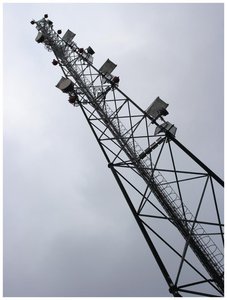
Electromagnetic waves are a type of transverse wave that can propagate through a vacuum. They are responsible for the transmission of energy from the sun, radio and TV signals, and are used in medical imaging and treatments.
Examples: Sunlight, radio waves, microwaves, X-rays, and gamma rays.
Applications: Imaging (X-rays, MRI), treatment (radiation therapy), communication (radio, TV, cell phones).
Source and Nature of Electromagnetic Waves
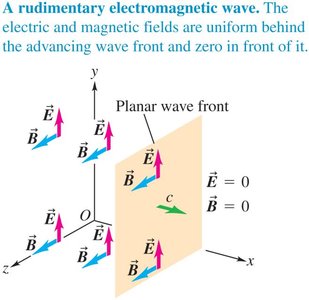
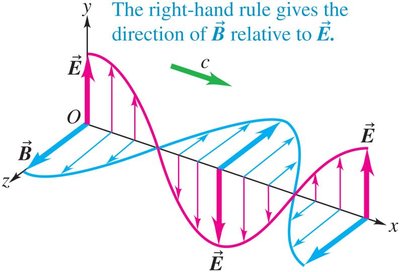
Electromagnetic waves are generated by time-varying electric and magnetic fields. According to Faraday's Law, a changing magnetic field produces an electric field, and Maxwell proposed that a changing electric field produces a magnetic field. These fields propagate together as electromagnetic waves.
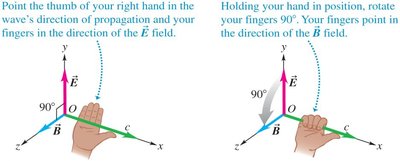
Transverse Nature: Both electric (\(\vec{E}\)) and magnetic (\(\vec{B}\)) fields are perpendicular to the direction of propagation and to each other.
Ratio of Field Magnitudes:
Speed of Light in Vacuum:
Right-Hand Rule: The direction of propagation is given by the right-hand rule, with \(\vec{E}\), \(\vec{B}\), and the direction of wave propagation mutually perpendicular.
The Electromagnetic Spectrum
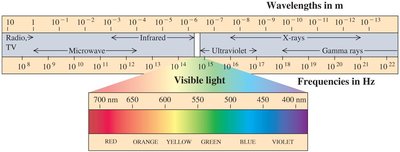
The electromagnetic spectrum encompasses all possible frequencies and wavelengths of electromagnetic waves, from radio waves to gamma rays. The relationship between frequency and wavelength is given by:
Visible Light: The small portion of the spectrum visible to the human eye, ranging from approximately 400 nm (violet) to 700 nm (red).
Sinusoidal Electromagnetic Waves
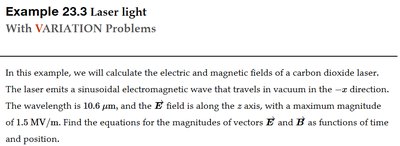
Sinusoidal electromagnetic waves can be described mathematically in a manner similar to mechanical waves. The electric and magnetic fields oscillate sinusoidally and are perpendicular to each other and to the direction of propagation.
Wave Functions:
For electric field:
For magnetic field:
Where and
Energy in Electromagnetic Waves
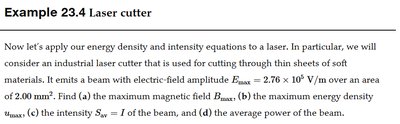
Electromagnetic waves carry energy, which is stored in both the electric and magnetic fields. The energy density and intensity are important quantities for describing the energy transport in these waves.
Energy Density (u):
Average Energy Density:
Intensity (I): The average power per unit area:
Units: Energy density in J/m3, intensity in W/m2.
Reflection and Refraction
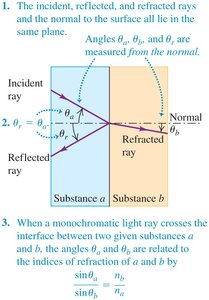
When light encounters the interface between two different media, it can be reflected and/or refracted. The behavior of light at the interface is governed by the laws of reflection and refraction.
Incident Ray: The incoming light ray striking the interface.
Reflected Ray: The part of the incident ray that bounces back into the original medium.
Refracted Ray: The part of the incident ray that passes into the second medium.
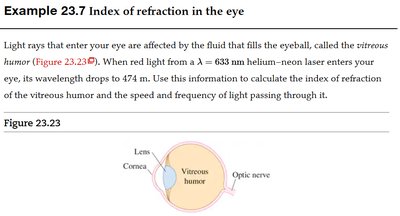
Index of Refraction (n): , where is the speed of light in the material.
Law of Reflection:
Snell's Law:
Wavelength in Medium:
Total Internal Reflection and Dispersion
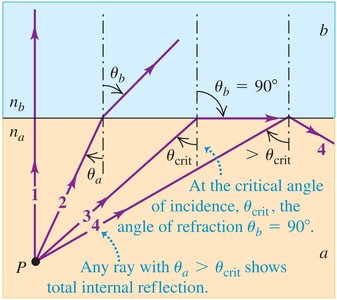
Total internal reflection occurs when light attempts to move from a medium with a higher index of refraction to one with a lower index, and the angle of incidence exceeds a certain critical value. Dispersion refers to the dependence of wave speed and index of refraction on wavelength.
Critical Angle (\(\theta_c\)): , where
Total Internal Reflection: Occurs when
Dispersion: The variation of refractive index with wavelength, causing different colors to refract at different angles.
Polarization
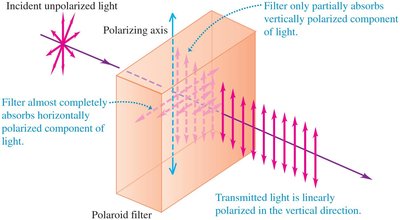
Polarization describes the orientation of the oscillations of the electric field in an electromagnetic wave. Light can be polarized by transmission through a polarizing filter, reflection, or scattering.
Linear Polarization: The electric field oscillates in a single direction.
Polarizing Filters: Transmit only the component of the electric field aligned with their axis.
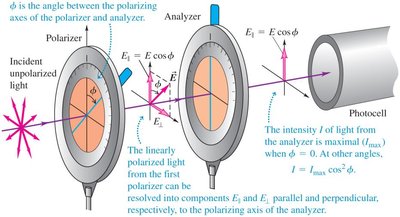
Intensity After Polarizer:
Malus's Law: where is the angle between the light's polarization direction and the axis of the second polarizer.
Summary Table: Key Equations and Concepts
Concept | Equation | Description |
|---|---|---|
Wave Speed | Speed of a wave | |
Frequency | Number of cycles per second | |
Speed of Light | Speed of light in vacuum | |
Index of Refraction | Ratio of light speed in vacuum to medium | |
Snell's Law | Refraction at an interface | |
Critical Angle | Total internal reflection | |
Energy Density | Energy per unit volume | |
Intensity | Power per unit area | |
Malus's Law | Intensity after two polarizers |
Examples and Applications
Speed of Light: Calculating the distance light travels in one second and the time to travel one foot. (See Example 23.1)
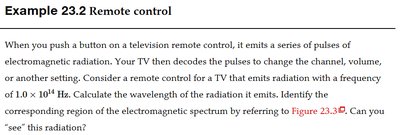
Remote Control: Determining the wavelength of infrared radiation emitted by a TV remote. (See Example 23.2)
Laser Light: Calculating electric and magnetic field equations for a laser beam. (See Example 23.3)
Laser Cutter: Applying energy density and intensity equations to a laser used in industry. (See Example 23.4)
Refraction in a Fishpond: Using Snell's law to find the angle of refraction at a water-air interface. (See Example 23.6)
Index of Refraction in the Eye: Calculating the index of refraction and speed of light in the vitreous humor. (See Example 23.7)
Linear Polarization: Applying Malus's law to two polarizing filters. (See Example 23.9)
Additional info: This guide expands on the provided notes with definitions, equations, and academic context to ensure completeness and clarity for college-level physics students.
