 Back
BackChapter 28 Part II - Electromagnetic Waves: Properties, Nature, and Spectrum
Study Guide - Smart Notes
 Tailored notes based on your materials, expanded with key definitions, examples, and context.
Electromagnetic Waves
Introduction
Electromagnetic (EM) waves are oscillations of electric and magnetic fields that propagate through space. These waves are fundamental to understanding light and many other phenomena in physics. The electric and magnetic fields are perpendicular to each other and to the direction of wave propagation.
Electric and Magnetic Fields: Both fields are of equal magnitude and are mutually perpendicular.
Origin: EM waves originate from the motion of charged particles, as discussed in earlier chapters on electric and magnetic fields.
Transverse Nature: EM waves are transverse, meaning the oscillations are at right angles to the direction of propagation.
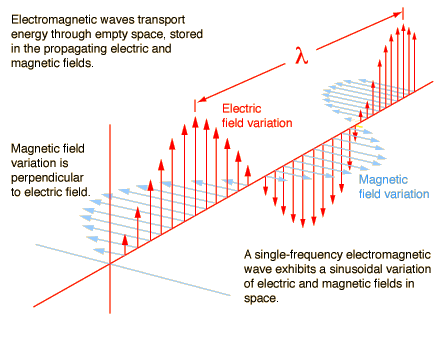
Nature of Electromagnetic Waves
Electromagnetic waves exhibit several important properties and forms, and their theoretical foundation was established by James Clerk Maxwell.
Forms of EM Waves:
Visible light (most familiar form)
Ultraviolet (UVA, UVB, UVC)
Infrared (heat)
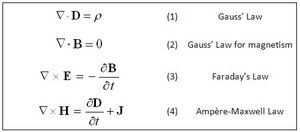
Maxwell's Equations: These four equations describe how electric and magnetic fields are generated and altered by each other and by charges and currents.
Field Strength and Distance: The strength of the fields decreases as the distance from the source increases.
Types of Fields:
Near Field: Dominates close to the source.
Radiation Field: Dominates at greater distances; associated with the propagation of EM waves (related to Faraday's Law of Induction).
Medium Independence: EM waves do not require a medium and can propagate through a vacuum.
Frequency Determination: The frequency of an EM wave is set by the oscillation frequency of the source electric charge.
Electromagnetic Spectrum
The electromagnetic spectrum encompasses all types of EM waves, classified by their wavelength or frequency. This includes radio waves, microwaves, infrared, visible light, ultraviolet, X-rays, and gamma rays. Each region of the spectrum has unique properties and applications.
Visible Light: The small portion of the spectrum detectable by the human eye.
Infrared: Associated with heat radiation.
Ultraviolet: Higher energy than visible light, can cause chemical reactions and biological effects.
Speed of Light (c)
All electromagnetic waves travel at the same speed in a vacuum, denoted by c. This is a fundamental constant of nature.
Value in Vacuum:
In Air: The speed is nearly the same as in vacuum.
In Other Media: The speed is reduced depending on the material's properties.
EM Waves and the Energy They Carry
Electromagnetic waves transport energy through space. This energy is stored in the oscillating electric and magnetic fields and can be transferred to matter when the wave interacts with it.
Energy Transport: The energy carried by EM waves is proportional to the square of the amplitude of the electric and magnetic fields.
Applications: EM waves are used in communication, medical imaging, heating, and many other technologies.
Key Equations
Relationship between Speed, Frequency, and Wavelength: where is the speed of light, is the wavelength, and is the frequency.
Maxwell's Equations (Summary):
Gauss's Law:
Gauss's Law for Magnetism:
Faraday's Law:
Ampère-Maxwell Law:
Example: Sunlight is an example of electromagnetic radiation, consisting of a range of wavelengths from the visible spectrum as well as ultraviolet and infrared.
Additional info: The notes reference Faraday's Law and the concept of changing magnetic flux (), which is central to the generation of EM waves. For a deeper understanding, review chapters on electromagnetic induction and Maxwell's synthesis of electricity and magnetism.
