 Back
BackElectrostatics: Charged Rods, Conductors, and Insulators
Study Guide - Smart Notes
 Tailored notes based on your materials, expanded with key definitions, examples, and context.
Q1. What happens to an aluminum can placed between two charged rods?
Background
Topic: Induced Charge and Polarization in Conductors
This question explores how conductors (like an aluminum can) respond to external electric fields created by nearby charged objects. It focuses on the concept of induced charge and the resulting forces.
Key Terms and Concepts:
Conductor: A material in which charges (usually electrons) can move freely.
Induced Charge: Redistribution of charges within a conductor due to the presence of an external electric field.
Polarization Force: The force resulting from the separation of positive and negative charges within a conductor.
Step-by-Step Guidance
Draw a diagram showing the can and the two rods, one positively charged and one negatively charged, placed symmetrically on either side of the can.
Indicate the induced charges on the surface of the can: negative charges will be attracted toward the positive rod, and positive charges toward the negative rod.
Draw force vectors (free-body diagram) showing the attractive forces between the can and each rod.
Consider the symmetry: since the rods are equidistant and have equal but opposite charges, the forces should be equal in magnitude but opposite in direction.
Try solving on your own before revealing the answer!
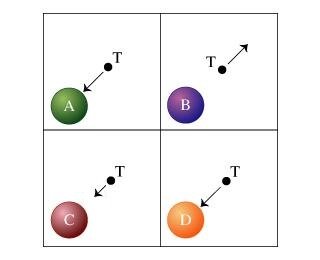
Q2. What is the nature of the force between a test charge and various charged and uncharged balls (A, B, C, D)?
Background
Topic: Electric Forces, Conductors, and Insulators
This question tests your understanding of how charged and neutral objects (both conductors and insulators) interact with a test charge, focusing on Coulomb's law and polarization effects.
Key Terms and Concepts:
Coulomb's Law: The force between two point charges is , where is Coulomb's constant.
Conductor vs. Insulator: Conductors allow free movement of charge; insulators do not, but can be polarized.
Polarization: In insulators, charges shift slightly, creating a weak attraction to a nearby charge.
Step-by-Step Guidance
For each ball, consider the force experienced by a positive test charge brought near it:
Ball A: Strong attraction suggests it is negatively charged.
Ball B: Strong repulsion suggests it is positively charged.
Ball C: Weak attraction suggests it is neutral but polarizable (insulator).
Ball D: Strong attraction suggests it is a neutral conductor (induced polarization).
Recall that conductors (like D) can have strong induced charges, while insulators (like C) only have weak polarization effects.
Use the direction and strength of the forces to deduce the charge or nature of each ball.
Try solving on your own before revealing the answer!
Q3. What happens when a negatively charged ball is brought near and then repeatedly touched to the end of an insulating rod?
Background
Topic: Charging by Contact and Induction in Insulators
This question examines how charge is transferred and distributed in insulators, and how polarization and charge localization occur.

Key Terms and Concepts:
Insulator: Material in which charges are not free to move throughout the material.
Charging by Contact: Transferring charge by touching a charged object to another object.
Polarization: Induced separation of charge within an insulator when exposed to an external electric field.
Step-by-Step Guidance
When the negatively charged ball is brought near end A, positive charge is induced at end A and negative charge at end B (due to polarization).
When the ball is touched to end A, some negative charge is transferred to the rod, but because it's an insulator, the charge remains localized at end A.
After several contacts, most of the negative charge will accumulate at end A, with little spreading to end B.
When the charged ball is brought near end A again, the interaction will be dominated by the like charges at end A, leading to repulsion.
Try solving on your own before revealing the answer!
