 Back
BackElectrostatics: Concepts, Laws, and Applications
Study Guide - Smart Notes
 Tailored notes based on your materials, expanded with key definitions, examples, and context.
Ch.22 - Electrostatics
Concept: Electric Charge
Electric charge is a fundamental property of matter, analogous to mass, but responsible for electric forces rather than gravitational forces. Atoms are composed of protons (positive charge), neutrons (neutral), and electrons (negative charge).
Electric Charge (Q): Measured in coulombs (C), it determines the strength of electric forces between objects.
Elementary Charge (e): The smallest unit of charge, carried by a single proton or electron. C.
Proton Charge:
Electron Charge:
Quantization: Charge exists in whole multiples of .
Neutrality: Most materials are neutral, meaning the number of protons equals the number of electrons, so .
Charge Calculation:
Example: An atom with 16 protons and 7 electrons has .
Example: To find the number of electrons in C: .
Example: For water (density 1 kg/L, molecular weight 18 g/mol, 10 electrons/molecule), calculate the total electrons in 2L and the total charge.
Practice: How many electrons must be added to decrease the charge by C?
Concept: Conservation of Charge
Charge is conserved; it can only be transferred, not created or destroyed. When two conductors touch, charge redistributes until equilibrium is reached (equal potential).
Charge Transfer: If one object gains 1 C, another loses 1 C.
Equilibrium: Charges move until (for identical conductors).
Conservation Law: before = $Q_{total}$ after.
Example: Two spheres with initial charges of 1 C and 3 C. If one ends up with -2 C, the other must have C.

Concept: Coulomb's Law
Coulomb's Law quantifies the electric force between two point charges. The force can be attractive or repulsive depending on the sign of the charges.
Formula:
Coulomb's Constant: N·m2/C2
Direction: Force acts along the line joining the charges.
Like Charges: Repel each other.
Unlike Charges: Attract each other.
Example: Compare electric and gravitational forces in a hydrogen atom.
Example: If two identical charges are connected by a 5 cm wire with 10 N tension, solve for the charge magnitude.
Practice: If distance doubles (), force becomes .
Example: Where to place a 1 C charge so net force is zero between two other charges?
Practice: For three charges in a line, determine the direction and acceleration of a -1 C charge (given mass).
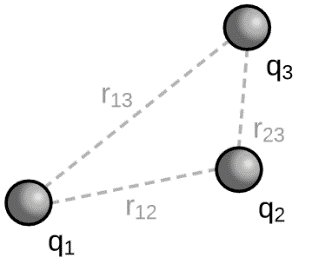
Example: For charges in a triangle, rank pairs by force magnitude.
Concept: Charging Objects
Objects can be charged by transferring electrons. Materials are classified as conductors (allow charge movement) or insulators (do not allow charge movement).
Conductors: Allow electrons to move freely (e.g., metals).
Insulators: Do not allow electrons to move freely (e.g., rubber, glass).
Charging by Friction: Rubbing transfers electrons from one object to another.
Polarization: Separation of charge within an object without net charge transfer.
Conduction: Transfer of charge by direct contact, resulting in net charge.
Induction: Charging without contact by rearranging charges via a nearby charged object and grounding.
Example: Rubbing fur and a plastic rod gives the rod a negative charge; fur and glass rod gives the rod a positive charge.
Concept: Electric Field
An electric field is a region around a charged object where other charges experience a force. The field is a vector quantity, pointing away from positive charges and toward negative charges.
Formula:
Units: N/C (newtons per coulomb)
Field Due to Point Charge:
Force on a Charge:
Example: If a 2 C charge is in a field of 10 N/C, force is N.
Practice: For a charge balanced by gravity, .
Concept: Electric Field Lines
Electric field lines visually represent the direction and strength of the field. Lines point away from positive charges and toward negative charges. The density of lines indicates field strength.
Direction for Positive Test Charge: Follows the field lines.
Direction for Negative Test Charge: Opposite to field lines.
Example: Draw field lines for a dipole (equal and opposite charges) and for two identical positive charges.
Concept: Capacitors
Capacitors consist of two parallel plates with equal and opposite charges, creating a uniform electric field between them. They store electric potential energy.
Uniform Field: between plates, where C2/(N·m2).
Capacitance: , measured in farads (F).
Energy Storage: Capacitors store potential energy in the electric field.
Example: If the electric field between plates is 1000 N/C and area is 5 cm2, find the charge on each plate.
Practice: An electron enters a capacitor; calculate its trajectory and which plate it strikes.
Concept: Conductors and Electric Fields
In conductors, electrons are free to move and distribute themselves on the surface to minimize repulsion. The electric field inside a conductor is zero in electrostatic equilibrium.
Surface Distribution: Net charge resides on the surface.
Field Outside Sphere: for outside the sphere.
Field Inside Sphere:
Example: For a sphere of radius 0.5 m and charge 2.0 µC, calculate at 0.8 m and 0.4 m from the center.
Concept: Electric Potential
Electric potential (V) is the potential energy per unit charge. The unit is the volt (V), where .
Potential Energy:
Potential Due to Point Charge:
Potential Difference (Voltage):
Example: A 5 C charge at 200 V has J.
Practice: Find the distance from a 5 µC charge where V.
Concept: Electric Potential Energy
Electric potential energy is the energy stored due to the position of charges. For two point charges:
Formula:
For Multiple Charges: $U_{tot} = \sum_{i
Energy Conservation:
Example: Find the separation for mJ between 3 µC and -2 µC charges.
Concept: Work Due to Electric Force
Work is done when a charge moves in an electric field, changing its potential and kinetic energy. The work done depends only on the initial and final positions, not the path taken.
Work-Energy Theorem:
Potential Difference:
Work by Field: (for uniform field and displacement at angle )
Example: Calculate work done moving a charge in a uniform field, and the resulting speed if starting from rest.
Concept: Relationships Between Force, Field, Energy, and Potential
The four main quantities in electrostatics are related as follows:
Electric Force:
Electric Field:
Electric Potential Energy:
Electric Potential:
Potential difference (voltage) is , and the work done is .
Concept: Capacitors and Capacitance
A capacitor stores electric potential energy by separating charges on two surfaces. Capacitance measures the ability to store charge per unit voltage.
Capacitance: (units: farads, F)
Energy Stored:
Connecting to Battery: The voltage across the capacitor equals the battery voltage.
Larger Capacitance: Stores more charge for the same voltage.
Example: For a 9 V battery and 3 F capacitor, C.
