Back
BackEngineering Physics 1A: Course Structure, Syllabus, and Academic Procedures
Study Guide - Smart Notes
 Tailored notes based on your materials, expanded with key definitions, examples, and context.
Engineering Physics 1A: Course Overview and Syllabus
Introduction to Engineering Physics 1A
Engineering Physics 1A (PHYE0A1) is an introductory module designed for students in the Faculty of Science and the Faculty of Engineering and the Built Environment at the University of Johannesburg. The course aims to provide a broad understanding of the fundamental principles of Mechanics, Waves, and Thermodynamics, with an emphasis on problem identification, scientific problem solving, and interpretation of results. The prescribed textbook is Douglas Giancoli's "Physics for Scientists and Engineers, with Modern Physics" (5th Edition, Pearson, 2024).

Course Structure and Educational Methods
Lectures: Three times a week, covering core concepts with discussions and demonstrations.
Practicals: One introductory and four experimental sessions, plus a practical test, to develop experimental techniques.
Tutorials: Five sessions to reinforce learning and assist with problem-solving.
Online Content: Supplementary materials and discussions available via Moodle.
Assessment: Includes semester tests, tutorial tests, practical reports, and a final written examination.
Assessment and Progression
Semester Tests: Three tests; best two count towards the Theory mark.
Tutorial Tests: Five in-person tests; all count.
Practical Reports: Four reports and one practical test; all count.
Final Examination: Written exam at the end of the semester.
Minimum Requirements: 40% Theory mark, 50% Practical mark, and attendance at four tutorials to qualify for the exam.
Final Mark Calculation: Semester Mark (Theory 70%, Practical 30%) and Exam Mark are weighted equally (50% each).
Course Syllabus
The syllabus is divided into three main courses, covering the first twenty chapters of the Giancoli textbook. Not all sections of each chapter are covered; some sections from later chapters are included in the introductory material.
Course I: Mechanics
Chapter 1: Introduction, Measurement, Estimating, Units, Dimensional Analysis, and Measurement. Includes sections on vectors (3.1–3.5, 7.2, 11.3).
Chapter 2: Motion in a straight line (Displacement, Velocity, Acceleration).
Chapter 3: Motion in two and three dimensions (Sections 3.6–3.9).
Chapter 9 (Part 1): Momentum (Sections 9.2–9.4).
Chapter 4: Newton's Laws (entire chapter).
Chapter 5: Applying Newton’s Laws (Sections 5.1–5.4).
Chapter 6: Newtonian Gravitation (Sections 6.1–6.5, 6.7).
Chapter 7: Work and Kinetic Energy (entire chapter).
Chapter 8: Conservation of Energy (all except 8.10).
Chapter 9 (Part 2): Linear Momentum (Sections 9.5–9.9).
Chapter 10: Rotational Motion (entire chapter).
Chapter 11: Angular Momentum and General Rotation (Sections 11.1–11.6, 11.8).
Chapter 12: Equilibrium and Elasticity (Sections 12.1, 12.2, 12.4, 12.5).
Course II: Waves
Chapter 14: Oscillations (Sections 14.1–14.5; mention of 14.7, 14.8).
Chapter 15: Wave Motion (Sections 15.1–15.4, 15.6–15.9).
Chapter 16: Sound (entire chapter except 16.8, 16.9).
Course III: Thermodynamics
Chapter 17: Temperature, Thermal Expansion, and the Ideal Gas Law (entire chapter).
Chapter 18: Kinetic Theory of Gases (entire chapter, time permitting).
Chapter 19: Heat and The First Law of Thermodynamics (entire chapter).
Chapter 20: The Second Law of Thermodynamics (entire chapter except 20.3; sections 20.5, 20.6 covered first; 20.10 may be covered).
Timetable and Group Allocation
The class is divided into two lecture groups and three practical/tutorial groups. Attendance is mandatory and punctuality is required. Venues and times are specified for each group, and students must check their group allocation via Moodle or departmental announcements.
Deferred Assessment Procedures
Students unable to attend scheduled assessments due to illness or personal crisis must follow the Standard Operating Procedure (SOP) for deferred assessments. Applications must be submitted within seven days, accompanied by valid documentation (e.g., medical certificate, court documents). The faculty reviews each application for authenticity and timeliness.
Key Points for Deferred Assessment
Valid reasons include illness (with proper medical documentation) and personal crisis (e.g., death of a close family member, court appearance).
Applications must be made within seven calendar days of the missed assessment.
Documentation must be authentic, complete, and verifiable.
Special summative assessment opportunities may be granted for legitimate reasons.
Summary Table: Syllabus Coverage
Course | Chapters Covered | Key Topics |
|---|---|---|
Mechanics | 1–13 | Units, Measurement, Kinematics, Newton's Laws, Gravitation, Work, Energy, Momentum, Rotation, Equilibrium |
Waves | 14–16 | Oscillations, Wave Motion, Sound |
Thermodynamics | 17–20 | Temperature, Ideal Gas Law, Kinetic Theory, Heat, First and Second Laws of Thermodynamics |
Example: Mechanics - Kinematics
Kinematics is the study of motion without considering its causes. Key concepts include displacement, velocity, and acceleration. The equations of motion for constant acceleration are:
These equations are fundamental for solving problems in one-dimensional motion.
Example: Thermodynamics - Ideal Gas Law
The Ideal Gas Law relates the pressure, volume, and temperature of an ideal gas:
Where P is pressure, V is volume, n is the number of moles, R is the universal gas constant, and T is temperature in Kelvin.
Student Support and Academic Integrity
Student support is available through the Student Service Bureau and PsyCad services for study skills and personal difficulties.
Academic integrity is strictly enforced; submission of false documentation is a serious offense.
Important Administrative Notes
Attendance is mandatory for lectures, tutorials, and practicals.
Communication with lecturers and tutors should be professional and courteous.
All course information and updates are communicated via Moodle; students must check regularly.
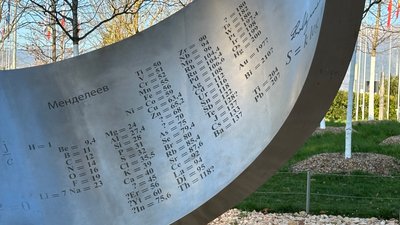
Visual Reference: Mendeleev’s Periodic Table Sculpture
The course materials reference Mendeleev’s original Periodic Table, engraved on a sculpture at CERN, as a symbol of scientific discovery and organization. While not directly part of the physics syllabus, it serves as an inspiration for scientific study.