 Back
BackEntropy and the Second Law of Thermodynamics
Study Guide - Smart Notes
 Tailored notes based on your materials, expanded with key definitions, examples, and context.
Entropy and the Second Law of Thermodynamics
Introduction to Entropy and Thermal Machines
The concept of entropy is central to understanding the Second Law of Thermodynamics and the operation of thermal machines such as heat engines and refrigerators. Entropy provides a quantitative measure of disorder and helps explain the direction of thermodynamic processes.
Heat Engines
Basic Operation of Heat Engines
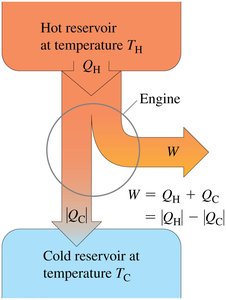
Heat engines operate on a cyclic process, absorbing heat QH from a hot reservoir at temperature TH, performing useful work W, and discarding some heat QC to a cold reservoir at temperature TC. This process is governed by the Second Law of Thermodynamics, which states that not all absorbed heat can be converted into work; some must always be expelled to a colder reservoir.
QH: Heat absorbed from the hot reservoir
QC: Heat expelled to the cold reservoir
W: Work done by the engine
The relationship between these quantities is given by:
Refrigerators
Basic Operation of Refrigerators
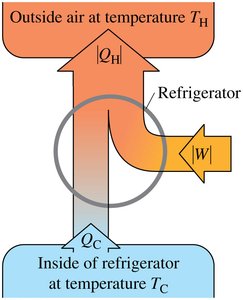
Refrigerators are thermal machines that transfer heat from a cold region (inside the refrigerator) to a warmer region (the room), requiring an input of mechanical work. This process is essentially the reverse of a heat engine and is also constrained by the Second Law of Thermodynamics.
QC: Heat extracted from the cold reservoir (inside)
QH: Heat expelled to the hot reservoir (outside)
W: Work input required
The energy balance is:
Entropy: A New Function of State
Definition and Properties of Entropy
Entropy (S) is a state function introduced to provide a mathematical description of the Second Law of Thermodynamics. It quantifies the amount of energy in a system that is unavailable for doing work and is closely related to the concept of disorder.
Infinitesimal entropy change during a reversible process is defined as:
Defined only for reversible processes
Entropy is a state function: its change depends only on the initial and final states, not the path taken
For a cyclic reversible process,
Entropy Changes in the Carnot Cycle
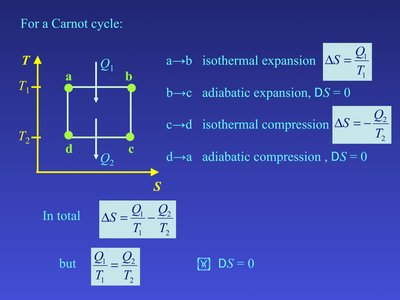
The Carnot cycle is a well-defined reversible cyclic process. Entropy changes occur only during the isothermal steps, as heat is exchanged at constant temperature. The total entropy change over one Carnot cycle is zero, reflecting the state function property of entropy.
Isothermal expansion (a→b):
Adiabatic expansion (b→c):
Isothermal compression (c→d):
Adiabatic compression (d→a):
For the entire cycle:
Calculating Entropy Change: Example with Water Heating
Reversible and Irreversible Processes
Consider heating 1 L of water from 20°C to 100°C at atmospheric pressure. The entropy change can be calculated for both reversible and irreversible processes. For a reversible process, the water is heated in small steps using a series of reservoirs at gradually increasing temperatures, ensuring the system is always nearly in equilibrium with the reservoir.
For each small step:
Total entropy change:
For 1 kg of water ( J K-1): J K-1
Heat enters the system, and entropy increases. Since entropy is a state function, the change is the same for any path between the same initial and final states.
Entropy Change of the Reservoir and the Universe
When water is heated irreversibly by a reservoir at 100°C, the reservoir loses heat:
Heat lost by reservoir:
Entropy change of reservoir:
Total entropy change (system + reservoir):
For the example above:
J K-1
J K-1 0
This positive total entropy change reflects the irreversibility of the process and the Second Law of Thermodynamics.
Clausius Inequality and the Principle of Increasing Entropy
Clausius Inequality
Clausius derived a general result for entropy change in any cyclic process (reversible or irreversible):
For an isolated system, the Second Law can be stated as: No process is possible in which the total entropy decreases when all systems involved are included. In other words, in an isolated system, entropy will either increase (irreversible process) or remain the same (reversible process). This is known as the Principle of Increasing Entropy.
Entropy-Temperature (T-S) Diagrams
Representation of Thermodynamic Processes
Thermodynamic processes can be represented on T-S diagrams, where:
Reversible adiabatic process: , (vertical line, S constant)
Reversible isothermal process: constant (horizontal line, T constant)
For a Carnot cycle, the T-S diagram clearly shows the entropy changes during each process and the total entropy change over the cycle is zero.
Microscopic Interpretation of Entropy
Boltzmann's Entropy Formula
On the microscopic level, entropy is related to the number of possible microstates (w) corresponding to a given macrostate. Boltzmann's famous formula expresses this relationship:
k: Boltzmann constant
w: Number of microstates for the macrostate

Example: Free Expansion of a Gas
When n moles of gas expand freely to double their volume at temperature T, each molecule has twice as much volume to occupy, doubling the number of possible states. For N molecules, the number of microstates increases by a factor of :
Entropy and Disorder
Physical Meaning of Entropy
Entropy provides a quantitative measure of disorder or randomness in a system. Many natural processes proceed in the direction of increasing entropy, reflecting a tendency toward greater disorder. For example:
Adding heat increases molecular motion and randomness
Free expansion of a gas increases the number of accessible microstates
Explosions increase disorder and entropy
Entropy and the Second Law in Popular Culture
References and Broader Impact
The Second Law of Thermodynamics and the concept of entropy have inspired references in literature, philosophy, ecology, psychology, and popular culture, highlighting their fundamental importance in understanding the natural world.
