 Back
BackEquations of State and the Kinetic Theory of Gases
Study Guide - Smart Notes
 Tailored notes based on your materials, expanded with key definitions, examples, and context.
Thermodynamic Systems and State Variables
Basic Definitions and Models
Thermodynamics studies the macroscopic properties of matter, focusing on how energy and matter interact within defined boundaries. A system is the part of the universe under study, separated from the surroundings by a boundary, which can be real or imaginary. The nature of the boundary determines whether the system is open, closed, or isolated.
Open system: Can exchange both matter and energy with surroundings.
Closed system: Can exchange energy but not matter.
Isolated system: Cannot exchange matter or energy (adiabatic and closed).
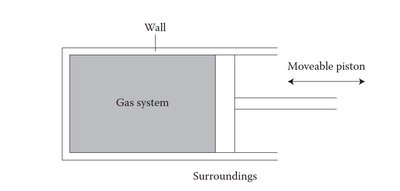
In thermodynamics, a common model is a gas in a container with a moveable piston. The volume (V) can change, affecting pressure (p) and temperature (T), especially if the walls are diathermal (allowing heat exchange).
State Variables
State variables are quantities that describe the condition of a thermodynamic system. The most important are:
Pressure (p)
Volume (V)
Temperature (T)
Amount of substance (n) or total mass (mtotal)
These variables are interdependent; changing one typically affects the others. The total mass is related to the number of moles and molar mass by:
where M is the molar mass.
Equations of State
The Ideal Gas Law
Experiments show that for many gases at low density (low pressure), the following relationships hold:
Volume is proportional to the number of moles:
Volume is inversely proportional to pressure:
Pressure is proportional to absolute temperature:
Combining these gives the ideal gas law:
where R is the universal gas constant (). This law applies well to gases at low density and high temperature.
Example: If 1 mole of an ideal gas is at 1 atm pressure and 273 K, the volume is .
General Equations of State
An equation of state relates the state variables of a system. In general, it can be written as:
For real substances, the equation of state may be more complex or only available as numerical tables.
The van der Waals Equation: Real Gases
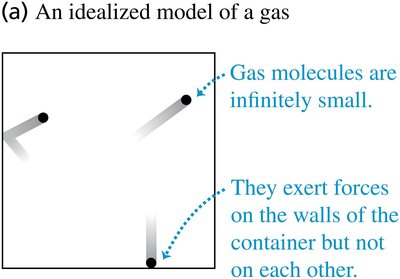
The ideal gas law assumes that gas molecules have no volume and do not attract each other. Real gases deviate from this behavior, especially at high pressures and low temperatures. The van der Waals equation introduces corrections for molecular volume and intermolecular forces:
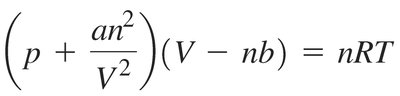
where:
a corrects for intermolecular attractions (reduces pressure)
b corrects for the finite volume of molecules (reduces available volume)
This equation better describes real gases under non-ideal conditions.
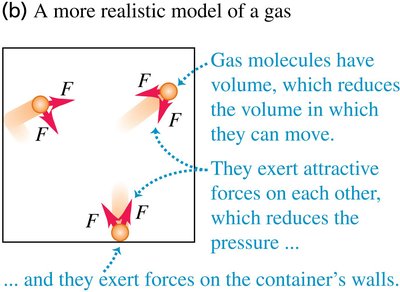
Comparison: Ideal vs. Real Gas Models
Property | Ideal Gas | Real Gas (van der Waals) |
|---|---|---|
Molecular Volume | Neglected (zero) | Finite (corrected by b) |
Intermolecular Forces | Neglected | Attractive forces included (corrected by a) |
Equation |
Kinetic Theory of Gases
Microscopic Interpretation of Gas Laws
While thermodynamics deals with macroscopic variables, the Kinetic Theory of Gases explains these properties in terms of the motion and interactions of atoms and molecules. For example, pressure arises from collisions of molecules with the walls of the container.
Ideal gas model: Molecules are point particles, only interact with walls.
Real gas model: Molecules have volume and interact with each other.
This molecular approach provides a deeper understanding of thermodynamic behavior and the limitations of the ideal gas law.
