 Back
BackEquilibrium and Elasticity: Static Equilibrium, Stability, and Elastic Properties of Materials
Study Guide - Smart Notes
 Tailored notes based on your materials, expanded with key definitions, examples, and context.
Equilibrium and Elasticity
Introduction
This chapter explores the principles of static equilibrium and elasticity, focusing on the conditions required for objects to remain at rest, the role of torque, and how materials respond to applied forces. Applications include engineering, biomechanics, and everyday stability.
Torque and Static Equilibrium
Conditions for Static Equilibrium
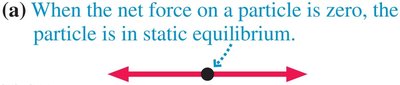
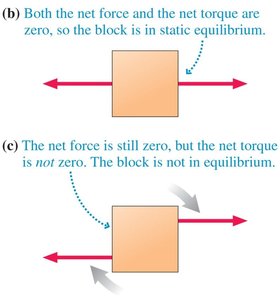
Static equilibrium occurs when an object is at rest and remains at rest under the action of applied forces and torques.
For a particle-like object, static equilibrium is achieved when the net force is zero.
For extended objects, both the net force and the net torque must be zero.
Net force zero:
Net torque zero:
If either condition is not met, the object will accelerate linearly or rotationally.
Choosing the Pivot Point
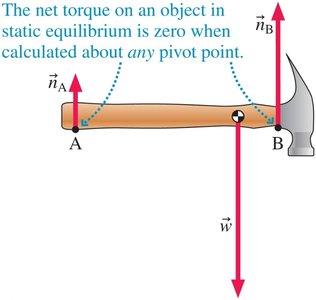
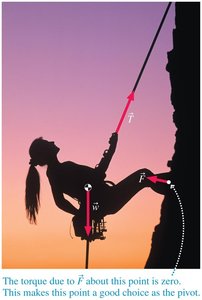
Torque calculations can be performed about any point, but choosing a point where unknown forces act can simplify the analysis.
The natural axis of rotation is often a convenient pivot, especially where forces are not well specified.
Stability and Balance
Base of Support and Center of Gravity
An object's base of support is the area over which it rests.
A wider base and a lower center of gravity increase stability.
As long as the center of gravity remains over the base, the object is stable; if it moves outside, the object becomes unstable and may topple.
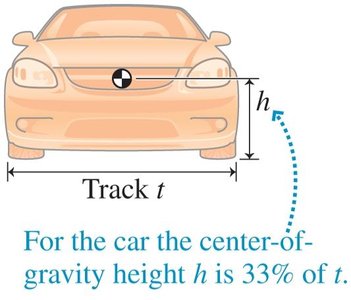
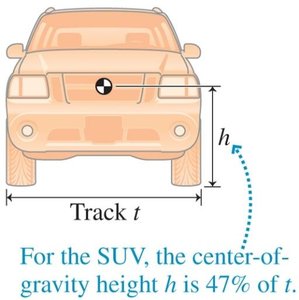
The critical angle for toppling depends on the track width and the height of the center of gravity:
Vehicles with a higher are less likely to roll over.
Stability of the Human Body
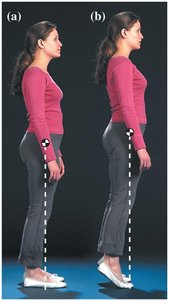
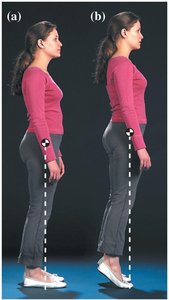
Humans maintain stability by adjusting their limbs to keep the center of gravity over the base of support.
Standing on tiptoes requires leaning forward to maintain balance.
Elasticity and Hooke’s Law
Elastic Deformation
All solid objects deform under applied forces, though some deformations are very small.
Materials that return to their original shape after deformation are called elastic.
The restoring force acts to return the object to equilibrium.
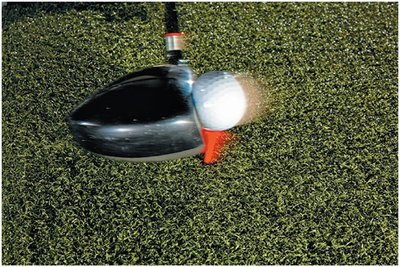
Hooke’s Law
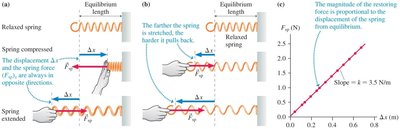
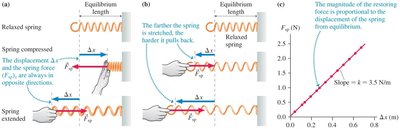
The force exerted by a spring is proportional to its displacement from equilibrium:
is the spring constant (N/m), a measure of stiffness.
The negative sign indicates the force is in the opposite direction of displacement.
Stretching and Compressing Materials
Atomic Model of Solids
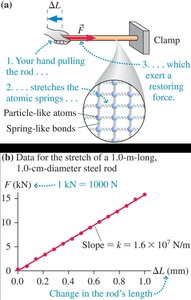
Solids can be modeled as atoms connected by spring-like bonds.
Applying a force stretches these bonds, causing the material to deform.
Young’s Modulus and Material Properties
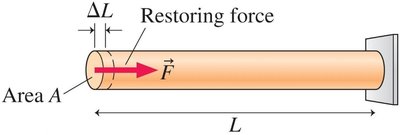
The spring constant for a rod depends on its cross-sectional area , length , and the material’s Young’s modulus :
Young’s modulus is a measure of a material’s stiffness.
Stress and Strain
Stress is the force per unit area:
Strain is the fractional change in length:
Hooke’s law for materials:

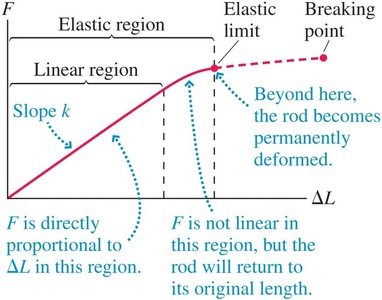
Elastic Limit and Permanent Deformation
Within the elastic region, deformation is reversible and follows Hooke’s law.
Beyond the elastic limit, the material is permanently deformed and may eventually break.
Biological Materials
Structure of Bone
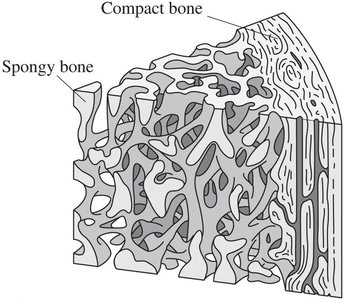
Bones are composed of dense, rigid compact bone and flexible, porous spongy bone.
This structure provides both strength and flexibility.
Tensile Strength of Biological Materials
Material | Young’s Modulus (N/m2) |
|---|---|
Spongy bone | |
Compact bone | |
Tendon | |
Spider silk |
Example: Forces in the Ankle Joint
Biomechanical Analysis
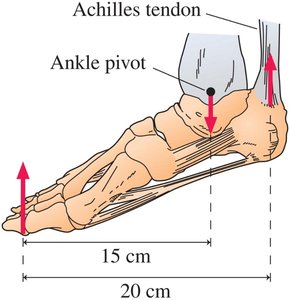
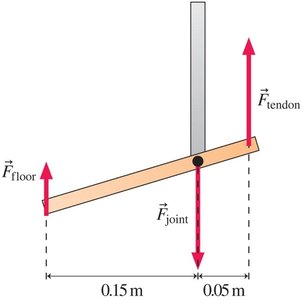
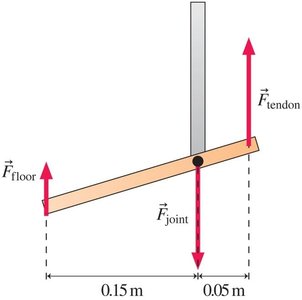
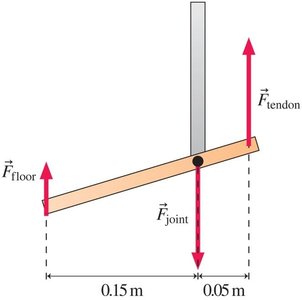
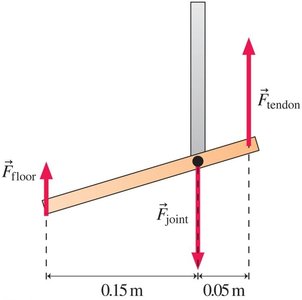
When standing on tiptoe, the foot pivots about the ankle, with forces applied by the floor, the Achilles tendon, and the ankle joint.
Static equilibrium conditions are used to solve for unknown forces.
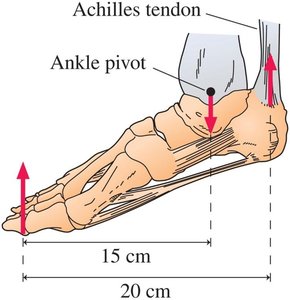
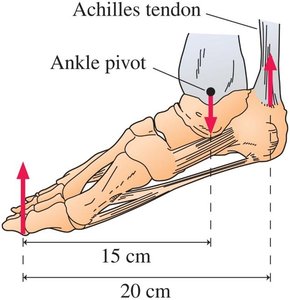
Given: Woman’s mass kg, N (rounded), distances to pivot are 0.15 m (floor) and 0.05 m (tendon).
Torque equilibrium about the ankle:
This is three times the woman’s weight.
Vertical force equilibrium:
The force in the ankle joint is four times her weight.
Conclusion
Static equilibrium and elasticity principles are essential for understanding the stability of structures and the mechanical properties of materials, including biological tissues.
These concepts are widely applicable in engineering, biomechanics, and safety analysis.
