 Back
Equilibrium & Elasticity: Statics, Stress, Strain, and Moduli
Study Guide - Smart Notes
 Tailored notes based on your materials, expanded with key definitions, examples, and context.
Equilibrium & Elasticity
Overview of Equilibrium and Elasticity
Equilibrium and elasticity are fundamental concepts in physics, especially in the study of statics and material properties. Equilibrium refers to the state in which a body remains at rest or moves with constant velocity, while elasticity describes how materials deform and return to their original shape under applied forces.
Statics: Conditions for Equilibrium
Equilibrium Conditions
For an extended body to be in equilibrium, two main conditions must be satisfied:
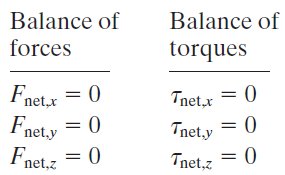
First Condition (Translational Equilibrium): The vector sum of all external forces acting on the body must be zero.
Second Condition (Rotational Equilibrium): The sum of all external torques about any point must be zero.
These requirements ensure that the body does not accelerate linearly or rotationally.


Center of Gravity
The center of gravity is the point at which the entire weight of a body can be considered to act. For most practical purposes, if gravity is uniform, the center of gravity coincides with the center of mass.
Suspension: When a body is suspended, the center of gravity is directly above or below the suspension point.
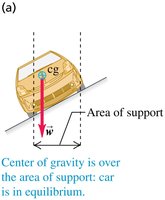
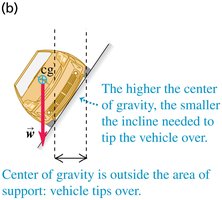
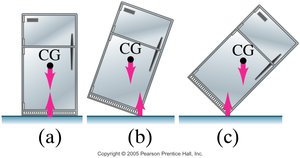
Support: For stability, the center of gravity must lie within the area bounded by the supports.

Stability and Balance
An object in stable equilibrium may become unstable if its center of gravity moves outside its area of support. Stability is crucial in engineering and architecture.
Torque
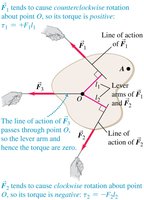
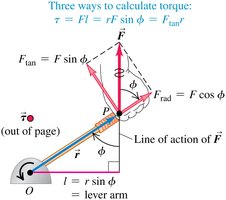
Torque is the rotational equivalent of force. It is defined as the product of the force and the perpendicular distance from the axis of rotation (lever arm).
Line of Action: The line along which the force vector acts.
Lever Arm: The perpendicular distance from the axis to the line of action.
Calculation:
Elasticity: Stress, Strain, and Moduli
Types of Stress
Stress is the force applied per unit area, and it produces strain, which is the resulting deformation. There are three main types of stress:
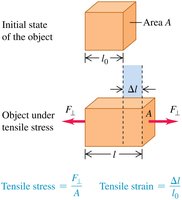
Tensile Stress: Stretching forces acting at the ends of an object.
Bulk Stress: Forces applied from all sides, such as pressure in fluids.
Shear Stress: Forces applied parallel to the surface, causing deformation.

Hooke's Law and Springs
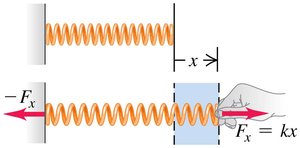
Hooke's Law states that the force required to stretch a spring is proportional to the displacement:
Formula:
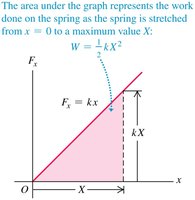
Work Done: The area under the force vs. displacement graph represents the work done:
Stress and Strain Relationship
Stress and strain are proportional for small deformations. The constant of proportionality is called the modulus of elasticity.
Stress:
Strain:
Modulus:
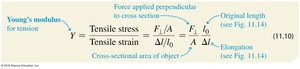
Tensile Stress and Young's Modulus
Tensile stress stretches an object, producing tensile strain. Young's modulus quantifies the stiffness of a material under tension.
Young's Modulus:
Compressive Stress and Strain
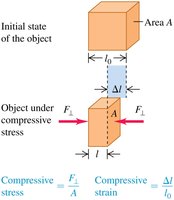
Compressive stress compresses an object, producing compressive strain. The definitions are analogous to tensile stress and strain.
Compressive Stress:
Compressive Strain:
Shear Stress and Shear Modulus
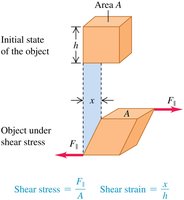
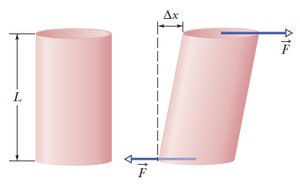
Shear stress is caused by forces acting parallel to the surface, resulting in shear strain. The shear modulus quantifies resistance to shear deformation.
Shear Stress:
Shear Strain:
Shear Modulus:
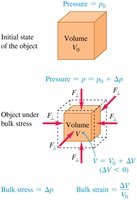
Bulk Stress and Bulk Modulus
Bulk stress is associated with changes in volume due to pressure. The bulk modulus measures a material's resistance to uniform compression.
Bulk Stress:
Bulk Strain:
Bulk Modulus:
Compressibility:

Elastic Moduli of Materials
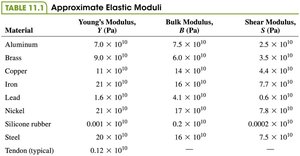
Different materials have characteristic values for Young's modulus, bulk modulus, and shear modulus. These values indicate their stiffness and resistance to deformation.
Material | Young's Modulus (Y) | Bulk Modulus (B) | Shear Modulus (S) |
|---|---|---|---|
Aluminum | 7.0 × 10¹⁰ Pa | 7.5 × 10¹⁰ Pa | 2.5 × 10¹⁰ Pa |
Brass | 9.0 × 10¹⁰ Pa | 6.0 × 10¹⁰ Pa | 3.5 × 10¹⁰ Pa |
Copper | 11 × 1010 Pa | 14 × 1010 Pa | 4.4 × 10¹⁰ Pa |
Iron | 21 × 1010 Pa | 16 × 1010 Pa | 8.0 × 10¹⁰ Pa |
Steel | 20 × 1010 Pa | 16 × 1010 Pa | 7.5 × 10¹⁰ Pa |
Tendon (typical) | 0.12 × 10¹⁰ Pa | — | — |
Elasticity and Plasticity
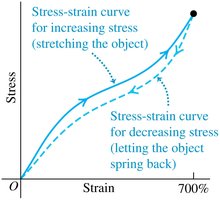
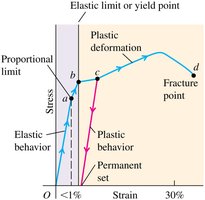
Hooke's law is valid only within the elastic limit. Beyond this limit, materials exhibit plastic behavior and may not return to their original shape. The stress-strain diagram illustrates elastic hysteresis and permanent deformation.
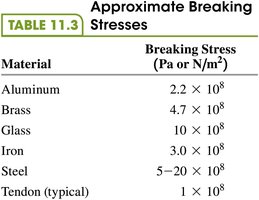
Fracture and Breaking Stress
If the applied stress exceeds a material's ultimate strength, it will fracture. The breaking stress is the value at which this occurs. For safety, anticipated stresses should be kept well below the breaking stress.
Material | Breaking Stress (Pa) |
|---|---|
Aluminum | 2.2 × 10⁸ |
Brass | 4.7 × 10⁸ |
Glass | 10 × 108 |
Iron | 3.0 × 10⁸ |
Steel | 5–20 × 108 |
Tendon (typical) | 1 × 10⁸ |
Springs in Series and Parallel
Spring Combinations
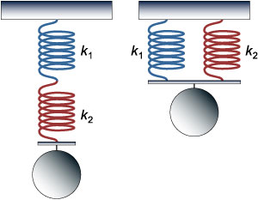
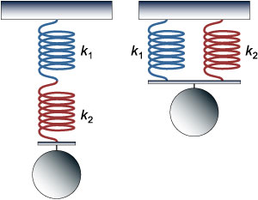
When springs are combined, their effective spring constant changes depending on the configuration:
Series:
Parallel:
Example Problems
Atwood's Machine
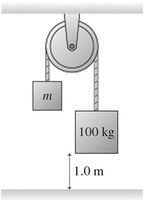
Atwood's machine consists of two masses connected by a string over a pulley. It is used to study acceleration and equilibrium in systems.
Acceleration Calculation:
Equilibrium: When , the system is in equilibrium.
Stress, Strain, and Modulus Calculations
Typical problems involve calculating the stretch of a wire, the effect of changing dimensions, and determining Young's modulus from experimental data.
Stretch Calculation:
Effect of Diameter and Length: Changing diameter or length affects the stretch and modulus calculations.
Summary Table: Balance of Forces and Torques
Balance of Forces | Balance of Torques |
|---|---|
|
|
Key Definitions
Stress: Force per unit area applied to a material.
Strain: Fractional change in dimension due to applied stress.
Elastic Modulus: Ratio of stress to strain; quantifies material stiffness.
Torque: Rotational effect of a force; product of force and lever arm.
Equilibrium: State where net force and net torque are zero.
Examples and Applications
Engineering: Design of bridges, buildings, and mechanical systems relies on understanding equilibrium and material properties.
Biomechanics: Tendons and bones are analyzed for their elastic moduli and breaking stresses.
Everyday Life: Springs in vehicles, musical instruments, and household items demonstrate elasticity and equilibrium principles.
