Back
BackEquilibrium and Elasticity: Structured Study Notes
Study Guide - Smart Notes
 Tailored notes based on your materials, expanded with key definitions, examples, and context.
Equilibrium and Elasticity
Introduction to Equilibrium and Elasticity
Equilibrium and elasticity are fundamental concepts in physics, especially in mechanics and material science. Equilibrium refers to the state in which a body remains at rest or moves with constant velocity, while elasticity describes the ability of materials to return to their original shape after being deformed. These principles are crucial in engineering and construction, as illustrated by structures such as Roman aqueducts, which use arches to sustain weight efficiently.

Conditions for Equilibrium
For a rigid body to be in static equilibrium, two essential conditions must be satisfied:
First Condition (Translational Equilibrium): The vector sum of all external forces acting on the body must be zero. This ensures the body does not accelerate.
Second Condition (Rotational Equilibrium): The sum of all external torques about any point must be zero. This prevents the body from rotating.


Equations:
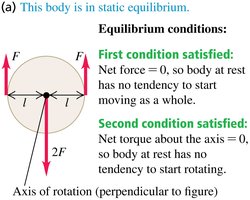
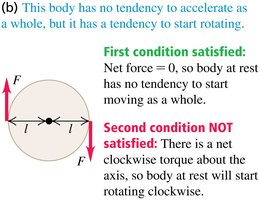
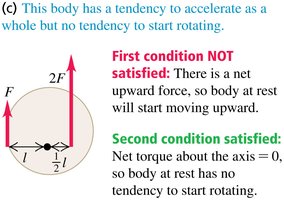
Examples of Equilibrium Conditions
Understanding equilibrium involves analyzing both force and torque. The following examples illustrate different scenarios:
Static Equilibrium: Both force and torque conditions are satisfied; the body remains at rest.
Translational Equilibrium Only: Net force is zero, but net torque is not; the body may start rotating.
Rotational Equilibrium Only: Net torque is zero, but net force is not; the body may start moving linearly.
Center of Gravity
The center of gravity is the point at which the entire weight of a body can be considered to act. For most practical purposes, especially when gravity is nearly uniform, the center of gravity coincides with the center of mass. This concept is vital for analyzing stability and equilibrium in structures.
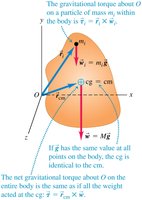
Example: The Petronas Towers in Malaysia have a center of gravity only slightly below their center of mass due to minimal variation in gravity with altitude.

Determining Center of Gravity
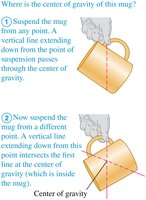
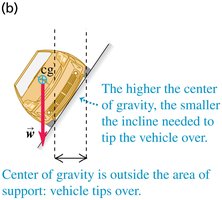
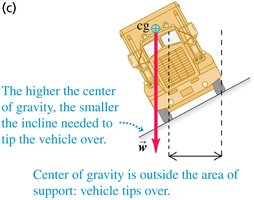
When a body is suspended or supported at a single point, its center of gravity lies directly above or below the point of suspension. For equilibrium, the center of gravity must be within the area bounded by the supports.
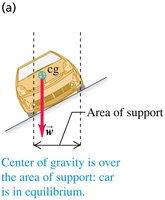
If the center of gravity lies outside the area of support, the body is not in equilibrium and may tip over.
Problem-Solving Strategy for Static Equilibrium
To solve static equilibrium problems, follow these steps:
Sketch the physical situation and identify the body in equilibrium.
Draw a free-body diagram showing all forces acting on the body.
Choose coordinate axes and specify their direction.
Choose a reference point about which to compute torques.
Write equations expressing the equilibrium conditions: , , .
Check your results by computing torques with respect to different reference points.
Elasticity: Stress, Strain, and Moduli
Types of Stress
Stress is the force per unit area applied to a material. There are three main types:
Tensile Stress: Stretching forces (e.g., guitar strings).
Bulk Stress: Compression from all sides (e.g., diver underwater).
Shear Stress: Forces causing deformation parallel to the surface (e.g., ribbon cut by scissors).

Stress and Strain
Stress is defined as force per unit area, while strain is the fractional change in size or shape. Elastic deformation occurs when the material returns to its original shape after the force is removed.

Tensile Stress and Strain
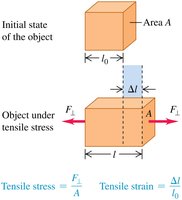
When an object is subjected to tension, it elongates. The net force is zero, but the object deforms, producing tensile strain.
Tensile Stress:
Tensile Strain:
Young's Modulus
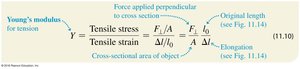
Young's modulus quantifies the relationship between tensile stress and strain for elastic materials. It is defined as:
Compressive Stress and Strain
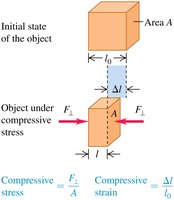
Compressive stress occurs when an object is squeezed, causing it to contract. The definitions are analogous to those for tensile stress and strain.
Compression and Tension in Beams
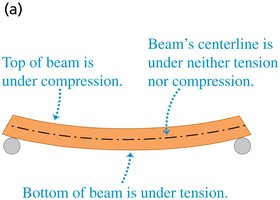
Beams supported at both ends can experience both compressive and tensile stresses simultaneously. The top of the beam is under compression, while the bottom is under tension.
Bulk Stress and Strain
Bulk stress is caused by pressure applied uniformly from all directions, leading to a change in volume. The bulk modulus is defined as:
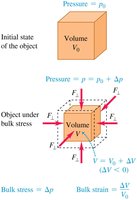
Example: Anglerfish can withstand high bulk stress at great ocean depths due to the absence of internal air spaces.

Shear Stress and Strain
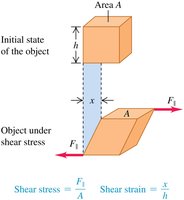
Shear stress results from forces applied parallel to a surface, causing deformation. The shear modulus is given by:
Elastic Moduli of Materials
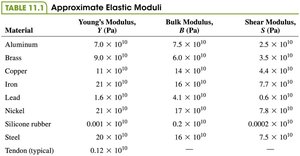
Elastic moduli quantify the stiffness of materials. The main types are Young's modulus, bulk modulus, and shear modulus. The following table compares these values for common materials:
Material | Young's Modulus, Y (Pa) | Bulk Modulus, B (Pa) | Shear Modulus, S (Pa) |
|---|---|---|---|
Aluminum | 7.0 × 10¹⁰ | 7.5 × 10¹⁰ | 2.5 × 10¹⁰ |
Brass | 9.0 × 10¹⁰ | 6.0 × 10¹⁰ | 3.5 × 10¹⁰ |
Copper | 11 × 1010 | 14 × 1010 | 4.4 × 10¹⁰ |
Iron | 21 × 1010 | 16 × 1010 | 8.0 × 10¹⁰ |
Steel | 20 × 1010 | 16 × 1010 | 7.5 × 10¹⁰ |
Tendon (typical) | 0.12 × 10¹⁰ | — | — |
Additional info: See image_22 for more materials. |
Compressibility
The reciprocal of the bulk modulus is called compressibility, denoted by k. It measures how much a material's volume changes under pressure.
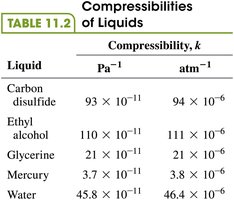
The following table shows compressibilities for common liquids:
Liquid | Compressibility, k (Pa-1) | Compressibility, k (atm-1) |
|---|---|---|
Carbon disulfide | 93 × 10-11 | 94 × 10-6 |
Ethyl alcohol | 110 × 10-11 | 111 × 10-6 |
Glycerine | 21 × 10-11 | 21 × 10-6 |
Mercury | 3.7 × 10⁻¹¹ | 3.8 × 10⁻⁶ |
Water | 45.8 × 10⁻¹¹ | 46.4 × 10⁻⁶ |

Elasticity and Plasticity
Hooke's law describes the proportionality of stress and strain in elastic deformations, but this relationship holds only within a limited range. Beyond the elastic limit, materials exhibit plastic behavior and may not return to their original shape. Elastic hysteresis is observed in materials like vulcanized rubber, where the stress-strain curve differs for loading and unloading.
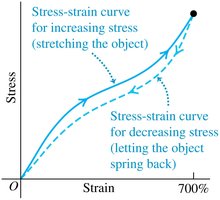
For ductile metals, the stress-strain diagram shows regions of elastic and plastic behavior, as well as the fracture point.
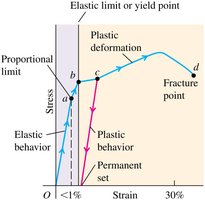
Breaking Stress
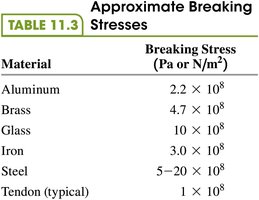
The breaking stress is the value of stress required to cause actual fracture of a material. Typical values for several materials are shown below:
Material | Breaking Stress (Pa or N/m2) |
|---|---|
Aluminum | 2.2 × 10⁸ |
Brass | 4.7 × 10⁸ |
Glass | 10 × 108 |
Iron | 3.0 × 10⁸ |
Steel | 5–20 × 108 |
Tendon (typical) | 1 × 10⁸ |