 Back
BackEquilibrium and Elasticity: Study Notes
Study Guide - Smart Notes
 Tailored notes based on your materials, expanded with key definitions, examples, and context.
Equilibrium and Elasticity
Introduction to Equilibrium and Elasticity
Equilibrium and elasticity are fundamental concepts in mechanics, describing how objects respond to forces and how materials deform under stress. This chapter covers the conditions for equilibrium, the calculation of torques, and the elastic properties of materials.
Torque and Rotational Equilibrium
Definition of Torque
Torque (\( \tau \)) is a measure of the tendency of a force to rotate an object about an axis. It depends on both the magnitude of the force and the perpendicular distance from the axis of rotation (lever arm):
Units: Newton-meter (Nm)
Sign convention: Positive for counterclockwise (ccw) rotation, negative for clockwise (cw) rotation.
Net Torque Example
When multiple forces act on an object, the net torque is the algebraic sum of individual torques. For example, if two forces act on a door in opposite directions:
\( F_1 = 250\,\text{N} \) at \( d_1 = 1\,\text{m} \)
\( F_2 = 200\,\text{N} \) at \( d_2 = 0.5\,\text{m} \)
Net torque:
Center of Gravity
Finding the Center of Gravity
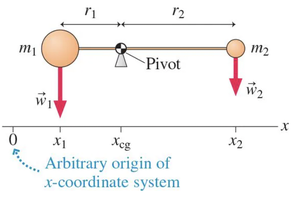
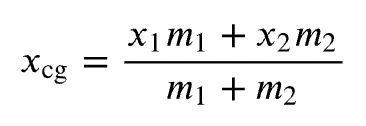
The center of gravity (\( x_{cg} \)) is the point where the total weight of a system can be considered to act. For a system of particles:
Conditions for Equilibrium
Static Equilibrium
An object is in static equilibrium if both the net force and the net torque acting on it are zero:
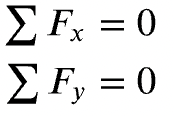
Translational equilibrium: No net force in any direction.
Rotational equilibrium: No net torque about any axis.
Example: Static Equilibrium
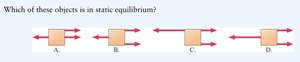
Consider which of the following objects is in static equilibrium based on the forces shown:
Solving Equilibrium Problems
Finding Unknown Forces
To solve for unknown forces in equilibrium, apply the conditions for equilibrium to the system. For example, a 100 N board resting on two sawhorses:
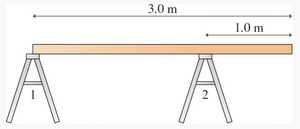
Sum of vertical forces:
Sum of torques about one support to solve for the normal forces and .
Ladder Problems
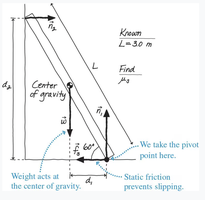
For objects like ladders, consider both the forces and torques, as well as frictional forces at the base. For a ladder at 60° with the floor, the minimum coefficient of static friction (\( \mu_s \)) can be found by setting the sum of torques and forces to zero:
Elasticity in Materials
Elastic and Plastic Behavior
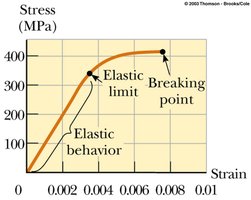
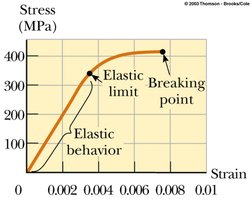
Elasticity describes how materials deform and return to their original shape when forces are applied and then removed. The stress-strain relationship characterizes this behavior:
Elastic regime: Deformation is proportional to applied force; material returns to original shape.
Plastic regime: Permanent deformation occurs beyond the elastic limit.
Breaking point: Material fails and breaks.
Types of Stress
Tensile stress: Pulling force per unit area.
Shear stress: Force parallel to the surface per unit area.
Compression: Pushing force per unit area (linear or bulk compression).
Applications of Elasticity
Elastic behavior of ligaments and tissues
Compression and fracture of bones
Engineering and design of structures
Hooke's Law and Springs
Restoring Force of a Spring
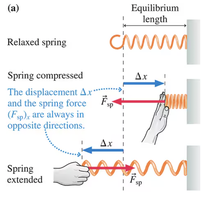
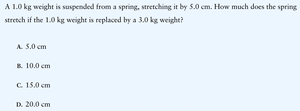
The restoring force of a spring is described by Hooke's Law:
\( k \): Spring constant (N/m)
\( x \): Displacement from equilibrium position
Negative sign: Force is always directed opposite to displacement
Energy in Springs
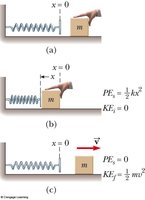
The potential energy stored in a stretched or compressed spring is:
When the spring is released, this energy is converted to kinetic energy.
Deformation of Solids: Hooke’s Law
Linear Elasticity
When a force is applied to a solid, it deforms. In the elastic range, the deformation is proportional to the applied force:
\( \Delta L \): Change in length
\( k \): Proportionality constant (depends on material and geometry)
Stress and Strain
Stress is the force per unit area, and strain is the relative deformation:
Tensile stress:
Tensile strain:
Young's modulus:
Units: Pascal (Pa) or N/m2
Young's modulus is a measure of material stiffness.
Stress-Strain Curve
The stress-strain curve illustrates the elastic, plastic, and breaking regions of a material's response to stress:
Summary Table: Key Elasticity Quantities
Quantity | Symbol | Formula | Units |
|---|---|---|---|
Torque | \( \tau \) | Nm | |
Spring Force | \( F \) | N | |
Potential Energy (spring) | \( PE_s \) | J | |
Tensile Stress | \( s \) | Pa (N/m2) | |
Tensile Strain | \( e \) | Dimensionless | |
Young's Modulus | \( Y \) | Pa (N/m2) |
