 Back
BackEquilibrium and Simple Harmonic Motion: Study Notes for College Physics
Study Guide - Smart Notes
 Tailored notes based on your materials, expanded with key definitions, examples, and context.
Equilibrium and Elasticity
Conditions for Equilibrium
Equilibrium in physics refers to the state in which the sum of all forces and torques acting on a body is zero, resulting in no linear or rotational acceleration. This is essential for analyzing static structures and objects at rest.
First Condition for Equilibrium: The vector sum of all external forces acting on a body must be zero.
Second Condition for Equilibrium: The vector sum of all external torques about any axis must be zero.


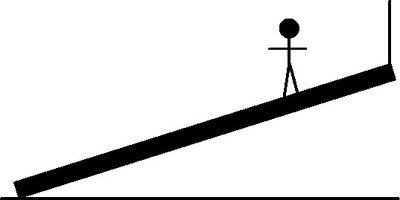
Example: A uniform board supported at one end by the floor and at the other by a rope, with a person standing on it, is a classic equilibrium problem. The forces include the weight of the board, the weight of the person, the tension in the rope, and the normal force from the floor.
Key Equations:
Sum of forces in the y-direction:
Sum of torques about the pivot point:
Periodic Motion and Simple Harmonic Oscillators
Introduction to Periodic Motion
Periodic motion is any motion that repeats itself at regular time intervals. The most fundamental type is simple harmonic motion (SHM), where the restoring force is directly proportional to the displacement from equilibrium and acts in the opposite direction.
Restoring Force: The force that brings the system back toward equilibrium.
Oscillation: The repetitive movement about an equilibrium position.

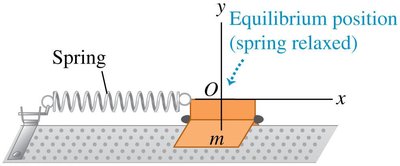
Example: Mass-Spring System
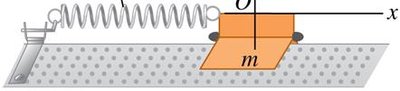
A glider attached to a spring on a frictionless surface is a classic example of SHM. When displaced from equilibrium, the spring exerts a restoring force proportional to the displacement.
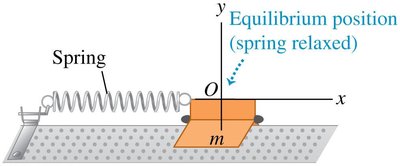
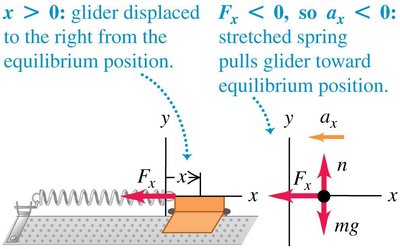
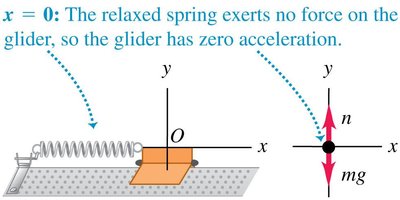
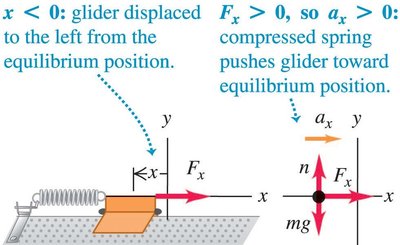
Hooke's Law: The restoring force is given by:
where is the spring constant and is the displacement from equilibrium.
Characteristics of Simple Harmonic Motion (SHM)
SHM is defined by several key parameters:
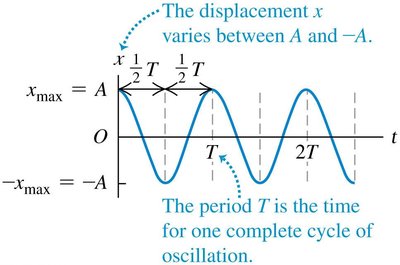
Amplitude (A): Maximum displacement from equilibrium.
Period (T): Time for one complete cycle.
Frequency (f): Number of cycles per unit time ().
Angular Frequency (\(\omega\)):
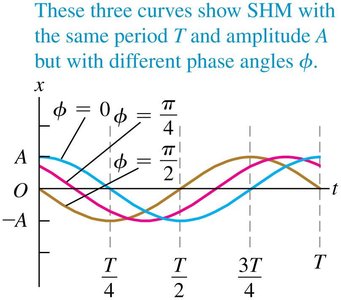
Displacement as a function of time:

Period and Frequency for a Mass-Spring System:
Angular frequency:
Frequency:
Period:


Displacement, Velocity, and Acceleration in SHM
In SHM, the displacement, velocity, and acceleration of the mass vary sinusoidally with time. The velocity is maximum at the equilibrium position, while the acceleration is maximum at the endpoints (maximum displacement).
Energy in Simple Harmonic Motion
In SHM, only conservative forces act, so the total mechanical energy (sum of kinetic and potential energy) is conserved. The energy oscillates between kinetic and potential forms as the mass moves.
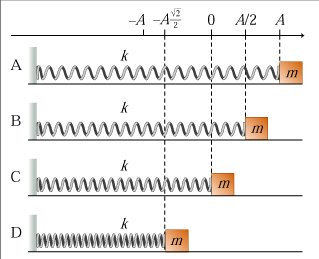
Kinetic Energy (KE):
Potential Energy (PE):
Total Mechanical Energy (E): (constant)
Example: An object of weight 2.45 N attached to a spring oscillates with a period of 0.64 s and amplitude of 12 cm. To find the spring constant and total mechanical energy:
Use to solve for .
Total energy:
Summary Table: Key Equations for SHM
Quantity | Equation | Description |
|---|---|---|
Restoring Force | Hooke's Law | |
Displacement | Position as a function of time | |
Angular Frequency | Depends on mass and spring constant | |
Frequency | Cycles per second | |
Period | Time for one cycle | |
Total Energy | Constant for SHM |
Additional info: These notes cover the core concepts of equilibrium (statics) and simple harmonic motion (dynamics), which are foundational for understanding more advanced topics in mechanics and waves.
