 Back
BackEquipotentials, Electric Potential, and Conductors in Electrostatics
Study Guide - Smart Notes
 Tailored notes based on your materials, expanded with key definitions, examples, and context.
Equipotentials and Electric Potential
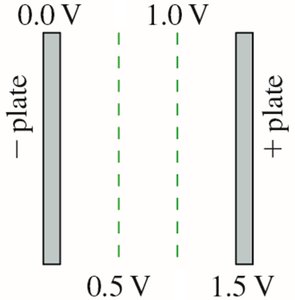
Equipotentials in a Uniform Electric Field
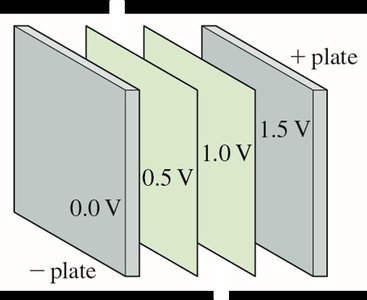
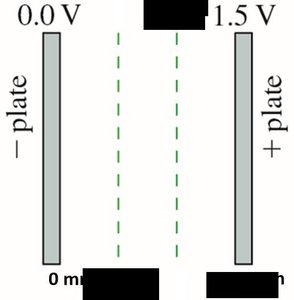
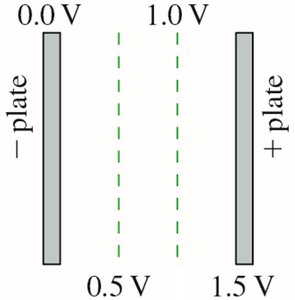
Equipotential surfaces are regions where the electric potential is constant. In a uniform electric field, such as that between parallel plate capacitors, equipotential surfaces are parallel to the plates and spaced evenly.
Definition: An equipotential is a surface or line where the electric potential is the same at every point.
Key property: No work is required to move a charge along an equipotential.
Example: In a parallel plate capacitor, the potential increases linearly from the negative plate to the positive plate.
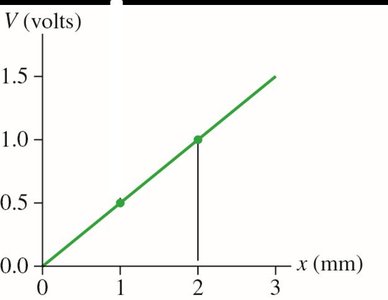
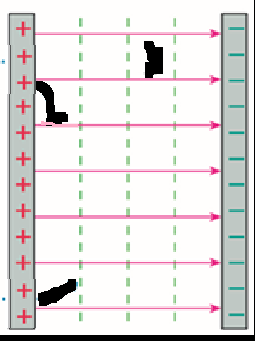
Formula: For a uniform field between plates:
where is the change in potential, is the electric field strength, and is the distance moved in the direction of the field.
Equipotentials of a Point Charge
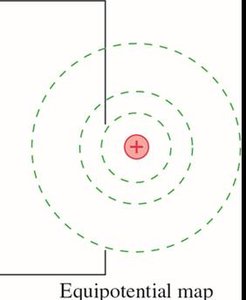
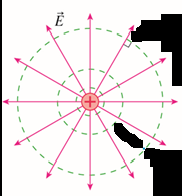
For a single point charge, equipotential surfaces are concentric spheres centered on the charge. The electric field points radially outward (for positive charge) and is perpendicular to each equipotential surface.
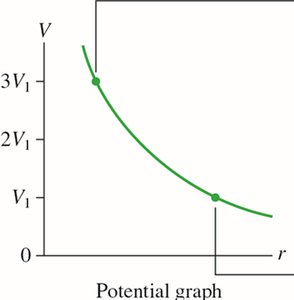
Potential at distance r:
Equipotential surfaces: Spheres where is constant.
Equipotentials of a Dipole
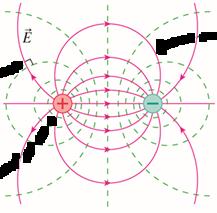
An electric dipole consists of two equal and opposite charges. The equipotential lines are more complex, forming closed curves around each charge and between them. The electric field lines emerge from the positive charge and terminate at the negative charge.
Dipole potential: (approximate, for points far from the dipole)
Equipotential lines: Symmetric about the axis joining the charges.
Electric Potential Energy and Conservation of Energy
Electric Potential Energy
Electric potential energy is the energy a charge has due to its position in an electric field. Moving a charge in an electric field changes its potential energy.
Formula:
Work done by the field:
Conservation of Energy:
Example: Two protons launched from the same point in a uniform field will have the same change in potential energy if they end at points with the same potential.
Acceleration of Charges in an Electric Field
When a proton and an electron are accelerated across the same distance in a uniform electric field, the electron experiences a larger acceleration due to its smaller mass.
Force:
Acceleration:
Electron: Larger acceleration because
Electric Field Strength and Equipotential Spacing
Relationship Between Field Strength and Equipotential Spacing
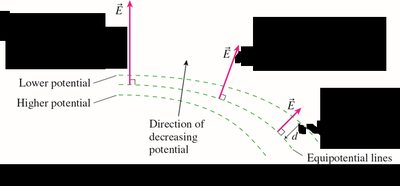
The electric field is strongest where equipotential lines are closest together. The direction of the field is perpendicular to equipotential lines, pointing from higher to lower potential.
Field strength:
Direction: Perpendicular to equipotential lines, toward decreasing potential.
Estimating Electric Field from Equipotential Maps
Given a map of equipotential lines, the magnitude of the electric field at a point can be estimated by the spacing of the lines. Closer lines indicate a stronger field.
Example: At points where lines are closer, is larger.
Potential Graphs and Field Magnitude
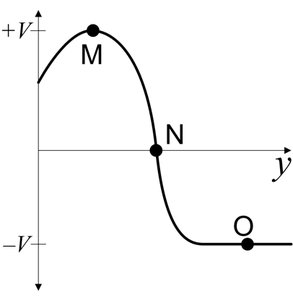
On a graph of potential versus position, the slope at a point gives the magnitude of the electric field. The steeper the slope, the stronger the field.
Field magnitude:
Conductors in Electrostatic Equilibrium
Properties of Conductors
When a conductor is in electrostatic equilibrium, several important properties hold:
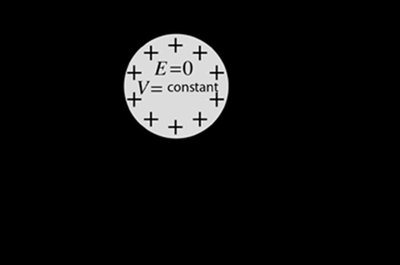
Any excess charge resides on the surface.
The electric field inside is zero.
The exterior field is perpendicular to the surface.
Field strength is largest at sharp corners.
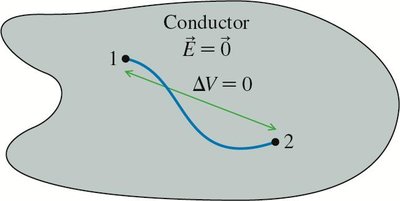
The entire conductor is at the same potential; its surface is an equipotential.
Formulas for a charged conducting sphere:
Inside: ,
At surface:
Outside: ,
Work and Potential Inside a Conductor
Since the electric field inside a conductor is zero, no work is required to move a charge within it, and all points inside are at the same potential.
Conducting Spheres in Contact
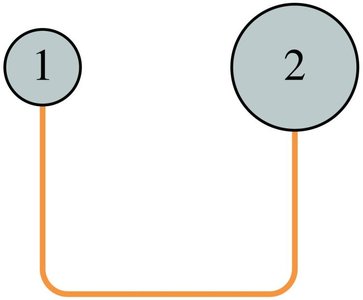
When two conducting spheres are connected by a wire, they share the same electric potential, but not necessarily the same charge or electric field.
Key property: Spheres in contact have equal potential.
Charge distribution: Depends on size and capacitance.
Summary Table: Properties of Conductors in Electrostatic Equilibrium
Property | Description |
|---|---|
Excess charge location | On the surface |
Electric field inside | Zero |
Field direction outside | Perpendicular to surface |
Field strength at corners | Largest |
Potential | Constant throughout conductor |
