 Back
BackEssential Kinematics, Dynamics, and Work-Energy Principles in Physics
Study Guide - Smart Notes
 Tailored notes based on your materials, expanded with key definitions, examples, and context.
Kinematics in One Dimension
Basic Kinematic Equations
Kinematics describes the motion of objects without considering the causes of motion. The following equations are fundamental for analyzing motion with constant acceleration:
Final velocity:
Displacement (using initial velocity and acceleration):
Final velocity squared:
Displacement (using average velocity):
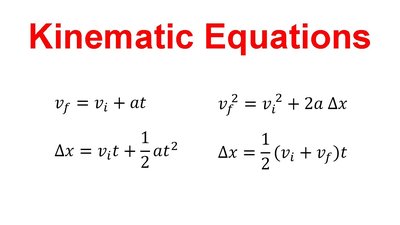
Definitions:
Displacement (): The change in position of an object.
Velocity (): The rate of change of displacement with respect to time.
Acceleration (): The rate of change of velocity with respect to time.
Example: A car accelerates from rest () at for . Its final velocity is .
Average and Instantaneous Velocity
Average velocity is defined as the total displacement divided by the total time interval:
Instantaneous velocity is the velocity at a specific instant, defined as the limit as the time interval approaches zero:
Speed is the magnitude of velocity and is always positive.
Average and Instantaneous Acceleration
Average acceleration is the change in velocity over the change in time:
Instantaneous acceleration is the limit as the time interval approaches zero:
Units: Acceleration is measured in .
Uniform and Non-Uniform Motion
Uniform motion: (constant velocity)
Non-uniform motion: (velocity varies with time)
Relative Motion and Catch-Up Problems
Relative motion problems often involve determining when one moving object overtakes another. For example, if Car A has a head start and Car B starts later with a higher speed, the time for Car B to catch up is:
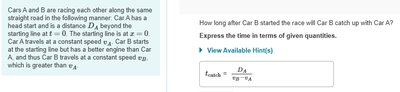
Example: If Car A is 100 m ahead and moves at , and Car B moves at , then .
Projectile Motion: Range Equation
The range of a projectile launched at an angle with initial speed is given by:
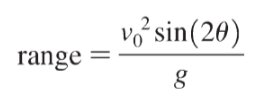
This equation assumes launch and landing heights are equal and neglects air resistance.
Dynamics: Force and Newton's Laws
Newton's Second Law
Newton's second law relates the net force acting on a particle to its acceleration:
In calculus form, for a particle of mass :
Using the chain rule, velocity as a function of position:
So,
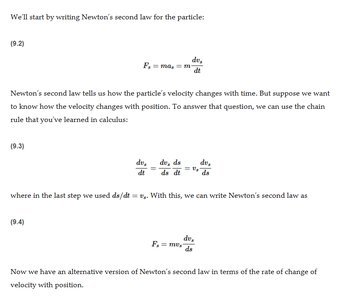
This form is useful for analyzing motion when force depends on position.
Friction and Normal Force
Friction force: , where is the coefficient of friction and is the normal force.
Normal force for a static object: (on a horizontal surface).
Work and Kinetic Energy
Kinetic Energy
Kinetic energy () is the energy of motion. It is always non-negative:
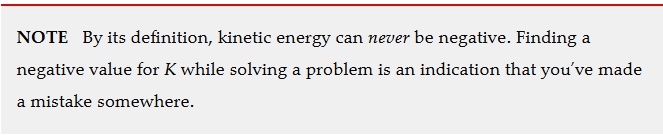
Note: If you calculate a negative kinetic energy, check your work for errors.
Work
Work is done when a force causes displacement. The basic definition is:
Where is the angle between the force and displacement vectors.
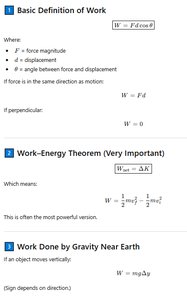
If force and displacement are in the same direction, . If perpendicular, .
Work-Energy Theorem
The net work done on an object equals its change in kinetic energy:
Work Done by Gravity
For vertical motion near Earth's surface:
Dot Product and Work
The dot product is used to calculate work when force and displacement are vectors:
Component form:
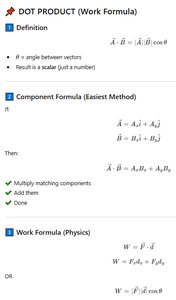
Work can be calculated directly using vector components, which automatically accounts for the angle between vectors.
General Formula for Work (Variable Force)
When force varies with position, work is given by the integral:
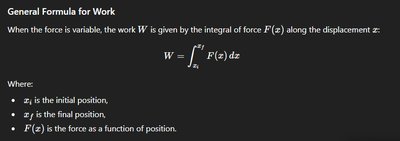
Where and are the initial and final positions, and is the force as a function of position.
Example: If , the work done from to is (units depend on the force and displacement units).
