 Back
Exam 1 Review: Kinematics and Newtonian Mechanics (Chapters 1-4)
Study Guide - Smart Notes
 Tailored notes based on your materials, expanded with key definitions, examples, and context.
Kinematic Definitions
Position and Displacement
The position of an object is described by a position vector, \( \vec{r} \). Displacement is the difference between two positions and represents the change in position over a time interval.
Displacement vector: \( \Delta \vec{r} = \vec{r}_f - \vec{r}_i \)
Component form: \( \Delta \vec{r} = \Delta x \hat{i} + \Delta y \hat{j} + \Delta z \hat{k} \)
\( \Delta x = x_f - x_i \), \( \Delta y = y_f - y_i \), \( \Delta z = z_f - z_i \)
Magnitude of displacement: \( \Delta r = \sqrt{(\Delta x)^2 + (\Delta y)^2 + (\Delta z)^2} \)
Velocity
Velocity describes the rate of change of position. The average velocity is displacement divided by the time interval, while instantaneous velocity is the limit as the interval approaches zero.
Average velocity: \( \vec{v}_{av} = \frac{\Delta \vec{r}}{\Delta t} \)
Component form: \( \vec{v}_{av} = v_{av,x} \hat{i} + v_{av,y} \hat{j} + v_{av,z} \hat{k} \)
\( v_{av,x} = \frac{\Delta x}{\Delta t} \), \( v_{av,y} = \frac{\Delta y}{\Delta t} \), \( v_{av,z} = \frac{\Delta z}{\Delta t} \)
Instantaneous velocity: \( \vec{v} = \lim_{\Delta t \to 0} \frac{\Delta \vec{r}}{\Delta t} = \frac{d\vec{r}}{dt} \)
Component form: \( \vec{v} = v_x \hat{i} + v_y \hat{j} + v_z \hat{k} \), where \( v_x = \frac{dx}{dt} \), \( v_y = \frac{dy}{dt} \), \( v_z = \frac{dz}{dt} \)
Speed (magnitude): \( v = \sqrt{v_x^2 + v_y^2 + v_z^2} \)
Displacement from velocity: \( \Delta \vec{r} = \int_{t_1}^{t_2} \vec{v} \, dt \)
Acceleration
Acceleration is the rate of change of velocity. The average acceleration is the change in velocity over a time interval, while instantaneous acceleration is the limit as the interval approaches zero.
Average acceleration: \( \vec{a}_{av} = \frac{\Delta \vec{v}}{\Delta t} \)
Component form: \( \vec{a}_{av} = a_{av,x} \hat{i} + a_{av,y} \hat{j} + a_{av,z} \hat{k} \)
\( a_{av,x} = \frac{\Delta v_x}{\Delta t} \), \( a_{av,y} = \frac{\Delta v_y}{\Delta t} \), \( a_{av,z} = \frac{\Delta v_z}{\Delta t} \)
Instantaneous acceleration: \( \vec{a} = \lim_{\Delta t \to 0} \frac{\Delta \vec{v}}{\Delta t} = \frac{d\vec{v}}{dt} \)
Component form: \( \vec{a} = a_x \hat{i} + a_y \hat{j} + a_z \hat{k} \), where \( a_x = \frac{dv_x}{dt} = \frac{d^2x}{dt^2} \), \( a_y = \frac{dv_y}{dt} = \frac{d^2y}{dt^2} \), \( a_z = \frac{dv_z}{dt} = \frac{d^2z}{dt^2} \)
Magnitude: \( a = \sqrt{a_x^2 + a_y^2 + a_z^2} \)
Change in velocity from acceleration: \( \Delta \vec{v} = \int_{t_1}^{t_2} \vec{a} \, dt \)
Direction of acceleration: If acceleration is in the direction of velocity, the object speeds up; if opposite, it slows down; if perpendicular, the object turns.
Types of Motion
Constant Velocity Motion
When acceleration is zero, the object moves in a straight line at constant speed. The kinematic equations simplify:
\( a_x = 0 \)
\( v_x = v_{0,x} \)
\( \Delta x = v_{0,x} t \)
Constant Acceleration Motion
For constant acceleration, the kinematic equations describe the position and velocity as functions of time:
\( a_x = a_{0,x} \)
\( v_x = v_{0,x} + a_{0,x} t \)
\( \Delta x = v_{0,x} t + \frac{1}{2} a_{0,x} t^2 \)
\( \Delta x = \frac{1}{2} (v_{0,x} + v_x) t \)
\( v_x^2 = v_{0,x}^2 + 2 a_{0,x} \Delta x \)
\( \Delta x = v_x t - \frac{1}{2} a_{0,x} t^2 \)
Circular Motion
Objects moving in a circle experience centripetal acceleration directed toward the center. Uniform circular motion occurs when speed is constant.
Centripetal acceleration: \( a_{rad} = \frac{v^2}{r} = \omega^2 r \)
\( \omega = \frac{v}{r} \) (angular velocity)
Period: \( T = \frac{2\pi}{\omega} = \frac{2\pi r}{v} \)
Free Fall and Projectile Motion
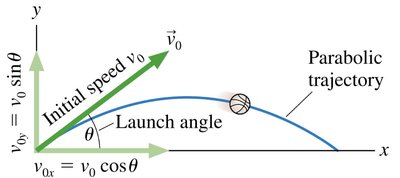
Projectile motion describes the ideal motion of an object under gravity, with constant acceleration vertically and constant velocity horizontally. The trajectory is parabolic.
\( \vec{a} = \vec{g} \), where \( g = 9.81 \) m/s2 downward
\( v_x = v_{0,x} \)
\( v_y = v_{0,y} - g t \)
\( \Delta x = v_{0,x} t \)
\( \Delta y = v_{0,y} t - \frac{1}{2} g t^2 \)
Initial velocity components: \( v_{0,x} = v_0 \cos \theta \), \( v_{0,y} = v_0 \sin \theta \)
Trajectory equation: \( \Delta y = \tan \theta (\Delta x) - \frac{g}{2 v_0^2 \cos^2 \theta} (\Delta x)^2 \)
Example: A ball launched at angle \( \theta \) with speed \( v_0 \) follows a parabolic path. The horizontal and vertical components of velocity determine its trajectory.
Relative Motion
Reference Frames and Velocity Addition
The velocity of an object relative to one frame can be related to its velocity relative to another frame using vector addition.
\( \vec{v}_{PA} = \vec{v}_{PB} + \vec{v}_{BA} \)
\( \vec{v}_{AB} = -\vec{v}_{BA} \)
Example: If a boat moves relative to the water, and the water moves relative to the shore, the boat's velocity relative to the shore is the sum of its velocity relative to the water and the water's velocity relative to the shore.
Newtonian Mechanics
Newton's Laws of Motion
Newton's laws form the foundation of classical mechanics, describing the relationship between forces and motion.
First Law (Law of Inertia): An object at rest remains at rest, and an object in uniform motion remains in uniform motion unless acted upon by an external force.
Second Law: The net force on an object is proportional to its acceleration and mass: \( \vec{F}_{net} = m \vec{a} \)
Third Law: For every action, there is an equal and opposite reaction: \( \vec{F}_{2 \text{ on } 1} = -\vec{F}_{1 \text{ on } 2} \)
Common Forces
Several forces commonly appear in mechanics problems:
Gravity: The gravitational force near Earth's surface is \( \vec{F}_g = m \vec{g} \), directed downward.
Normal Force: The force between two solids in contact, acting perpendicular to the interface. It adjusts to balance other forces.
Tension: The force transmitted through a taut string or rope, acting along its length. It is also adjustable up to the point of failure.
Example: A block resting on a table experiences gravity downward and a normal force upward. If suspended by a string, tension acts upward.
