 Back
BackExam II Review – Step-by-Step Physics Guidance
Study Guide - Smart Notes
 Tailored notes based on your materials, expanded with key definitions, examples, and context.
Q5. What is the equivalent resistance of the arrangement of three identical resistors (each of resistance R) shown in the diagram?
Background
Topic: Series and Parallel Resistor Combinations
This question tests your understanding of how to calculate the equivalent resistance for a combination of resistors arranged in both series and parallel.
Key Terms and Formulas
Series:
Parallel:
Equivalent resistance: The single resistance that can replace all resistors in the circuit without changing the total current or voltage.
Step-by-Step Guidance
Identify which resistors are in parallel and which are in series in the diagram. Notice that two resistors are in parallel, and their combination is in series with the third resistor.
Calculate the equivalent resistance of the two parallel resistors using .
Simplify the parallel resistance formula to find in terms of .
Add the resistance of the third resistor (in series) to the equivalent parallel resistance: .

Try solving on your own before revealing the answer!
Final Answer:
For two resistors in parallel: . Adding the third resistor in series: .
This is a classic mixed series-parallel circuit problem. The equivalent resistance is less than the sum of all three resistors, but more than any single resistor.
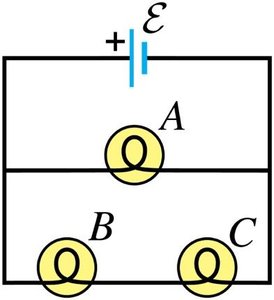
Q7. Three identical incandescent light bulbs are connected to a source of emf as shown. Which bulb glows the brightest?
Background
Topic: Series and Parallel Circuits – Power Distribution
This question tests your understanding of how current and voltage are distributed in circuits, and how this affects the brightness of bulbs (which depends on power dissipated).
Key Terms and Formulas
Power dissipated in a resistor: or
Series circuit: Current is the same through all elements, voltage divides.
Parallel circuit: Voltage is the same across all branches, current divides.
Step-by-Step Guidance
Analyze the circuit diagram to determine which bulbs are in series and which are in parallel.
Recall that the brightness of a bulb depends on the power it dissipates.
For bulbs in parallel, each receives the full voltage of the source. For bulbs in series, the voltage is divided.
Compare the power dissipated in each bulb using the formulas above, based on their position in the circuit.
Try solving on your own before revealing the answer!
Final Answer: Bulb A glows the brightest.
Bulb A is in parallel with the series combination of B and C, so it receives the full voltage and thus dissipates more power than B or C.
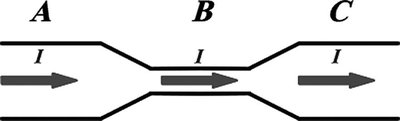
Q9. The figure shows a steady electric current passing through a wire with a narrow region. What happens to the drift velocity of the moving charges as they go from region A to B and then to C?
Background
Topic: Current, Drift Velocity, and Conservation of Charge
This question tests your understanding of how drift velocity changes when the cross-sectional area of a wire changes, given a constant current.
Key Terms and Formulas
Current:
= number density of charge carriers
= charge of each carrier
= cross-sectional area
= drift velocity
Step-by-Step Guidance
Observe that the current is constant throughout the wire.
Recall that , so if decreases, must increase to keep constant.
As charges move from region A (wide) to B (narrow), decreases, so increases.
As charges move from B (narrow) to C (wide), increases, so decreases.
Try solving on your own before revealing the answer!
Final Answer: The drift velocity increases from A to B and decreases from B to C.
Drift velocity is inversely proportional to cross-sectional area for a constant current.
