 Back
BackExam Review Guidance: Physics Concepts and Problem-Solving
Study Guide - Smart Notes
 Tailored notes based on your materials, expanded with key definitions, examples, and context.
Q4. Simple Harmonic Motion – A 5 kg mass on a spring exhibits simple harmonic motion as shown in the position vs. time plot. Each grid line is 1 s in the time axis and 1 cm in the position axis.
Background
Topic: Simple Harmonic Motion (SHM)
This question tests your understanding of SHM, including force, spring constant, and energy calculations using position vs. time graphs.
Key Terms and Formulas:
Amplitude (): Maximum displacement from equilibrium.
Spring constant (): Measures stiffness of the spring.
Hooke's Law:
Period (): Time for one complete oscillation.
Angular frequency ():
SHM equation:
Spring-mass system:
Kinetic energy at position :
Step-by-Step Guidance
Examine the position vs. time plot to determine the amplitude () and period () of the oscillation. Count the number of grid squares for maximum displacement and for one full cycle.
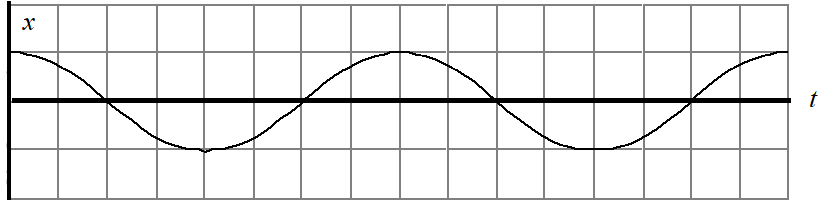
Use the period () to find the angular frequency () with .
Apply the relationship to solve for the spring constant . Rearranged: .
For kinetic energy at , use . Substitute $x = \frac{A}{4}$ and your value for .
Try solving on your own before revealing the answer!
Final Answer:
Spring constant
Kinetic energy at :
We used the period from the graph to find , then calculated using the mass. For kinetic energy, we substituted into the energy formula.
