 Back
BackFalling Objects and Projectile Motion: Study Notes
Study Guide - Smart Notes
 Tailored notes based on your materials, expanded with key definitions, examples, and context.
Falling Objects and Projectile Motion
Equations of Motion
Understanding the motion of objects under constant acceleration is fundamental in physics. The following equations describe the relationships between displacement, velocity, acceleration, and time for objects in linear motion:
Average speed:
Average velocity:
Average acceleration:
For objects under constant acceleration (such as free fall):
Displacement:
Velocity:
Where is the initial velocity, is acceleration, is time, and is displacement.
Free Fall
Free fall describes the motion of objects under the influence of gravity alone, with no other forces (such as air resistance) acting on them. On Earth, the acceleration due to gravity is:
Acceleration due to gravity: (often approximated as for calculations)
Direction: Always points downward, toward the center of the Earth
Key points:
All objects in free fall accelerate downward at the same rate, regardless of mass (neglecting air resistance).
Velocity increases by approximately every second.
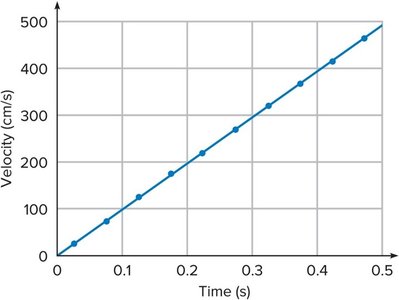
Tracking a Falling Object
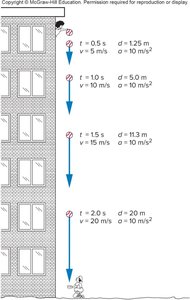
To analyze a falling object, we often ask:
How long does it take to reach the ground?
How fast is it traveling when it gets there?
For an object dropped from rest ():
After 1 s:
After 2 s:
After 3 s:
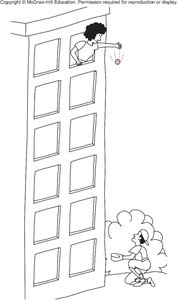
Throwing a Ball Downward
If a ball is thrown downward instead of being dropped, it starts with an initial velocity ():
It reaches the ground more quickly.
It has a larger velocity upon impact.
The equations become:
Throwing a Ball Upward
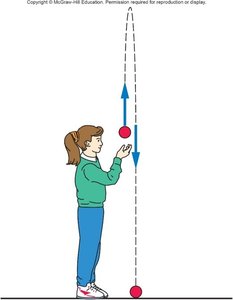
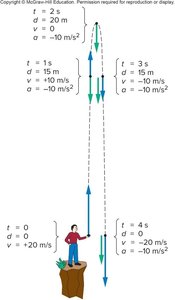
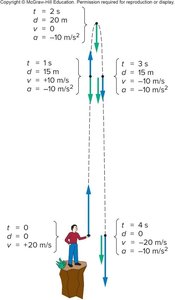
When a ball is thrown upward, gravity acts in the opposite direction to the initial velocity. The ball slows down, stops momentarily at its highest point, and then accelerates downward.
At the top of its path, the velocity is zero, but acceleration is still .
The time to reach the top:
Total time in the air (up and down):
Acceleration at the Top of the Path
At the highest point of its trajectory, the ball's velocity is zero, but the acceleration due to gravity remains constant and downward (). Gravity does not "turn off" at the top.
Velocity vs. Time Graph for a Ball Thrown Upward
The velocity-time graph for a ball thrown upward starts at a positive value (upward velocity), decreases linearly due to constant negative acceleration, reaches zero at the top, and becomes negative as the ball falls back down.
Projectile Motion
Definition and Trajectory
A projectile is any object that moves through the air under the influence of gravity alone. The path it follows is called its trajectory, which is typically parabolic.
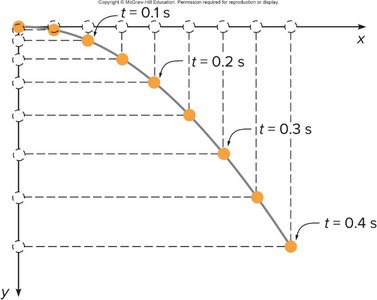
Horizontal motion: Constant velocity (no horizontal acceleration if air resistance is neglected)
Vertical motion: Constant acceleration downward ()
Projectile motion is the combination of independent horizontal and vertical motions.
Horizontal and Vertical Components
Key facts:
Horizontal acceleration is zero; horizontal velocity is constant.
Vertical acceleration is ; vertical velocity changes linearly with time.
In equal time intervals, the projectile covers equal horizontal distances but increasing vertical distances.
Effect of Initial Velocity
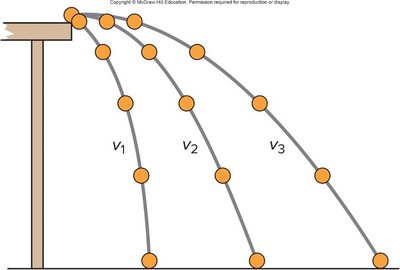
The horizontal distance traveled by a projectile depends on its initial horizontal velocity. For objects launched from the same height at different horizontal velocities:
Greater initial horizontal velocity results in a longer range.
All objects hit the ground at the same time if dropped from the same height (neglecting air resistance).
Projectile Range and Launch Angle
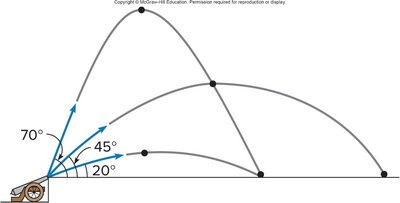
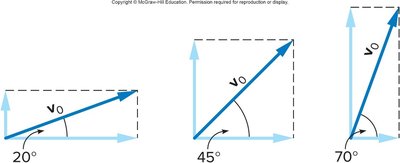
The range of a projectile depends on both its initial velocity and the angle of launch. The maximum range (neglecting air resistance) is achieved at a launch angle of 45°.
Low angles: Greater horizontal velocity, shorter flight time, lower height.
High angles: Greater vertical velocity, longer flight time, but shorter horizontal range.
Hitting a Target
When aiming at a target, the trajectory of the projectile must be considered. If a projectile is fired horizontally, it will begin to fall immediately due to gravity, so the point of impact will be below the line of sight unless compensated for.

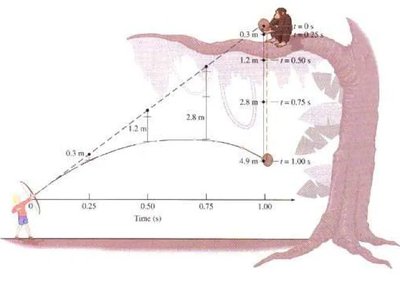
Classic Experiment: The Monkey and the Hunter
In this classic demonstration, a projectile is aimed directly at a target (e.g., a monkey) that begins to fall at the instant the projectile is fired. Both the projectile and the target experience the same gravitational acceleration, so the projectile will hit the target if aimed directly at it, regardless of the launch velocity.
Summary Table: Key Equations for Free Fall and Projectile Motion
Situation | Equation for Displacement | Equation for Velocity | Acceleration |
|---|---|---|---|
Free fall from rest | downward | ||
Thrown downward | downward | ||
Thrown upward | downward | ||
Projectile (horizontal launch) |
|
| downward (vertical only) |
