 Back
BackFinding the Density of Charge Carriers in a Liquid-Filled Pipe
Study Guide - Smart Notes
 Tailored notes based on your materials, expanded with key definitions, examples, and context.
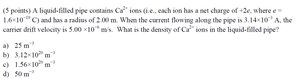
Q1. A liquid-filled pipe contains Ca2+ ions (each ion has a net charge of +2e, where e = 1.6 × 10⁻¹⁹ C) and has a radius of 2.00 mm. When the current flowing along the pipe is 3.14 × 10⁻⁴ A, the carrier drift velocity is 5.00 × 10⁻⁵ m/s. What is the density of Ca2+ ions in the liquid-filled pipe?
Background
Topic: Current and Drift Speed
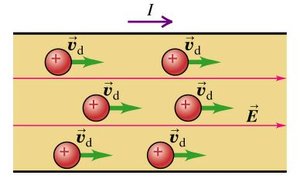
This question tests your understanding of how electric current relates to the density of charge carriers, their charge, drift velocity, and the cross-sectional area of the conductor. It is a classic application of the formula for current in terms of microscopic properties.
Key Terms and Formulas
Current (): The rate of flow of charge.
Charge carrier density (): Number of charge carriers per unit volume.
Drift velocity (): Average velocity of charge carriers due to an electric field.
Charge of carrier (): For Ca2+, .
Cross-sectional area (): For a pipe of radius , .
Key formula:
Step-by-Step Guidance
Identify the known values: A, mm m, m/s, C.
Calculate the cross-sectional area of the pipe: .
Write the formula for current in terms of charge carrier density: .
Rearrange the formula to solve for : .
Plug in the values for , , , and to set up the calculation for . Do not compute the final value yet.
Try solving on your own before revealing the answer!
Final Answer: m-3
m2 C m-3
This is the density of Ca2+ ions in the pipe, found by relating the macroscopic current to the microscopic properties of the charge carriers.
