Back
BackFluid Mechanics: Density, Pressure, and Applications
Study Guide - Smart Notes
 Tailored notes based on your materials, expanded with key definitions, examples, and context.
15.1 Density
Definition and Examples
Density is a fundamental property of matter, defined as mass per unit volume. It is crucial in understanding how substances interact in fluid mechanics.
Density (\( \rho \)): The ratio of mass (m) to volume (V), given by the formula:
Units: The SI unit for density is kg/m3.
Examples: Different materials have characteristic densities, such as aluminum (2700 kg/m3), iron (7800 kg/m3), and water (1000 kg/m3).
Example: Calculating the density of a block with given dimensions and mass.
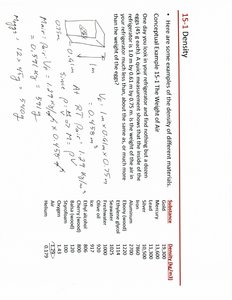
Material | Density (kg/m3) |
|---|---|
Aluminum | 2700 |
Iron | 7800 |
Water | 1000 |
Air | 1.29 |
Gold | 19300 |
15.2 Pressure in Fluids
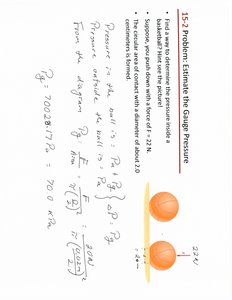
Gauge Pressure Estimation
Pressure in fluids is the force exerted per unit area. Gauge pressure is the difference between the pressure inside a system and the atmospheric pressure outside.
Pressure (P): Defined as , where F is force and A is area.
Gauge Pressure:
Application: Estimating the pressure inside a ball using the force applied and the area of contact.
15.3 Pressure in Liquids
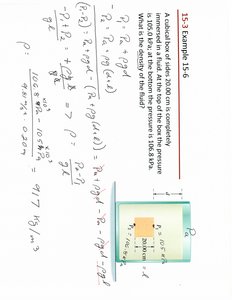
Pressure at Depth and Density Calculation
Pressure increases with depth in a fluid due to the weight of the fluid above. The relationship is given by the hydrostatic pressure equation.
Hydrostatic Pressure:
Variables: is atmospheric pressure, is fluid density, is acceleration due to gravity, is depth.
Example: Calculating the density of a fluid from known pressure difference and depth.
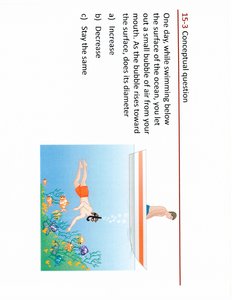
Conceptual Question: Bubble Diameter Change
As a bubble rises from the bottom of a swimming pool to the surface, the pressure decreases, causing the bubble to expand. According to Boyle's Law, the volume of the bubble increases as pressure decreases, so its diameter increases.
Key Point: The diameter of the bubble increases as it rises.
15.3 Applications of Pressure
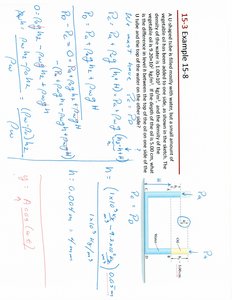
Manometer and Pressure Measurement
A U-tube manometer is used to measure pressure differences in fluids. The height difference in the columns corresponds to the pressure difference.
Manometer Equation:
Application: Used to measure gas pressure in laboratory and industrial settings.
Hydraulic Lift
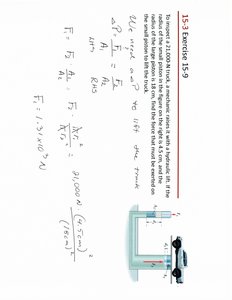
Hydraulic systems use the principle of pressure transmission in fluids to lift heavy objects. The force applied at one piston is transmitted to another piston with a larger area, amplifying the force.
Hydraulic Lift Equation:
Application: Used in car lifts and heavy machinery.
15.5 Archimedes' Principle
Buoyancy and Floating Objects
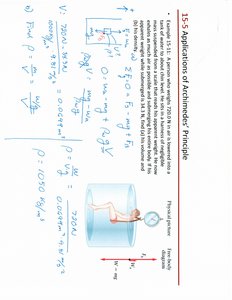
Archimedes' Principle states that the upward buoyant force on an object immersed in a fluid is equal to the weight of the fluid displaced by the object.
Buoyant Force:
Application: Explains why objects float or sink in fluids.
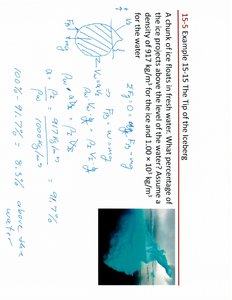
Tip of the Iceberg Example
When ice floats in water, only a portion of it is visible above the surface. The fraction above water depends on the densities of ice and water.
Fraction Above Water:
Example: For ice (917 kg/m3) and water (1000 kg/m3), about 8.3% of the ice is above water.
15.6 Fluid Flow
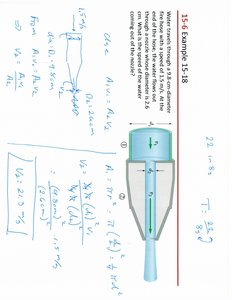
Continuity Equation and Flow Rate
The continuity equation describes the conservation of mass in fluid flow. The product of area and velocity remains constant for incompressible fluids.
Continuity Equation:
Application: Used to calculate flow speed in pipes and nozzles.
15.7 Bernoulli's Principle
Pressure and Velocity Relationship
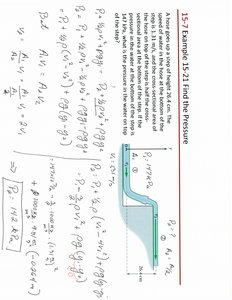
Bernoulli's Principle states that in a streamline flow, the sum of pressure, kinetic energy per unit volume, and potential energy per unit volume is constant.
Bernoulli's Equation:
Application: Used to analyze pressure changes in pipes and open channels.
15.8 Applications of Fluid Mechanics
Pressure Difference Across a Roof
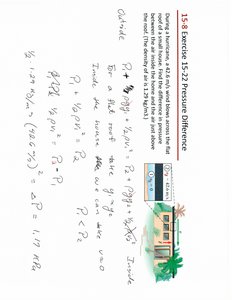
Wind blowing over a roof creates a pressure difference, which can be calculated using Bernoulli's equation. This difference can cause structural damage if not accounted for.
Pressure Difference:
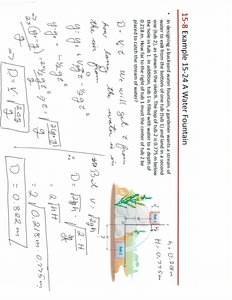
Water Fountain Example
The height and speed of water in a fountain can be determined using the principles of fluid flow and energy conservation.
Fountain Height:
Application: Used in designing fountains and irrigation systems.
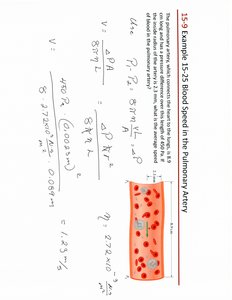
Blood Speed in the Pulmonary Artery
Bernoulli's equation can be applied to biological systems, such as blood flow in arteries, to estimate speed and pressure differences.
Blood Speed:
Application: Important in medical diagnostics and physiology.