 Back
BackFluid Mechanics: Density, Pressure, and Buoyancy
Study Guide - Smart Notes
 Tailored notes based on your materials, expanded with key definitions, examples, and context.
Fluid Mechanics
Introduction to Fluids
Fluids are materials that can flow, encompassing both liquids and gases. Unlike solids, fluids do not have a fixed shape and can adapt to the shape of their container. The study of fluid mechanics begins with fluids at rest (fluid statics) and extends to fluids in motion (fluid dynamics).
Fluids include substances such as water (liquid) and air (gas).
Fluid mechanics is essential for understanding phenomena like atmospheric pressure, buoyancy, and hydraulic systems.
Density
Density is a fundamental property of matter, defined as mass per unit volume. It is crucial for distinguishing between different materials and understanding fluid behavior.
Definition: Density () is given by the formula:
where is mass and is volume.
The SI unit of density is kilograms per cubic meter (kg/m3).
Homogeneous materials have uniform density throughout.
Density varies with temperature and pressure, especially in gases.
Example: A 250 mL cup filled with water has a different mass than when filled with blood, due to blood's higher density.
States of Matter and Density
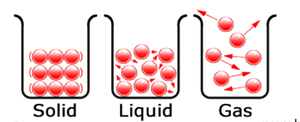
Solids, liquids, and gases differ in their densities due to the arrangement of their molecules:
Solids: Molecules are closely packed, resulting in high density.
Liquids: Molecules are less tightly packed than in solids but more than in gases, leading to moderate density.
Gases: Molecules are far apart, resulting in low density.
Pressure in Fluids
Definition of Pressure
Pressure is defined as the force acting perpendicularly per unit area. It is a scalar quantity, meaning it has magnitude but no direction.
Formula:
where is the force applied perpendicular to the surface and is the area over which the force is distributed.
The SI unit of pressure is the pascal (Pa), where 1 Pa = 1 N/m2.
Pressure Variation with Depth
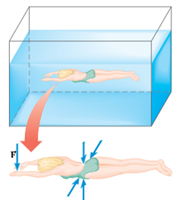
In a static fluid, pressure increases with depth due to the weight of the fluid above. This principle explains why divers experience greater pressure as they descend in water.
Key Point: The deeper you go in a fluid, the greater the pressure exerted on you.
Formula for pressure at depth:
where is the pressure at the surface, is the fluid density, is the acceleration due to gravity, and is the depth below the surface.
Pressure Gauges and Measurement
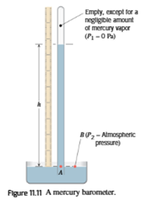
Pressure can be measured using various instruments, including mercury barometers and open-tube manometers. These devices help distinguish between atmospheric, absolute, and gauge pressures.
Atmospheric Pressure: The pressure exerted by the weight of the atmosphere, typically measured with a barometer.
Gauge Pressure: The pressure relative to atmospheric pressure, often measured in practical applications.
Absolute Pressure: The total pressure, including atmospheric pressure.
Blood Pressure
Blood pressure is a practical example of gauge pressure, commonly measured in millimeters of mercury (mm Hg or torr). It varies with vertical position in the body, with the standard reference at the upper arm, level with the heart.
Pascal’s Principle
Statement and Applications
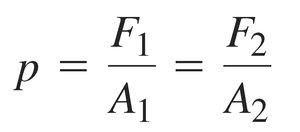
Pascal’s Principle states that a change in pressure applied to an enclosed fluid is transmitted undiminished throughout the fluid and to the walls of its container. This principle is fundamental to hydraulic systems.
Formula:
where and are forces applied to areas and , respectively.
Hydraulic lifts and brakes operate based on Pascal’s Principle.
Archimedes’ Principle and Buoyancy
Archimedes’ Principle
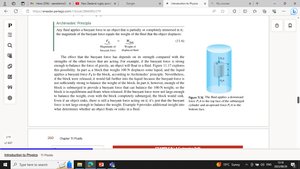
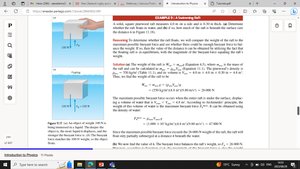
Archimedes’ Principle states that any object wholly or partially submerged in a fluid experiences an upward buoyant force equal to the weight of the fluid displaced by the object. This principle explains why objects float or sink in fluids.
Buoyant Force Formula:
where is the buoyant force, is the density of the fluid, is the volume of fluid displaced, and is the acceleration due to gravity.
If the buoyant force equals the object's weight, the object floats; otherwise, it sinks.
Example: Floating and Sinking
When an object is immersed in water, the deeper it goes, the more water it displaces, and the greater the buoyant force. If the buoyant force matches the object's weight, it floats; if not, it sinks.
Summary Table: Key Properties and Units
Quantity | Symbol | SI Unit | Formula |
|---|---|---|---|
Density | kg/m3 | ||
Pressure | Pa (N/m2) | ||
Buoyant Force | N |
Additional info: This guide covers the foundational concepts of fluid statics, including density, pressure, Pascal’s Principle, and Archimedes’ Principle, with relevant examples and diagrams to support understanding for college-level physics students.
