 Back
Fluid Mechanics: Pressure, Buoyancy, and Principles in Physics with Calculus
Study Guide - Smart Notes
 Tailored notes based on your materials, expanded with key definitions, examples, and context.
States of Matter and Fluids
Classification of Matter
Matter exists in four primary states: solids, liquids, gases, and plasmas. The arrangement and bonding of molecules determine the properties of each state.
Solids: Molecules are closely packed with fixed positions, resulting in a definite shape and volume. Elasticity applies.
Liquids: Molecules are randomly distributed but maintain strong bonds, giving liquids a nearly fixed volume but no definite shape.
Gases: Molecules are randomly distributed with weak bonds, resulting in no definite shape or volume.
Plasmas: Ionized gases at high temperatures, not commonly encountered in everyday fluid mechanics.

Fluids
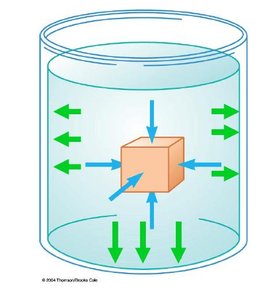
Fluids are substances that can flow, including both liquids and gases. Their shape is determined by the container, and they exert forces normal to surfaces in contact.
Fluids are in close contact at boundaries, with no macroscopic gaps.
Forces exerted by fluids are always perpendicular (normal) to the surface if viscosity is negligible.
Density
Definition and Properties
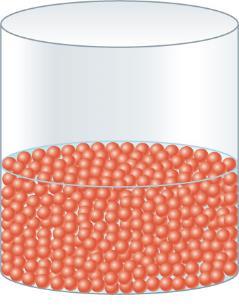
Density is a fundamental property of matter, defined as mass per unit volume:
Unit: kg/m3
Density is independent of shape and is definable for solids and fluids.
For solids and liquids, density weakly depends on temperature and pressure; for gases, it strongly depends on both.
Density Variation in Fluids
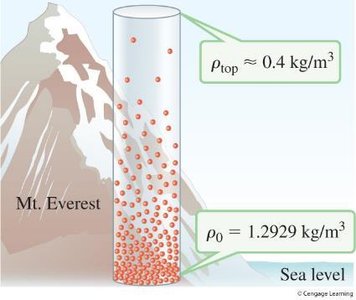
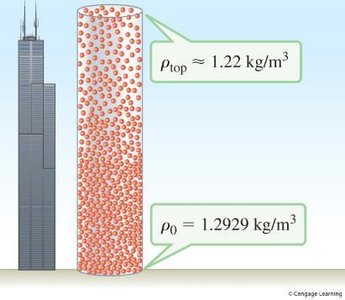
Gravity causes density to increase toward the bottom of static fluids. Atmospheric density decreases with altitude.
At sea level, air density is higher than at mountain tops.
Pressure in Fluids
Definition and Units
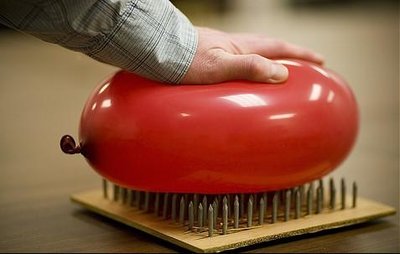
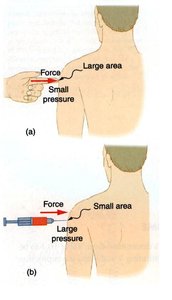
Pressure is the force exerted per unit area by a fluid on a surface:
Unit: N/m2 (Pascal, Pa)
Pressure is a scalar quantity and depends only on the magnitude of the force.
Atmospheric Pressure
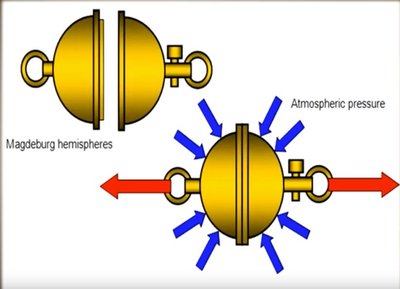
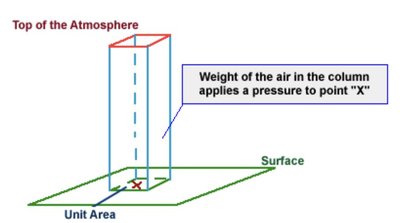
Atmospheric pressure is the result of air molecules constantly bombarding surfaces. At sea level and room temperature:
Pressure Variation with Depth
Pressure in a fluid increases with depth due to the weight of the fluid column above. The pressure at depth is given by:
is the pressure at the surface, is fluid density, is acceleration due to gravity, is depth below the surface.

Absolute vs. Gauge Pressure
The distinction between absolute and gauge pressure is based on the reference point:
Absolute pressure: Measured from absolute zero, always positive, true pressure value (barometer).
Gauge pressure: Measured relative to atmospheric pressure, can be positive or negative, used for tire pressure and similar measurements.
Pressure at Equal Levels and Fluid Density
Pressure at Same Level
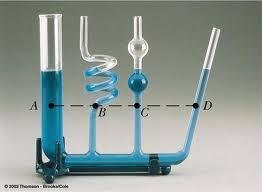
Pressure at the same depth in a connected fluid is equal, regardless of the container's shape. This is a consequence of fluid equilibrium.
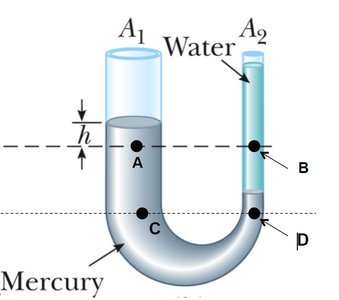
For points C and D at the same level in a connected fluid, .

Pressure with Different Densities
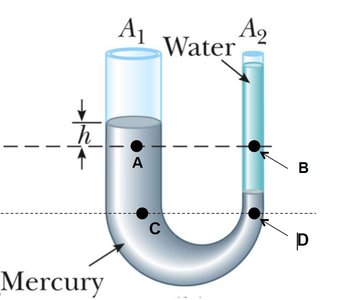
If fluids have different densities, pressure at the same level may differ. For example, water and oil at the same level have different pressures due to their density difference.
Pascal’s Principle
Statement and Implications
Pascal’s Principle states that pressure applied to a contained fluid is transmitted undiminished to every point in the fluid and to the walls of the container. Pressure is the same at the same height/depth.
Pressure transmission is independent of container shape.
If pressure were not equal, fluid would flow until equilibrium is reached.
Buoyancy and Archimedes’s Principle
Buoyant Force
Objects immersed in fluids experience an upward force called buoyancy. Archimedes’s Principle states:
The buoyant force is equal to the weight of the fluid displaced by the object.
Buoyant force is always upward and is caused by pressure differences over depth.
It is independent of the object's shape and density.
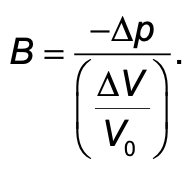
Buoyant Force Equations
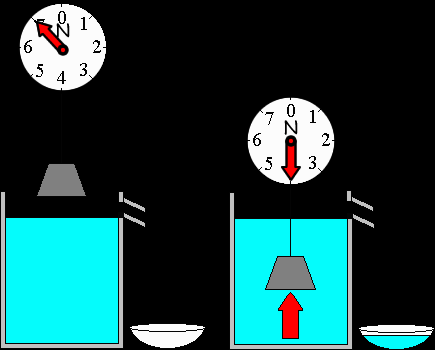
Floating and Sinking
Whether an object floats or sinks depends on the relationship between its density and the fluid's density:
If , the object sinks ().
If , the object floats ().
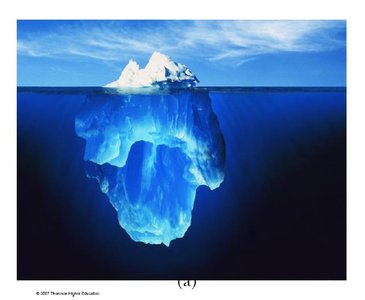
Exercise: Floating Iceberg
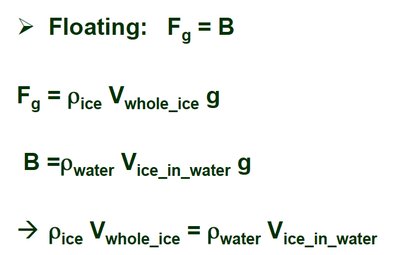
To find the portion of a floating iceberg under water:
Given ,
For floating:
Thus,
90% of the iceberg's volume is under water.
Exercise: Archimedes and the Crown
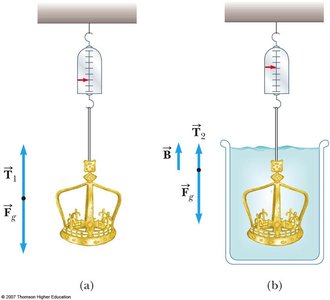
Archimedes determined whether a crown was pure gold by comparing its weight in air and in water:
Weight in air: N
Weight in water: N
Buoyancy: N
Density of crown:
Result: kg/m3 (much less than gold's density kg/m3)
Summary Table: Key Fluid Properties
Property | Definition | Formula | Unit |
|---|---|---|---|
Density | Mass per unit volume | kg/m3 | |
Pressure | Force per unit area | Pa (N/m2) | |
Pressure at depth | Pressure increases with depth | Pa | |
Buoyant force | Upward force on submerged object | N |
