 Back
BackFluid Mechanics: Pressure, Pascal's Principle, and Hydraulic Lifts
Study Guide - Smart Notes
 Tailored notes based on your materials, expanded with key definitions, examples, and context.
Fluid Mechanics
Pressure Exerted by Fluids
In fluid mechanics, the pressure exerted by a fluid at a certain depth is determined by the fluid's density, the depth, and the atmospheric pressure acting on the surface. This pressure acts on any area submerged at that depth, and the force can be calculated using the relationship between pressure and area.
Pressure (P): The force per unit area exerted by a fluid. The formula for pressure at depth is: where is the fluid density, is the acceleration due to gravity, is the depth, and is the atmospheric pressure.
Force (F): The total force exerted by the fluid on a surface area is:
Area of a Circle: For a circular base, the area is:
Example: A beaker with a circular base (diameter 5 cm, radius 0.025 m) contains a fluid (density 1200 kg/m3, depth 0.07 m). The force on the base is:
Convert units: diameter = 0.05 m, radius = 0.025 m, depth = 0.07 m
Area:
Pressure:
Force:
Additional info: Atmospheric pressure () may be included if the beaker is open to air.
Pascal's Principle
Pascal's Principle states that any change in pressure applied to an enclosed fluid is transmitted undiminished to every point in the fluid and to the walls of its container. This principle is fundamental to hydraulic systems.
Statement: If the pressure at one point in an incompressible fluid is changed, the pressure at every other point in the fluid changes by the same amount.
Application: Used in hydraulic machines, such as lifts and brakes.
Hydraulic Lifts
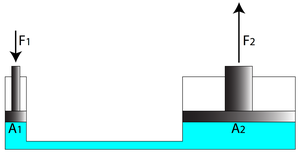
A hydraulic lift uses Pascal's Principle to lift heavy objects with a smaller applied force. The system consists of two pistons of different areas connected by a fluid. When a force is applied to the smaller piston, the pressure is transmitted to the larger piston, resulting in a larger force.
Pressure Transmission: The pressure applied to piston 1 ( on area ) is transmitted to piston 2 ( on area ).
Mathematical Relationship:
Force Amplification: The force on the larger piston is:
Example: If is 10 times , then is 10 times .
Additional info: Hydraulic lifts are used in car repair shops, construction equipment, and industrial machinery.
Hydrostatic Paradox
The hydrostatic paradox refers to the fact that the force exerted by a fluid at a given depth depends only on the depth and area, not on the shape or volume of the container. Three containers with the same base area and fluid depth experience the same force at their base, regardless of their shape.
Key Point: The pressure at the base is determined by depth and density, not container shape.
Application: Used to explain why different shaped vessels exert the same force at their base if filled to the same depth.
Additional info: This principle is important in designing tanks, dams, and other fluid containers.
