 Back
Fluid Mechanics: Principles, Applications, and Phenomena
Study Guide - Smart Notes
 Tailored notes based on your materials, expanded with key definitions, examples, and context.
Fluid Mechanics
Archimedes’s Principle and Buoyancy
Archimedes’s Principle describes the buoyant force experienced by objects immersed in a fluid. This principle is fundamental to understanding why objects float or sink and is widely applied in engineering and natural sciences.
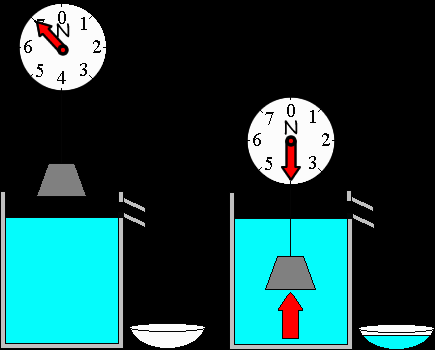
Archimedes’s Principle: When an object is completely or partially immersed in a fluid, the fluid exerts an upward force equal to the weight of the fluid displaced by the object.
Buoyant Force: Always acts upwards and is caused by the pressure difference over depth.
Independence: The buoyant force is independent of the shape and density of the object.
Formula:
Apparent Weight: Buoyant force reduces the apparent weight of the object in the fluid.
Example: A block submerged in water appears lighter due to the upward buoyant force.

Pressure in Fluids
Pressure in a fluid increases with depth due to the weight of the fluid above. This relationship is essential for understanding fluid statics and is used in calculations involving submerged objects and atmospheric pressure.
Pressure Formula:
Variables: is the pressure at the surface, is the fluid density, is acceleration due to gravity, is depth below the surface.
Application: Used to determine the pressure at any point within a fluid of uniform density.

Floating Iceberg Example
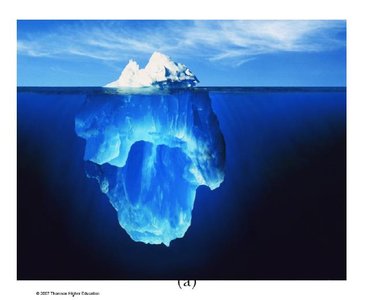
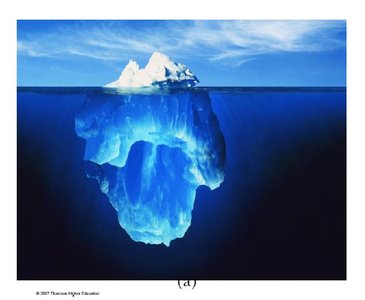
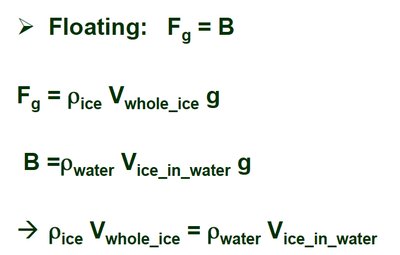
When an object floats, the buoyant force equals its weight. The fraction of the object submerged depends on the ratio of its density to the fluid's density.
Floating Condition:
Equations: ,
Submerged Fraction:
Example: For , , 90% of the iceberg is submerged.
Pascal’s Principle
Pascal’s Principle states that pressure applied to a confined fluid is transmitted undiminished throughout the fluid. This principle is the basis for hydraulic systems and force amplification.
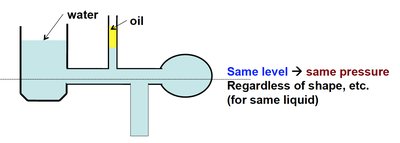
Pascal’s Principle: Pressure in a contained fluid is transmitted to every point, in every direction, regardless of the container's shape.
Pressure Equality: Pressure is the same at the same height/depth for a given fluid.
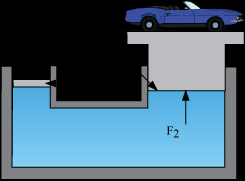
Hydraulic Systems: Used to amplify force, such as in car lifts.
Formula:
Force Amplification:
Fluid Dynamics: Ideal Fluid Flow
Fluid dynamics studies the motion of fluids. For ideal fluids, assumptions include steady, non-turbulent flow, zero viscosity, incompressibility, and irrotational motion.
Ideal Fluid Flow: Steady, non-turbulent, non-viscous, incompressible, and irrotational.
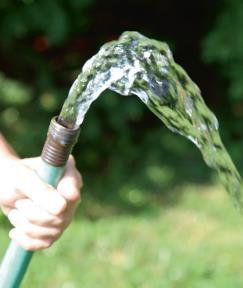
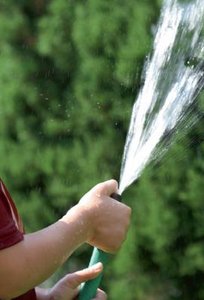
Continuity Equation: The mass flow rate is constant along a streamline.
Formula:
Application: Used to analyze flow in pipes and open channels.
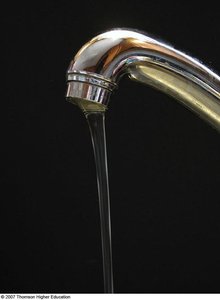
Bernoulli’s Equation
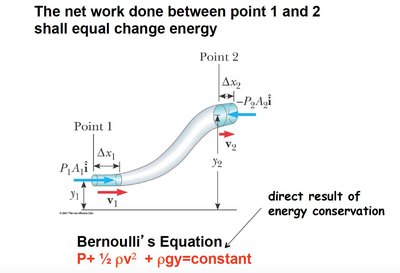
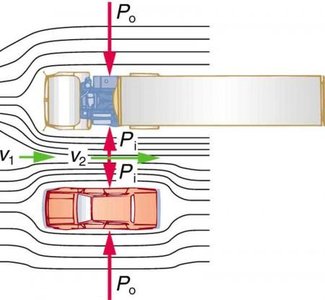
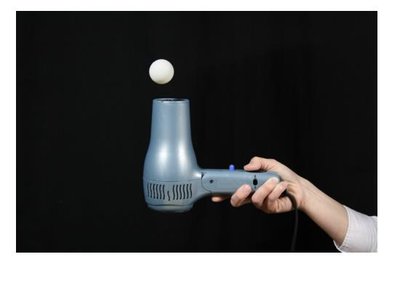
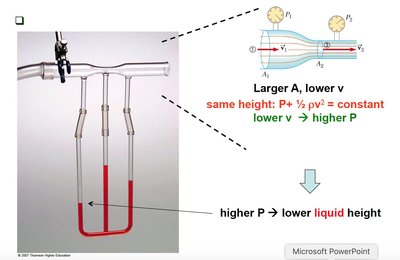
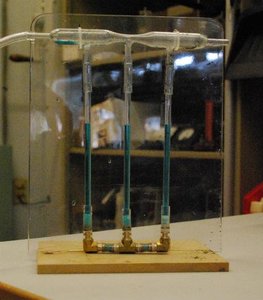
Bernoulli’s Equation relates pressure, velocity, and height in a moving fluid. It is a statement of energy conservation for fluids and explains phenomena such as lift, pressure drops, and fluid acceleration.
Bernoulli’s Equation:
Pressure-Velocity Relationship: Pressure decreases as fluid speed increases.
Elevation Effect: Pressure decreases as elevation increases.
Applications: Used in aircraft lift, pipe flow, and Venturi meters.
Viscosity
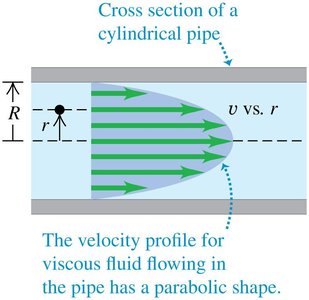
Viscosity is the internal friction within a fluid, affecting its flow. It causes the fluid to move slower near the walls and faster at the center of a pipe.
Definition: Viscosity is a measure of a fluid's resistance to flow.
Velocity Profile: In pipes, the speed is zero at the walls and greatest at the center, forming a parabolic profile.
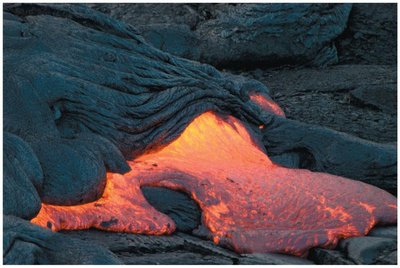
Temperature Effect: Viscosity decreases with increasing temperature.
Example: Lava flows more easily when hot due to lower viscosity.
Turbulence
Turbulence occurs when fluid flow becomes chaotic and irregular, typically at high speeds or with low viscosity.
Laminar Flow: Smooth, orderly flow at low speeds.
Turbulent Flow: Chaotic, irregular flow at high speeds.
Critical Speed: The speed at which flow transitions from laminar to turbulent.
Surface Tension
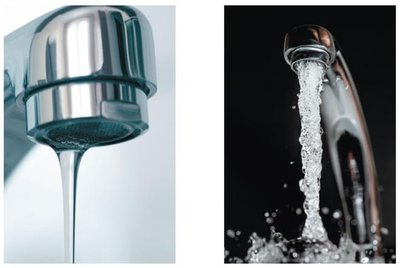
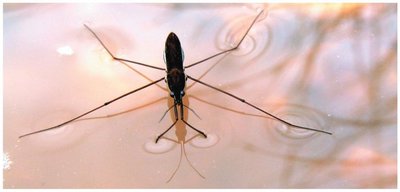
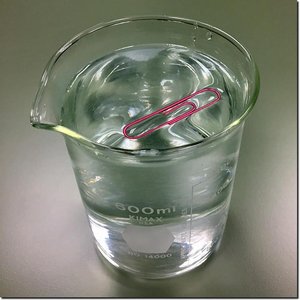
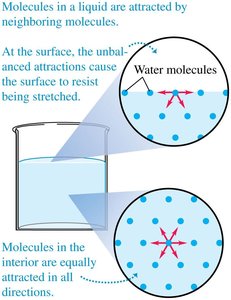
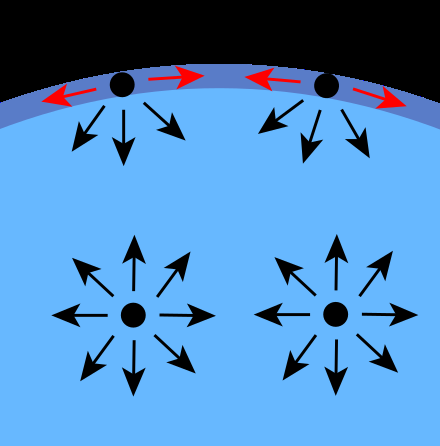
Surface tension is the tendency of a liquid's surface to resist external force, due to cohesive forces among molecules. It allows small objects to float and insects to walk on water.
Definition: Surface tension is caused by unbalanced molecular attractions at the surface.
Effects: Allows objects like paper clips and insects to float or walk on water.
Applications: Important in biology, chemistry, and engineering.
Summary Table: Fluid Properties and Principles
This table summarizes the main properties and principles discussed in fluid mechanics.
Principle | Formula | Key Application |
|---|---|---|
Archimedes’s Principle | Buoyancy, floating objects | |
Pressure in Fluid | Submerged objects, atmospheric pressure | |
Pascal’s Principle | Hydraulics, force amplification | |
Continuity Equation | Pipe flow, open channels | |
Bernoulli’s Equation | Lift, pressure drops, Venturi meter | |
Viscosity | Parabolic velocity profile | Pipe flow, lava, oil |
Surface Tension | Depends on molecular forces | Floating objects, insects on water |
Additional info: Academic context was added to clarify the application and significance of each principle, and to ensure completeness for exam preparation.
