 Back
BackFluid Pressure: Solids, Liquids, and Gases – Concepts and Applications
Study Guide - Smart Notes
 Tailored notes based on your materials, expanded with key definitions, examples, and context.
Solid Pressure
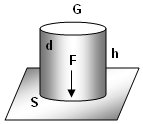
Definition and Calculation of Pressure
Pressure is defined as the perpendicular force acting on a unit area. In solids, pressure is exerted on surfaces due to the weight of the object or any applied force. The formula for pressure is:
Pressure (P): The force per unit area, given by
Unit: The SI unit of pressure is the Pascal (Pa), where .
Other units include bar, atmosphere (atm), and mmHg.
Perpendicular Component of Force
If the applied force is not perpendicular to the surface, only the perpendicular component contributes to pressure:
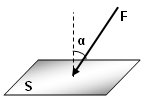
Pressure on Inclined Planes
When an object rests on an inclined plane, the pressure is determined by the component of weight perpendicular to the surface:
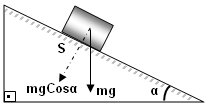
Effect of Area on Pressure
For a constant force, pressure is inversely proportional to the area over which it acts. A smaller area results in higher pressure.
Example: The pointed end of a nail exerts more pressure than the flat end for the same force.
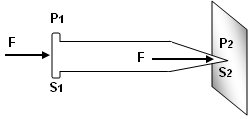
Applications and Examples
Cutting with a Knife: A sharp edge concentrates force over a small area, increasing pressure and making cutting easier.
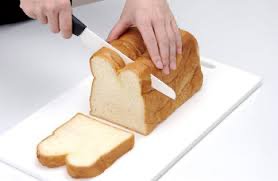
Distribution of Pressure in Solids
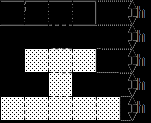
Solids transmit forces only in the direction of application without changing magnitude. The shape and position of the solid do not affect the pressure exerted due to weight.
Example: Identical cubes arranged differently exert the same total force but may exert different pressures depending on the contact area.
Liquid Pressure
Definition and Properties
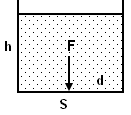
Liquids exert pressure in all directions due to their ability to flow and take the shape of their container. The pressure at a depth in a liquid depends on the height of the liquid column, the density of the liquid, and gravity:
h: Height (depth) of the liquid
d: Density of the liquid
g: Acceleration due to gravity
Comparing Liquid Pressures
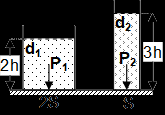
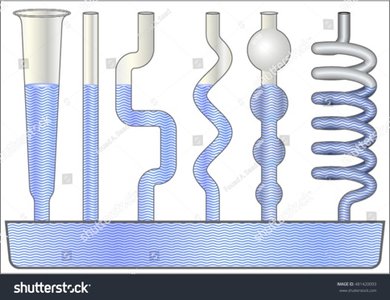
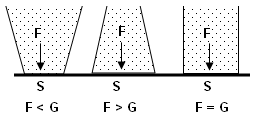
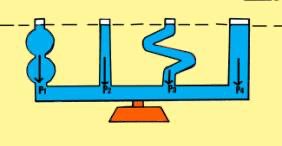
For containers with different shapes but the same liquid height and density, the pressure at the bottom is the same. However, the pressure force depends on the area of the bottom surface.
Pressure in Multi-Liquid Systems
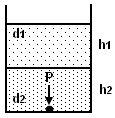
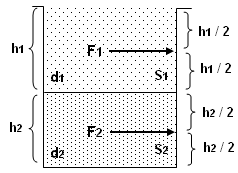
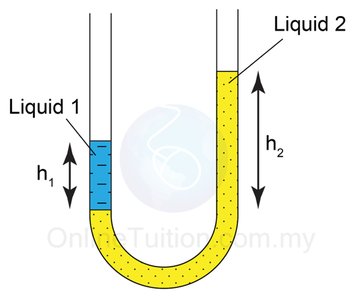
When two immiscible liquids are present, the total pressure at a point below both is the sum of the pressures due to each liquid:
Pressure Force in Liquids
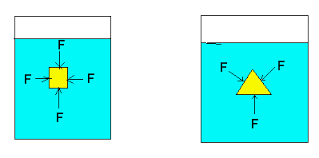
The pressure force on a surface submerged in a liquid is:
Where is the area of the surface.
Pressure Variation with Depth
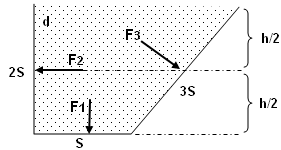
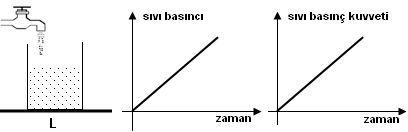
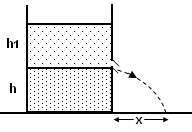
Liquid pressure increases linearly with depth. The pressure force also increases as the submerged area increases.
Special Cases: Geometric Containers and Multi-Liquid Layers
For containers with different shapes, the pressure at the bottom depends only on the height and density, not the shape.
For multiple layers of liquids, add the contributions from each layer.
Transmission of Pressure in Liquids (Pascal's Principle)
Pascal's Principle
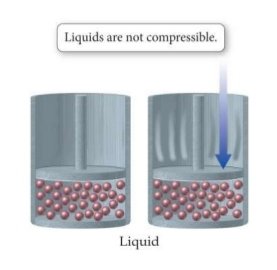
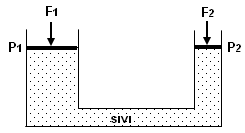
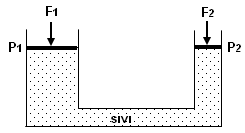
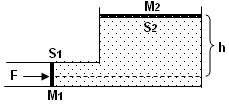
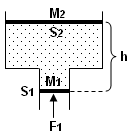
Liquids transmit pressure equally in all directions. When pressure is applied to a confined fluid, the change is transmitted undiminished throughout the fluid. This principle is the basis for hydraulic systems.
Hydraulic Press: A small force applied to a small-area piston is transmitted through the liquid to a larger-area piston, resulting in a larger force output.
Combined Vessels
In connected vessels, the liquid levels adjust so that the pressure at the bottom of each vessel is equal. This is used in manometers and other fluid measurement devices.
Gas Pressure
Atmospheric Pressure
The atmosphere exerts pressure on the Earth's surface due to the weight of air molecules. Atmospheric pressure is greatest at sea level and decreases with altitude. It is measured using a barometer.
Torricelli's Experiment: Demonstrated atmospheric pressure using a column of mercury. Standard atmospheric pressure supports a 76 cm column of mercury at sea level.
Manometers and Trapped Gas Pressure
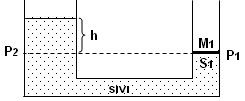
A manometer measures the pressure of a trapped gas by comparing it to atmospheric pressure. The difference in liquid column heights indicates the pressure difference.
If the gas pressure is greater than atmospheric,
If the gas pressure is less,
Fluid Pressure and Flow
Bernoulli's Principle
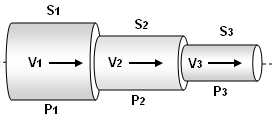
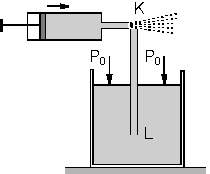
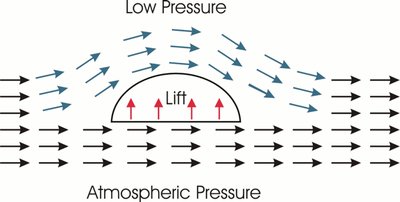
Bernoulli's Principle states that where the speed of a fluid increases, the internal pressure decreases. This explains phenomena such as lift on airplane wings and the operation of atomizers.
Fluids move from high pressure to low pressure.
As cross-sectional area decreases, fluid speed increases and pressure decreases.
Buoyancy and Archimedes' Principle
Buoyant Force
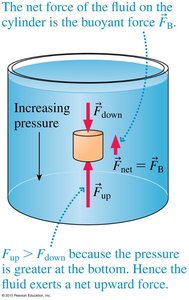
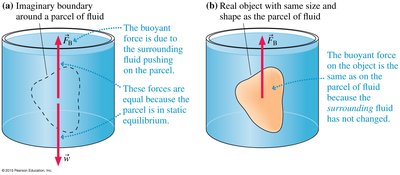
When an object is immersed in a fluid, it experiences an upward force called the buoyant force, equal to the weight of the fluid displaced by the object. This is known as Archimedes' Principle:
: Density of the fluid
: Volume of fluid displaced
: Acceleration due to gravity
Applications and Examples
If the buoyant force equals the object's weight, the object floats (neutral buoyancy).
If the buoyant force is less, the object sinks; if greater, the object rises.
Summary Table: Pressure Units
Unit | Symbol | Equivalent |
|---|---|---|
Pascal | Pa | 1 N/m2 |
Bar | bar | 100,000 Pa |
Atmosphere | atm | 101,325 Pa |
mmHg (Torr) | mmHg | 133.322 Pa |
Additional info: This guide covers the core concepts of pressure in solids, liquids, and gases, including practical applications, mathematical relationships, and key principles such as Pascal's and Bernoulli's. It is suitable for exam preparation in introductory college physics courses.
