Back
BackFluids: Density, Pressure, and Applications in Physics
Study Guide - Smart Notes
 Tailored notes based on your materials, expanded with key definitions, examples, and context.
15.1 Density
Definition and Examples
Density is a fundamental property of matter, defined as mass per unit volume. It is crucial in understanding how substances interact in fluids and solids.
Density (\( \rho \)): The ratio of mass (\( m \)) to volume (\( V \)).
Formula:
SI unit: kg/m3
Common materials have characteristic densities, which can be used for identification and calculations.
Example: Calculating the density of a block with given dimensions and mass.
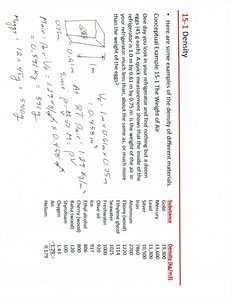
Table: Densities of Common Substances
Substance | Density (kg/m3) |
|---|---|
Aluminum | 2700 |
Iron | 7870 |
Lead | 11300 |
Mercury | 13600 |
Water | 1000 |
Ice | 917 |
Air | 1.29 |
15.2 Pressure in Fluids
Gauge Pressure
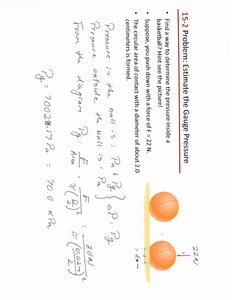
Pressure is the force exerted per unit area. In fluids, pressure can be measured as absolute or gauge pressure (relative to atmospheric pressure).
Pressure (\( P \)): , where \( F \) is force and \( A \) is area.
SI unit: Pascal (Pa) = N/m2
Gauge Pressure: The pressure relative to atmospheric pressure.
Example: Estimating the gauge pressure inside a basketball using the force applied and the area of contact.
15.3 Pressure in a Fluid at Rest
Hydrostatic Pressure
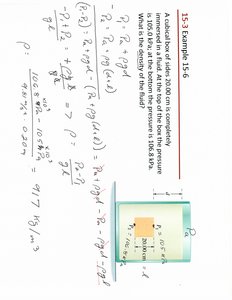
Hydrostatic pressure is the pressure exerted by a fluid at equilibrium due to the force of gravity. It increases with depth in the fluid.
Formula:
\( P_0 \): Pressure at the surface
\( \rho \): Density of the fluid
\( g \): Acceleration due to gravity
\( h \): Depth below the surface
Example: Calculating the density of a fluid given the pressure difference at two depths.
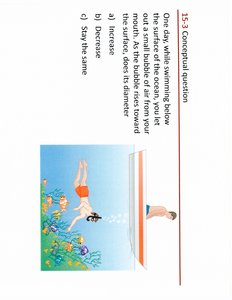
Conceptual Question: Gas Bubble in Water
As a bubble rises in water, the pressure decreases, causing the bubble to expand. This is an application of Boyle's Law (for ideal gases at constant temperature).
Key Point: The diameter of the bubble increases as it rises toward the surface.
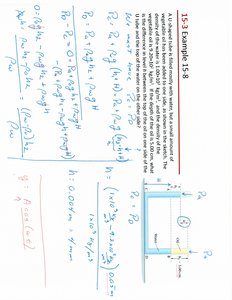
Manometers and Pressure Measurement
Manometers are devices used to measure pressure differences using columns of fluid. The height difference in the columns is proportional to the pressure difference.
Formula:
Example: Calculating the pressure difference using a U-tube manometer.
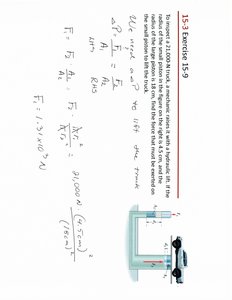
Hydraulic Lifts and Pascal's Principle
Pascal's Principle states that a change in pressure applied to an enclosed fluid is transmitted undiminished throughout the fluid. This principle is used in hydraulic lifts.
Formula:
\( F_1, F_2 \): Forces applied
\( A_1, A_2 \): Areas of pistons
Example: Calculating the force needed to lift a car using a hydraulic lift.
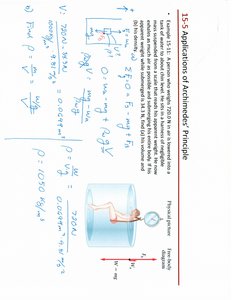
15.5 Buoyancy and Archimedes' Principle
Archimedes' Principle
Archimedes' Principle states that a body immersed in a fluid experiences an upward buoyant force equal to the weight of the fluid displaced by the body.
Buoyant Force:
Example: Calculating the buoyant force on a person floating in water.
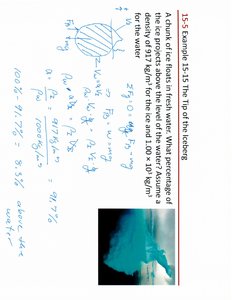
Floating Ice: The Tip of the Iceberg
When an object floats, the fraction submerged equals the ratio of the object's density to the fluid's density.
Fraction Submerged:
Example: Determining the percentage of an iceberg above water.
15.6 Fluid Dynamics
Continuity Equation
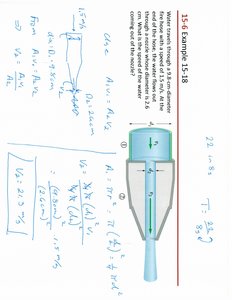
The continuity equation expresses the conservation of mass in fluid flow. For incompressible fluids, the product of cross-sectional area and velocity is constant along a streamline.
Formula:
Example: Calculating the speed of water through a constriction in a pipe.
Bernoulli's Equation
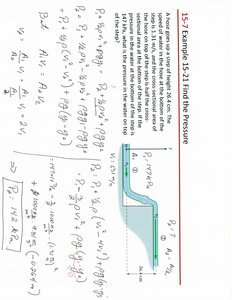
Bernoulli's Equation relates the pressure, velocity, and height at two points in a flowing fluid. It is a statement of energy conservation for fluids.
Formula:
Example: Finding the pressure at a point in a pipe with varying diameter and height.
15.8 Applications of Fluid Statics and Dynamics
Pressure Differences in Weather
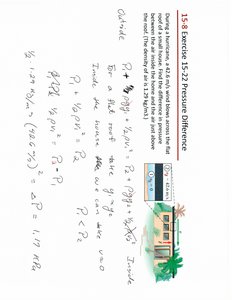
Pressure differences between the inside and outside of a house can be calculated using the hydrostatic pressure formula, especially during storms or hurricanes.
Formula:
Example: Calculating the pressure difference caused by a hurricane.
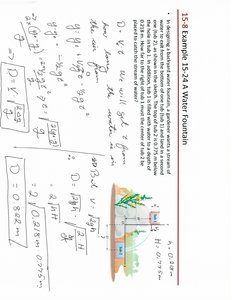
Water Fountain Example
The height and diameter of a water fountain stream can be analyzed using the equations of motion and the continuity equation.
Formula for range:
Example: Determining how far water will land from a fountain spout.
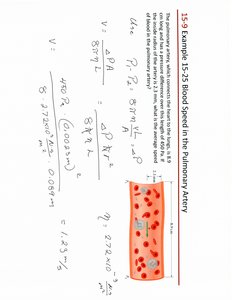
Blood Flow in the Pulmonary Artery
Blood flow in arteries can be analyzed using Poiseuille's Law, which relates the flow rate to the pressure difference, viscosity, and dimensions of the vessel.
Formula:
\( \Delta P \): Pressure difference
\( r \): Radius of artery
\( \eta \): Viscosity
\( l \): Length of artery
Example: Calculating the speed of blood in the pulmonary artery.